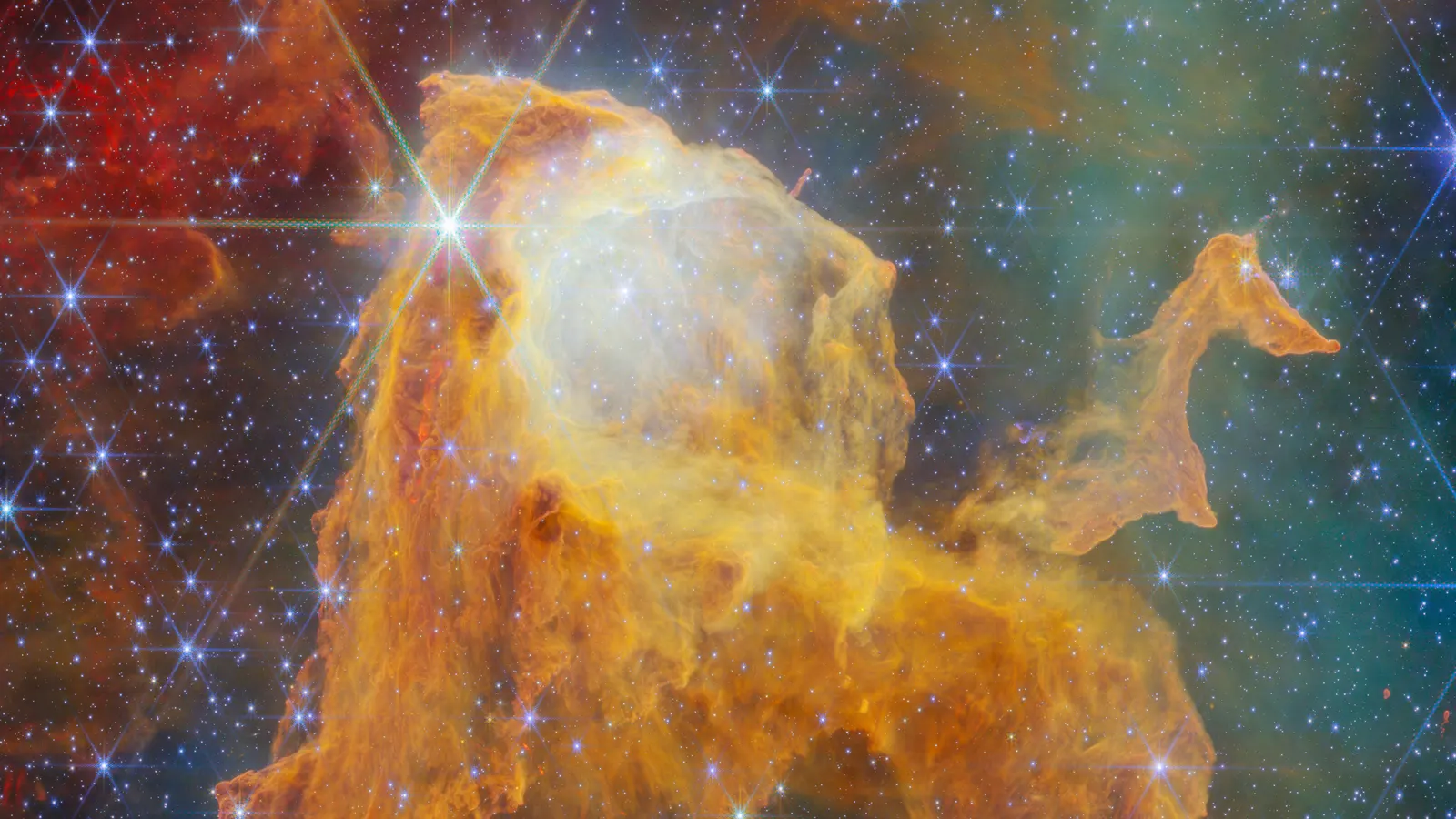
Just before Halloween, on 28 October 2026, the team behind NASA's Chandra X-ray Observatory released an image of something that looks like a ghost: a glowing hooded head with a long, ragged cape trailing away from it. It lies in the Carina Nebula, about 7,500 light-years from Earth. The release's own title gives away the twist: “Helpful Cosmic Ghost Brings Stellar Birth, Not Death.” The cloud is not a sign of anything dying. New stars are being born inside it.
01What the new picture is made of
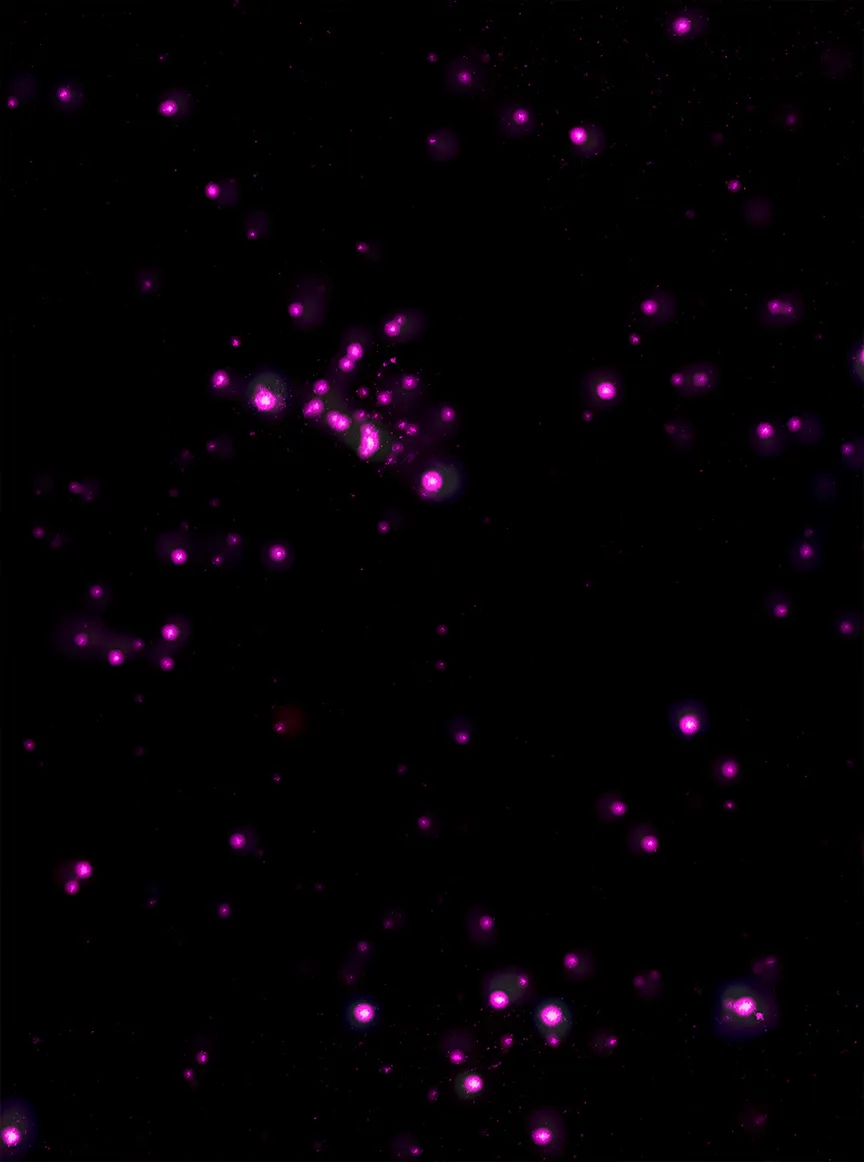
The image is a composite of light that our eyes cannot see. The pink dots are X-rays from Chandra, which the Chandra team says reveal young stars. They are laid over infrared data from the James Webb Space Telescope, shown in red, green and blue, and, according to the release, over visible-light data from the CTIO telescope in Chile, run by the US National Science Foundation.
The picture is new, but the X-rays are not. Chandra's fact sheet for the image says its X-ray data were taken on 28 August 2008, a 16-and-a-half-hour observation. The whole frame is about 4.3 arcminutes wide, which Chandra says is about 9.4 light-years at the nebula's distance. Our own check of that conversion gives the same answer.
02A ‘cometary globule’, not a comet
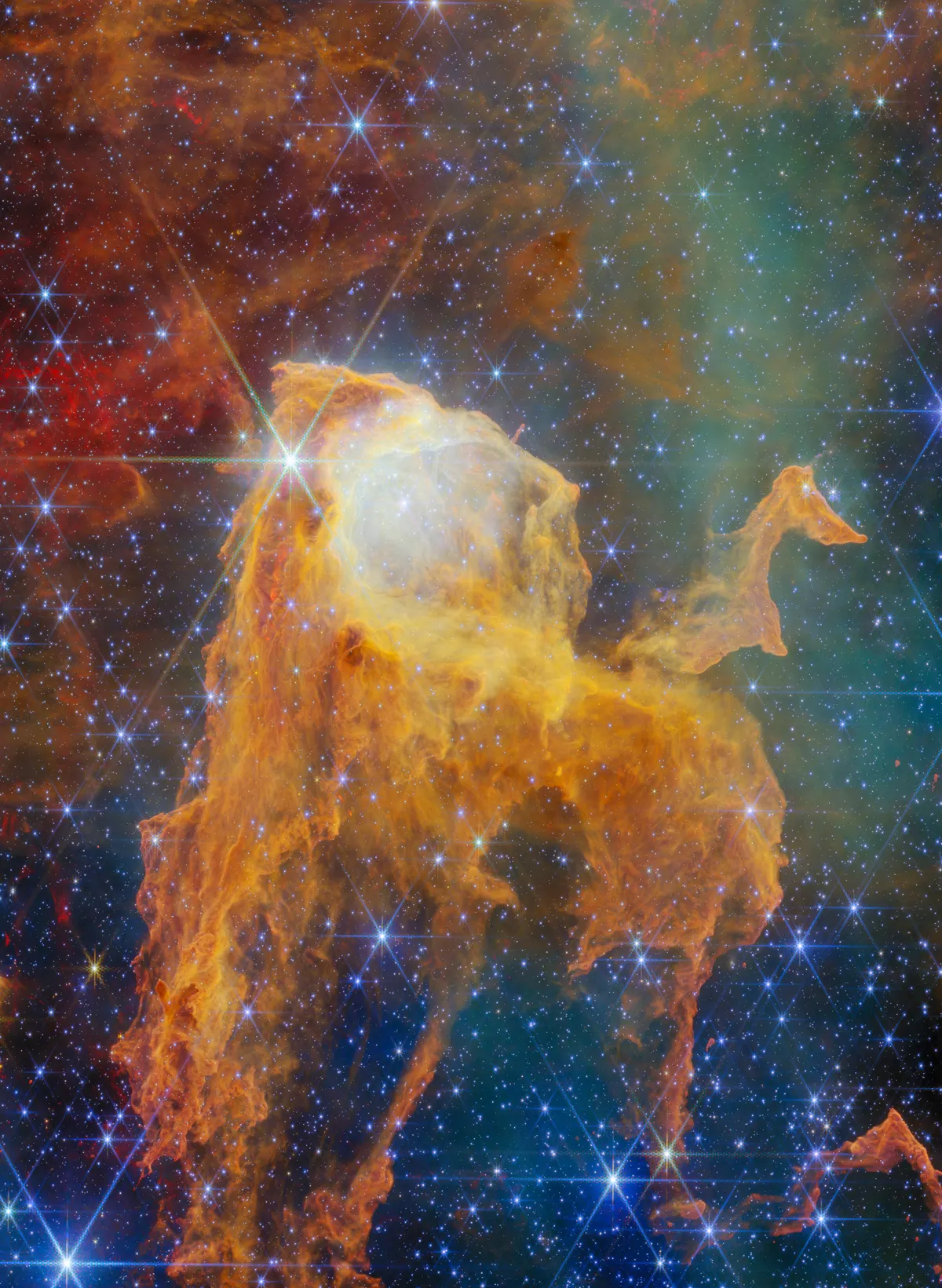
The ghost is what astronomers call a cometary globule: an isolated cloud of gas and dust with a dense head and a sweeping tail. Both Chandra and the European Space Agency's Webb team define it that way. The name comes only from the shape, which can look like a comet with its tail. The Chandra release stresses that these clouds have no connection to real comets.
This one has been studied before. Chandra's image is centred on the same sky position, and covers almost the same patch, as a Webb picture that ESA released in August 2026 under the name the “Treasure Chest”. That name goes back to a 2005 study by Nathan Smith, Keivan Stassun and John Bally, who thought the glowing cavity in the cloud's head looked like an opened chest full of sparkling riches. In the scientific catalogues, the cloud is G287.84−0.82. A 2019 study led by Bhaswati Mookerjea of the Tata Institute of Fundamental Research in Mumbai estimated its total mass at about 1,000 times the mass of the Sun.
03Who carved the ghost?
The cloud's shape is probably the work of its neighbours. The Carina Nebula contains some of the most massive stars in our galaxy. Chandra says the ghost's shape may come from erosion by the powerful radiation of some of these stars, including the famous Eta Carinae. None of them are in the picture.
Eta Carinae is not right next to the cloud. ESA says it sits about 39 light-years to the north-west, measured across the sky; our own calculation from the two positions agrees. That is a distance across our line of sight. How far apart they are in depth is not known. ESA describes Eta Carinae as a system of at least two stars, one of them about 100 times the mass of the Sun and about 5 million times as luminous. The Chandra team adds that astronomers suspect it could soon explode as a supernova, “soon” meaning on the timescales astronomers work with.
Eta Carinae is not working alone, either. ESA and the 2019 study both point to the hot, massive stars of the nearby cluster Trumpler 16 as well. The 2019 team measured how gas moves in the cloud and found the overall shape, with tails that are evaporating away, consistent with ultraviolet radiation and winds from Eta Carinae and the O-type stars of Trumpler 16.
04The nursery inside the hood
Hidden in the ghost's head is a compact cluster of young stars. ESA says researchers estimate it holds about 70 stars. The 2019 study counts more than 69. The brightest and most massive is an O-type star catalogued as CPD −59°2661, of spectral type O9.5 V, according to Smith and colleagues and the 2019 study. ESA puts its mass at roughly 19 times the Sun's.
How young is the cluster? The 2005 study estimated less than about 100,000 years. A later estimate, from a 2018 study cited by the 2019 paper and by ESA, is about 1.3 million years. Either way it is very young compared with the Sun's 4.6 billion years. Smith and colleagues found that about two-thirds of the cluster's stars show signs of dusty discs around them, the kind of disc that planets can form in.
The cloud is being eaten from inside as well as outside. The 2019 study found that the gas in the head is strongly affected by the embedded cluster, and that light from CPD −59°2661 lights up its own bubble inside the head. ESA and the 2019 team both say the young stars will eventually clear away the cloud around them and leave the cluster in the open.
05Why X-rays find baby stars
Young stars are much brighter in X-rays than middle-aged stars like the Sun. Chandra's guide to young stars explains why. Their fast spin and churning outer layers twist up magnetic fields, which heat their outer atmospheres to millions of degrees and set off frequent flares. In a Chandra study published in April 2026, three-million-year-old stars with the Sun's mass gave off, on average, about a thousand times more X-rays than the Sun does today.
So in a crowded region like Carina, X-ray images are a good way to pick out the young stars. Chandra has mapped the wider nebula before: a mosaic released in 2011 found more than 14,000 stars in the region. In the new image, the X-ray dots are spread across the whole frame, not only inside the ghost. The densest group lies at its head, where the Treasure Chest cluster is.
06What Webb adds
Webb sees the gas and dust itself. In near-infrared light, the outer skin of the cloud glows where starlight from outside strikes it, and the hollowed-out head shines from the young stars inside. ESA says Webb's images of this region come from an observing programme led by Megan Reiter (programme 5408). It is studying how young stars in the Carina Nebula pull in gas from their surroundings and blow it out again in jets.
The ghost, in other words, is a cloud that massive stars nearby are slowly wearing away while it makes new stars of its own. In a few million years there may be no ghost left, only the cluster it was hiding.
ENDSources
- Helpful Cosmic Ghost Brings Stellar Birth, Not Death (28 October 2026), with fast facts, NASA Chandra X-ray Center (SAO)
- More images: X-ray, infrared and optical views of the “ghost”, NASA Chandra X-ray Center (SAO)
- Webb opens a Treasure Chest filled with stars (August 2026), with coordinates, ESA/Webb
- Webb Opens Treasure Chest (21 August 2026), NASA
- Mookerjea et al. 2019, Opening the Treasure Chest in Carina, A&A 626, A131, Astronomy & Astrophysics
- Smith, Stassun & Bally 2005, Opening the Treasure Chest: a newborn star cluster emerges from its dust pillar in Carina, The Astronomical Journal
- JWST programme 5408 (PI: Reiter): accretion and outflow in Carina; gives Carina's distance as 2.3 kpc, STScI
- Field Guide to X-ray Astronomy: Young Stars and Star Clusters, NASA Chandra X-ray Center (SAO)
- NASA Finds Young Stars Dim in X-rays Surprisingly Quickly (14 April 2026), NASA Chandra X-ray Center (SAO)
- Carina Nebula: Nearby Supernova Factory Ramps Up (24 May 2011), NASA Chandra X-ray Center (SAO)
Written by Facts Nero from the Chandra release of 28 October 2026 and the sources above, all checked on 1 November 2026. This is a written article with no video. The distance of about 7,500 light-years is given by Chandra, ESA/Webb and the JWST programme 5408 description (2.3 kiloparsecs). Chandra does not name the cloud. We identify it with Webb's “Treasure Chest” and the cloud G287.84−0.82 because Chandra's listed centre (RA 10h 45m 53.1s, Dec −59° 57′ 45.9″) matches ESA's image to a tenth of a second and the two frames are almost the same size. Chandra says only that the shape may come from radiation from massive stars. The roles of Trumpler 16 and of the cluster inside come from ESA and the 2019 study. The 39 light-years to Eta Carinae is ESA's figure, measured across the sky. Our calculation from Eta Carinae's catalogued position gives the same value. The cluster's star count, the 19-solar-mass figure and Eta Carinae's mass and luminosity come from ESA only. The cloud's mass comes from the 2019 study only. The composite image itself is not shown here because it contains optical data that is not NASA's. Instead we show Chandra's X-ray-only view (NASA/CXC/SAO) and ESA's Webb image (CC BY 4.0); see the Chandra release for the composite. We do not repeat the Halloween social-media post that drew attention to the image; we worked from the release itself.