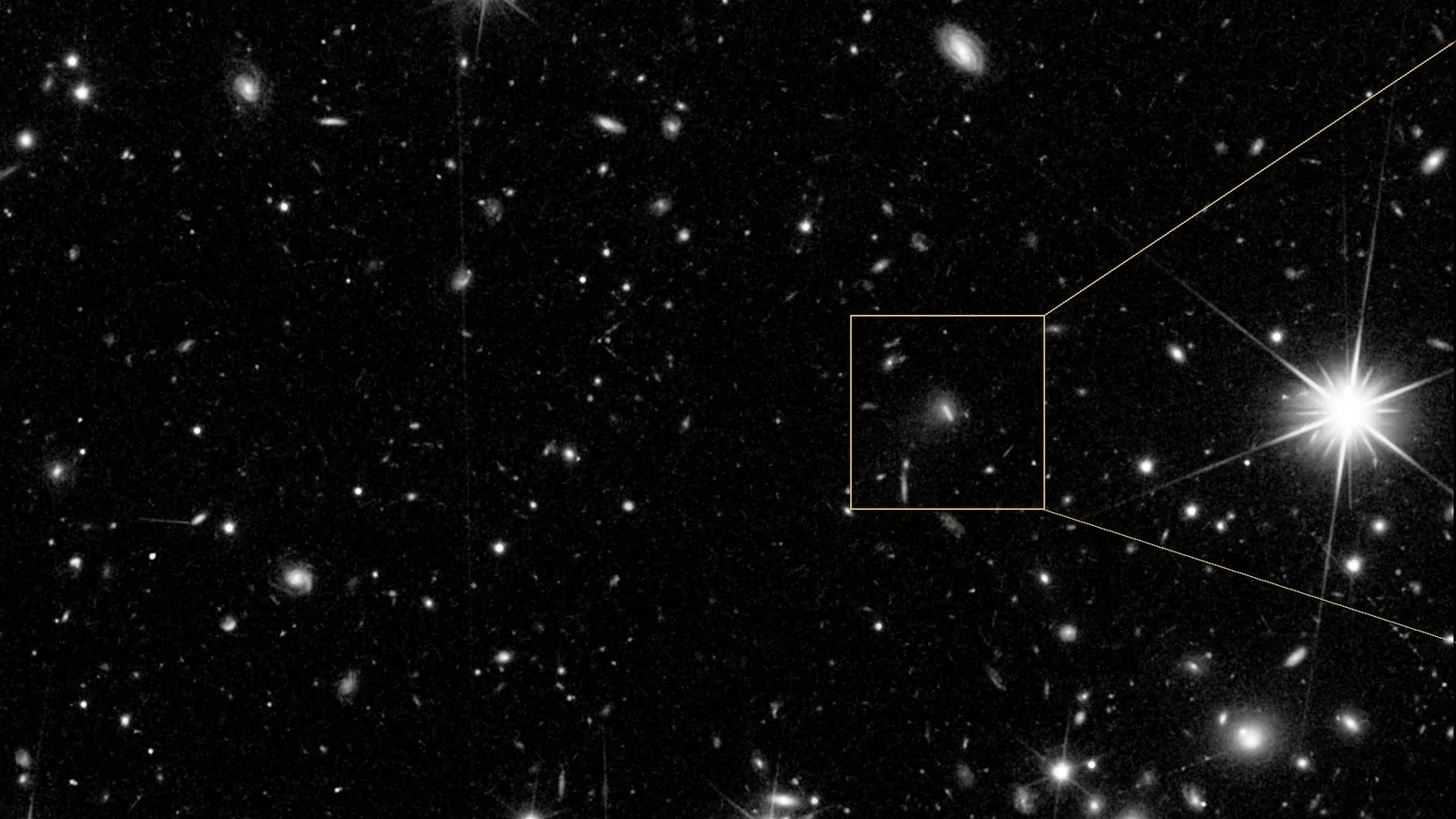
The European Space Agency's Euclid space telescope was built to map billions of distant galaxies. In September 2026 it also caught something much closer: a comet that no one had seen before. On 19 October 2026, ESA announced that the comet, now officially named C/2026 S1 (Euclid), is the first new comet Euclid has discovered.
01A streak in the deep field
Euclid launched on 1 July 2023 and works from a point about 1.5 million km from Earth, according to ESA and NASA. Its job is to measure the shapes and positions of galaxies to study dark matter and dark energy. It takes long, steady exposures of the distant universe, which is not what you need to follow fast-moving comets.
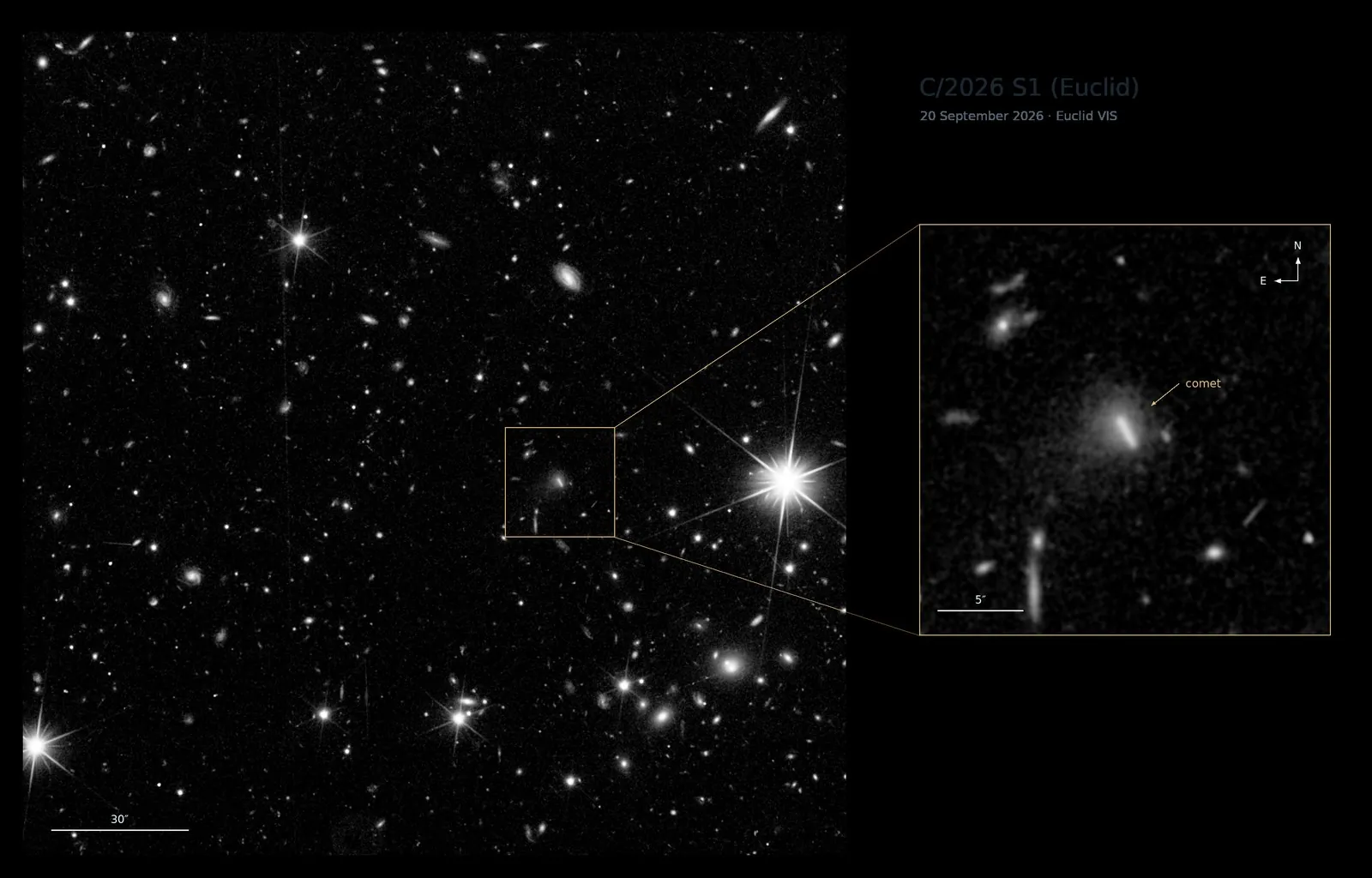
ESA says the comet turned up in images taken between 16 and 24 September 2026. Mikko Pöntinen, a PhD student at the University of Helsinki, had written software that searches Euclid's images for moving objects. "I was excited to see my software flag a 'streak' smeared across several images," he said in ESA's announcement. By predicting where the object would be next, he found it in five sets of images, 16 exposures in all. It had a fuzzy cloud around it, a sign of a comet shedding dust and gas.
02How a new comet becomes official
The object matched nothing in catalogues of known comets and asteroids, so the team reported it to the International Astronomical Union's Minor Planet Center, which confirms discoveries and assigns names. Telescopes on the ground then followed it up. The Minor Planet Center confirmed it as a comet on 8 October 2026, in its circular MPEC 2026-T146.
The name follows the usual rules. C/ marks a comet that is not periodic in the usual sense, one that takes more than 200 years to go around the Sun. 2026 S1 means it was the first comet found in the second half of September 2026. Comets are named after their discoverers, so this one carries Euclid's name.
03Arching over the Solar System
ESA says the comet is about 1.3 billion km from Earth. NASA JPL's Horizons system agrees: about 8.9 times the Earth–Sun distance (8.9 au) at the end of October 2026.
The planets orbit the Sun in a nearly flat disc. This comet does not. Orbit fits from JPL and from the Minor Planet Center put its orbit at about 85° to that disc, almost at right angles. ESA describes it as "straight up" from the Sun's point of view. That fits where it was found: the Euclid Deep Field North, one of the telescope's deep survey patches, lies almost exactly at the north pole of the planets' plane.
It will not come close to us. The same orbit fits say its closest point to the Sun, reached in the second half of 2027, is about 8.7 au, about 1.3 billion km from the Sun. That is a little inside Saturn's orbit and far beyond Jupiter's.
04How long is its year?
ESA says its orbit will take thousands of years to complete, and that the period will be refined as more observations come in. For now the numbers are very uncertain: JPL's current fit, from less than a month of observations, has an uncertainty larger than the size of the orbit itself. So we are not giving a figure.
05Why a dark-matter telescope found a comet
Comets are hard for Euclid to find. ESA says the telescope deliberately avoids the band of sky along the planets' plane, where most asteroids and comets are, because dust there adds glare to its deep images. It also usually photographs each patch of sky only once. "Very few comets are expected to be discovered by Euclid," said Bruno Altieri, Euclid archive scientist, so it was "a happy coincidence" that this comet's path crossed Euclid's view several times over those days.
Tracking moving objects still matters to Euclid. Comet trails and asteroid streaks have to be identified and removed so they do not spoil measurements of distant galaxies.
06A practice run for Comet Interceptor
ESA also sees this as a test for a future mission. Comet Interceptor, planned for launch in late 2028 or early 2029, will wait in space 1.5 million km from Earth for a suitable comet entering the inner Solar System for the first time, then fly past it with three spacecraft. Finding such comets early, while they are still far from the Sun, is key.
Euclid's project scientist Valeria Pettorino and Altieri said this comet is not a suitable target for Comet Interceptor, but the discovery and alert gave the two teams a real test of how they would work together. ESA did not say why it is unsuitable. One clear difference is that Comet Interceptor is designed to meet a comet heading into the inner Solar System, and this one never comes closer to the Sun than about 8.7 au.
ENDSources
- Euclid discovers new comet (19 October 2026), ESA
- Comet C/2026 S1 (Euclid) observations in context (image), ESA
- MPEC 2026-T146: Comet C/2026 S1 (Euclid) (8 October 2026), IAU Minor Planet Center
- C/2026 S1 (Euclid): orbit solution, NASA JPL Small-Body Database
- Horizons ephemeris for C/2026 S1, 29 October 2026, NASA JPL
- C/2026 S1 (Euclid): orbital elements and ephemeris (from MPC data), astro.vanbuitenen.nl
- Euclid data release Q1 (Euclid Deep Field North position), Euclid Consortium
- ESA's Euclid Mission Launches to Explore 'Dark Universe' (1 July 2023), NASA
- Comet Interceptor factsheet, ESA
Written by Facts Nero from ESA's announcement of 19 October 2026 and the sources above, all checked on 29 October 2026. This is a written article with no video. The discovery details (dates, software, number of exposures) come from ESA. The distance, orbit tilt and closest approach to the Sun are from ESA and from orbit fits by NASA JPL and the Minor Planet Center; they will change slightly as more observations come in. Estimates of when it is closest to the Sun range from late August to late September 2027, so we only say 2027. We give no orbital period because current estimates are too uncertain. The sky position is from JPL Horizons for 29 October 2026, and the brightness is the predicted magnitude from JPL and the MPC-based ephemeris.