What happens if we miss a city-killer asteroid hitting Earth?
Chelyabinsk came out of the Sun's glare in 2013 and nobody saw it. What happens if we miss a city-killer asteroid, from DART and nuclear options to evacuation.
On the morning of 15 February 2013, the sky over Chelyabinsk in Russia lit up. A rock about 17 to 20 metres across hit the atmosphere at about 19 kilometres per second and exploded about 30 km up. According to NASA, the fireball was brighter than the Sun even for people 100 km away.
Then the shock wave arrived. The Planetary Society says it damaged 7,200 buildings in six cities and sent 1,500 people to hospitals and clinics, most of them hurt by glass from windows they had walked up to after seeing the flash.
Nobody saw it coming. According to NASA's Jet Propulsion Laboratory, the rock approached from within 15 degrees of the Sun's direction, and asteroid-hunting telescopes cannot scan the sky that close to the Sun. Our video asks the uncomfortable follow-up: what happens on the day we miss a bigger one?
01How big is a city-killer?
Chelyabinsk never reached the ground. Neither did the Tunguska object of 30 June 1908, which NASA estimates was 50 to 100 metres across. It exploded about 6 to 10 km above a remote part of Siberia, and according to NASA, flattened millions of trees across an area of about 2,150 square kilometres (830 square miles). Almost nobody lived there. Over a big city, it would have been a disaster.
NASA uses that size as its line too. Its 2023 planetary defence strategy estimates that there are 230,000 or more near-Earth objects at least 50 metres wide "that could destroy a concentrated urban area". That is the class people call "city-killers".
And this is the uncomfortable part. According to the same NASA document:
- About 95% of the roughly 1,000 near-Earth objects larger than 1 km have been found, and none is a current threat.
- Of the roughly 25,000 larger than 140 m, big enough for regional devastation, less than 50% have been found.
- Of the 50-metre-plus objects, fewer than 8% have been found.
ESA's numbers point the same way. In November 2025, when the 40,000th near-Earth asteroid was discovered, ESA said current models suggest we have found only about 30% of the ones between about 100 and 300 metres wide.
02How we look, and where we can't
Asteroid hunting is mostly patient photography. Survey telescopes image the same patch of sky again and again through the night, and software looks for points of light that move against the stars.
The newest of them is huge. In June 2025, the NSF–DOE Vera C. Rubin Observatory in Chile reported that in about 10 hours of test observations it had found 2,104 asteroids never seen before, including seven near-Earth asteroids (none of them dangerous). Its ten-year Legacy Survey of Space and Time officially began, the observatory announced on 30 June 2026.
The video describes four blind spots, and each one has already let something through.
1. The Sun. Telescopes on the ground work at night, looking away from the Sun. Chelyabinsk came from the sunward side.
2. Dark asteroids. Some asteroids reflect very little light. NASA describes these dark objects as the hardest type to find with current telescopes. 2019 OK, estimated at 60 to 130 m across, passed about 65,000 km above Earth's surface on 24–25 July 2019, one-fifth of the distance to the Moon. According to ESA, it was spotted only about a day before its closest approach, even though archival survey images show it had been observed before without being recognised as a near-Earth asteroid.
3. Weather and moonlight. Ground telescopes can only search when the sky is clear and dark enough.
4. Looking the wrong way at the wrong time. In December 2024, the ATLAS telescope in Chile discovered 2024 YR4. NASA says it had passed Earth on 25 December and was discovered two days later, on 27 December. Its 2032 impact odds rose to 3.1% on 18 February 2025, which NASA called "the highest impact probability NASA has ever recorded for an object of this size or larger". New observations the next day cut the odds, and by 25 February, ESA put the chance at 0.001%. The Webb telescope later measured it at about 53 to 67 metres across.
The Moon was a separate question for longer. By June 2025 the odds of YR4 hitting the Moon on 22 December 2032 had risen to about 4%. That is the number in our video, and it is now out of date: on 5 March 2026, using new Webb observations, NASA ruled out a lunar impact. YR4 is now expected to pass about 21,200 km from the Moon's surface.
For about two months, from late December to late February, the best warning system humanity had built couldn't rule out a city-killer hitting Earth seven years later.
03It's all about time
Everyone in planetary defence says the same thing: the more warning, the more options. The video walks down a ladder of warning times.
Ten years or more is the case in the brochures: design a spacecraft, launch it and give the asteroid a small push years ahead, so a tiny change adds up to a clean miss. With a few years, you can still try, but with fewer choices. With months, according to Lawrence Livermore National Laboratory, the options shrink to the most powerful one available (more on that below). With weeks or less, no spacecraft can reach the asteroid in time to move it.
The bottom of the ladder has already been tested, with tiny rocks. On 6 October 2008, the Catalina Sky Survey discovered 2008 TC3, a small asteroid estimated at no more than a few metres across. According to ESA, it entered the atmosphere over Sudan about 20 hours later and exploded about 37 km up. NASA calls it the first time the place and time of an impact were predicted in advance. ESA's list of asteroids detected before they hit Earth's atmosphere now has 13 entries, all of them small: a few metres across at most.
Now imagine the same chain (find it, work out where it lands, tell people) with a 60-metre rock. "Tell people where to look" becomes "tell people where to leave". And at the very bottom of the ladder is zero warning, which is what Chelyabinsk was.
04Push it: DART
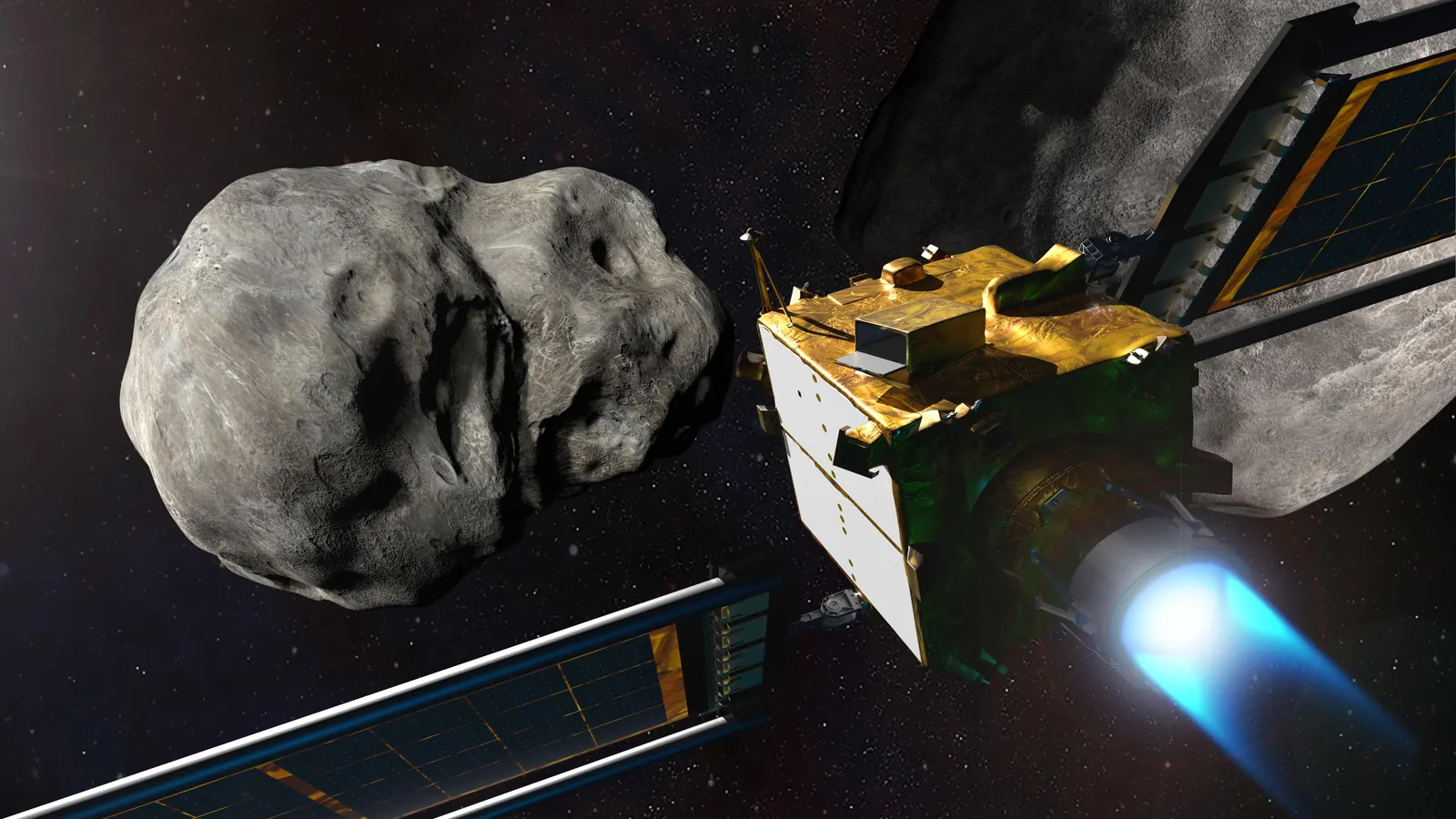
On 26 September 2022, NASA's DART spacecraft flew into Dimorphos, a small moon of the asteroid Didymos, at about 22,500 km/h (about 6 km per second). Neither asteroid was a threat to Earth. DART was a test.
NASA's minimum goal was to shorten Dimorphos's 11-hour-55-minute orbit by 73 seconds. The impact shortened it by 32 minutes, to 11 hours 23 minutes. NASA called it the first time humanity had purposely changed the motion of a celestial object.
Why so much? The impact threw a huge plume of rock off Dimorphos, and that ejecta pushed back like rocket exhaust. In a 2023 Nature paper, Andrew Cheng and colleagues calculated a momentum enhancement factor of about 3.6: the total push was about 3.6 times DART's own momentum, mostly because of the ejecta.
ESA's Hera mission, launched on 7 October 2024, is now arriving at Didymos to measure what DART did, including the crater and Dimorphos's mass. ESA brought the arrival forward to November 2026, and scheduled Hera's two main braking burns for 15 and 22 October.
Other ideas exist on paper. NASA's 2024 tabletop exercise report lists kinetic impact, the "ion beam" (a spacecraft firing its thrusters at the asteroid for many months or years) and nuclear deflection, and also mentions gravity tractors. Only one, the kinetic impactor, has been demonstrated in flight.
05Or break it: the nuclear option
A nuclear device would not be landed on the asteroid like in a Hollywood film. The idea is to set it off at a distance. The burst of X-rays heats a thin layer of the asteroid's surface, which blasts off and pushes the rest of the rock the other way.
In 2024, Sandia National Laboratories tested the physics. Using its Z machine, which Sandia calls the most powerful pulsed-power machine on Earth, the team aimed an X-ray pulse at mock asteroids 12.5 millimetres across, "about the width of a finger". For the 20 millionths of a second the test took, the targets were effectively in free fall. In the team's Nature Physics paper, the X-rays pushed them to around 70 metres per second, about 250 km/h. The authors scaled the results up and predicted that the method could deflect asteroids up to about 4 km across. That last step is still modelling, not a test.
With even less warning, the target could be broken up. A 2021 Lawrence Livermore study modelled a 1-megaton nuclear device exploded next to a 100-metre asteroid shaped like Bennu, two months before impact. In the simulations, 99.9% of the asteroid's mass missed Earth. Bigger asteroids need more time: for a 99% miss, the team found, they need at least six months. Lead author Patrick King called nuclear disruption "a very effective defense of last resort", and said that with decade-long warning times, kinetic impactors are generally preferred.
There are two big catches. No such spacecraft exists or is ready to launch. And there is the law. The 1967 Outer Space Treaty bans placing nuclear weapons in orbit or stationing them in space, and the 1963 Partial Test Ban Treaty bans nuclear explosions in outer space. (Our video mentions only the 1967 treaty. Both apply.)
06Move the people
Earth has one defence that works without any warning at all: the atmosphere. Small rocks hit the air at high speed and break apart high up. According to NASA, most of the tens of millions of small near-Earth objects would break up in the atmosphere, but those larger than about 10 metres could cause some damage on the ground. Chelyabinsk and Tunguska were both airbursts, and neither left a crater.
For a city-killer, though, the blast is the danger. NASA says that if 2019 OK had exploded over land like Chelyabinsk, it could have devastated an area roughly 80 km across. That is a city and its surroundings, not a country. So with weeks of warning, the plan is to work out exactly where the rock will come down and get people out of the way.
This has been rehearsed. In April 2024, NASA and FEMA ran their fifth planetary defence tabletop exercise with US agencies and international partners. The imaginary asteroid had a 72% chance of hitting Earth in about 14 years. The after-action report found that best practices and procedures between countries, including through the United Nations, could help coordinate a response. It also found that space mission planning, disaster management and public communication are linked in ways that were "not fully appreciated before the exercise".
07Closing the holes
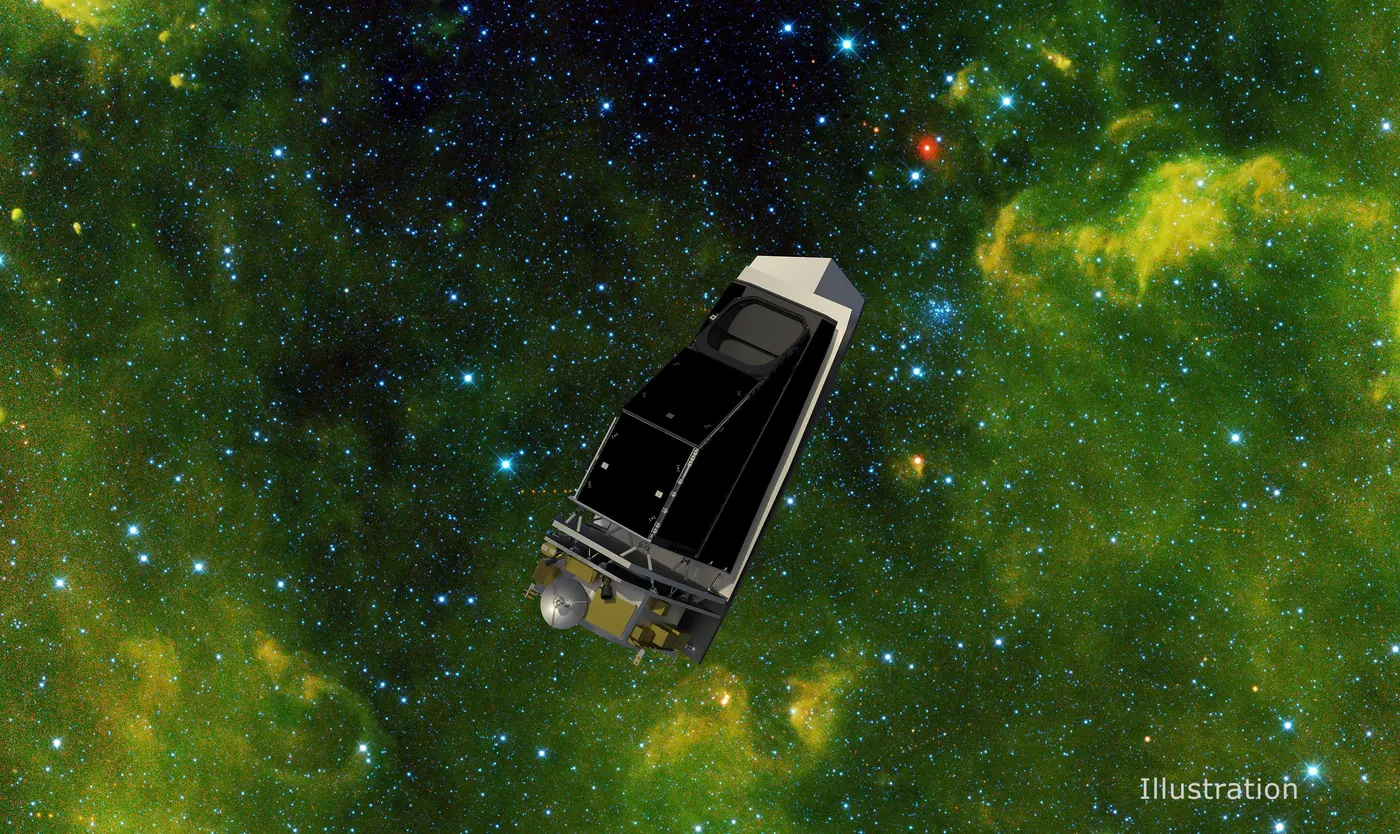
The best fix is not to be surprised. NASA's NEO Surveyor is an infrared space telescope with a 50 cm mirror. NASA says it will launch no earlier than September 2027 on a SpaceX Falcon 9, with a commitment to be ready for launch by June 2028. According to NASA's Jet Propulsion Laboratory, it will travel about a million miles (1.5 million km) to the L1 Lagrange point between Earth and the Sun.
From there it fixes two of the four holes. Infrared light shows an asteroid's heat, so dark asteroids are no harder to see than bright ones. And with its large sunshade, NEO Surveyor can look for asteroids coming from the direction of the Sun. Its five-year survey is meant to find at least two-thirds of the near-Earth objects larger than 140 metres that are still unknown. Together with Rubin on the ground, it should make surprises much rarer.
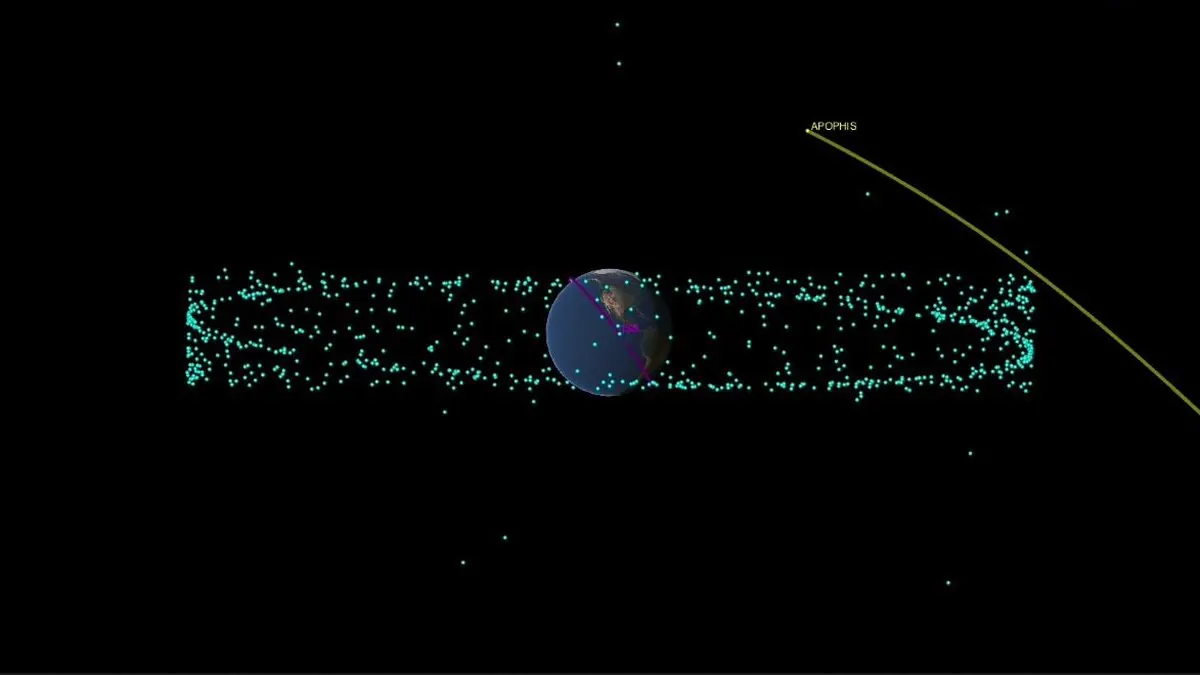
Nature is also giving us a free experiment. On 13 April 2029, the 340-metre asteroid Apophis will pass closer to Earth than geosynchronous satellites. It will not hit. ESA's Ramses mission, built with Japan's space agency JAXA, is planned to launch in spring 2028 and reach Apophis about two months before the flyby. NASA's OSIRIS-APEX is due to arrive afterwards, in June 2029. The OSIRIS-APEX team estimates that about two billion people will be able to see Apophis with the naked eye. Read the full Apophis story.
So what happens if we miss a city-killer? With less than about six months, the options shrink to a nuclear plan that exists only on paper, and evacuation. The goal for the next decade is never to be in that position. Chelyabinsk was a lucky warning, and since then DART has flown, Rubin has started its survey and NEO Surveyor is being built.
Planetary defence mostly means finding the asteroid early. Everything else is for when that fails.
Would you trust the nuclear option?
Sources
- NASA and International Researchers Obtain Crucial Data from Meteoroid Impact, NASA
- Additional Details on the Large Feb. 15 Fireball over Russia, NASA Jet Propulsion Laboratory
- What was the Chelyabinsk meteor event?, The Planetary Society
- 115 Years Ago: The Tunguska Asteroid Impact Event, NASA
- A Cosmic Explosion Over Siberia, NASA Earth Observatory
- NASA Planetary Defense Strategy and Action Plan (April 2023, PDF), NASA
- 40 000 near-Earth asteroids discovered! (20 November 2025), ESA
- Ever-changing Universe Revealed in First Imagery From NSF–DOE Vera C. Rubin Observatory, Rubin Observatory
- Action! Rubin Observatory begins capturing the greatest cosmic movie ever made (30 June 2026), Rubin Observatory
- 2019 OK, NASA Science
- Asteroid's surprise close approach illustrates need for more eyes on the sky, ESA
- 2024 YR4 facts, NASA Science
- Dark Skies Bring New Observations of Asteroid 2024 YR4, Lower Impact Probability, NASA
- Asteroid 2024 YR4 no longer poses significant impact risk, ESA
- NASA's Webb Observations Update Asteroid 2024 YR4's Lunar Impact Odds, NASA
- New NASA Asteroid Observations Eliminate Chance of 2032 Lunar Impact (5 March 2026), NASA
- Asteroid 2008 TC3 Strikes Earth: Predictions and Observations Agree, NASA/JPL CNEOS
- 2008 TC3, ESA NEO Coordination Centre
- Past impactors (updated 24 September 2026), ESA NEO Coordination Centre
- NASA Confirms DART Mission Impact Changed Asteroid's Motion in Space, NASA
- Cheng et al. 2023, Momentum transfer from the DART mission kinetic impact on asteroid Dimorphos, Nature
- ESA's Hera targets early arrival at Didymos asteroids, ESA
- Braking news! Time for ESA's Hera asteroid mission to go slow (7 October 2026), ESA
- Deflecting doom: How Sandia research could save Earth from asteroids, Sandia National Laboratories
- Moore et al. 2024, Simulation of asteroid deflection with a megajoule-class X-ray pulse, Nature Physics
- Late-time small-body disruptions can protect the Earth, Lawrence Livermore National Laboratory
- Outer Space Treaty (1967), UN Office for Outer Space Affairs
- Treaty Banning Nuclear Weapon Tests in the Atmosphere, in Outer Space and Under Water (1963), US Department of State
- NASA, Partners Conduct Fifth Asteroid Impact Exercise, Release Summary, NASA
- Planetary Defense Interagency Tabletop Exercise 5: After-Action Report (PDF), NASA/JPL CNEOS
- NEO Surveyor, NASA Science
- NASA Awards Planetary Defense Space Telescope Launch Services Contract, NASA
- Work Is Under Way on NASA's Next-Generation Asteroid Hunter, NASA Jet Propulsion Laboratory
- Introducing Ramses, ESA's mission to asteroid Apophis, ESA
- OSIRIS-APEX, NASA Science
Written by Facts Nero from the script of our video. Every claim was checked against the sources above on 27 October 2026. Corrections to the video: the chance of 2024 YR4 hitting the Moon (about 4% in the video) was ruled out by NASA on 5 March 2026; the period when an Earth impact couldn't be ruled out was about two months, not six weeks; ESA's current estimate is that about 30% of 100–300 m asteroids have been found, not one in ten; DART's total push was about 3.6 times its own momentum, not 3.5; Sandia's targets reached about 250 km/h (70 m/s), not 260; Tunguska flattened "millions" of trees, as NASA puts it (we dropped the 80 million figure); OSIRIS-APEX arrives about two months after Apophis's flyby, not one; and both the 1967 Outer Space Treaty and the 1963 Partial Test Ban Treaty apply to a nuclear option. We dropped the claims we could not confirm in a primary source: the exact delay before Chelyabinsk's shock wave, a nuclear burst giving "10 to 100 times" more push, the 50 m and 150 m atmosphere thresholds, a 30–50 km kill zone (we use NASA's 80 km figure for 2019 OK instead), and the Livermore team's warning about acting weeks too late.
More from Facts Nero
-
 Long video · 10 minNASA/JPL-Caltech
Apophis 2029: the asteroid that once had a 1 in 37 chance of hitting Earth
On Friday 13 April 2029, a 340-metre asteroid passes closer to Earth than many of our satellites. In 2004, nobody could rule out a hit.
AsteroidsRead · 8 minWatch ▶ -
 Long video · 10 minNASA/Bill Stafford
Why Artemis III won't land on the Moon
Four astronauts, three heavy-lift rockets and test versions of two Moon landers, all in Earth orbit.
MissionsRead · 7 minWatch ▶