Apophis 2029: the asteroid that once had a 1 in 37 chance of hitting Earth
On Friday 13 April 2029, a 340-metre asteroid will pass closer to Earth than many of our satellites. In December 2004, for a few days, nobody could rule out a hit.
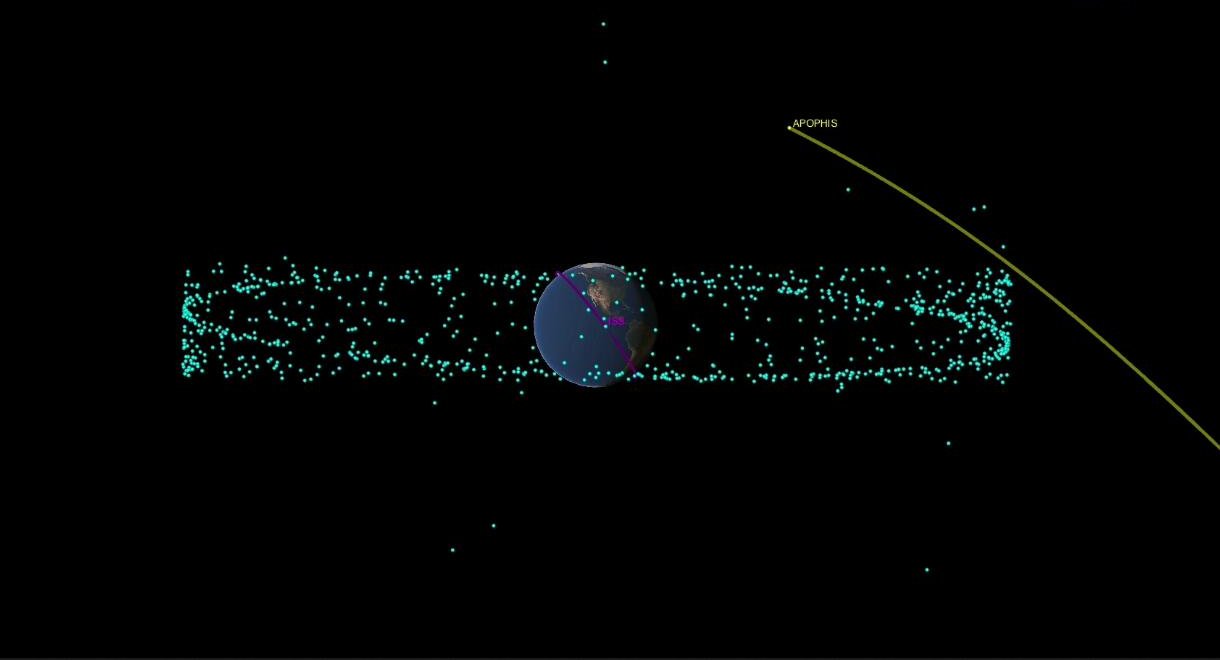
On Friday 13 April 2029, a rock about 340 metres across will pass about 32,000 km above Earth's surface. That is closer than many satellites in geosynchronous orbit, about 36,000 km up. Its name is Apophis.
It will not hit us. In 2021, NASA said its calculations showed no impact risk for at least the next 100 years. But for a few days around Christmas 2004, nobody could promise that.
01Found, then lost
On 19 June 2004, Roy Tucker, David Tholen and Fabrizio Bernardi spotted a faint moving dot from Kitt Peak National Observatory in Arizona, using the 2.3-metre Bok telescope. They could only follow it for two nights before technical problems and bad weather stopped them. The asteroid got the code name 2004 MN4 and dropped out of sight.
Six months later, on 18 December, Gordon Garradd of the Siding Spring Survey found it again from Australia. As astronomers worked out its orbit and ran it forward, some of the possible paths in 2029 ended at Earth.
02Christmas week, 2004
On 23 December, NASA's Near-Earth Object Program put the chance of an impact on 13 April 2029 at about 1 in 300. Those odds were "unusual enough to merit special monitoring by astronomers, but should not be of public concern", it said. It was the first object to reach level 2 on the 10-point Torino Scale.
Usually, more observations of a new asteroid shrink the risk to zero. This time they pushed it up. On 24 December the odds rose to about 1.6%, which NASA said corresponded to level 4 on the Torino Scale, the highest score any asteroid had reached. Level 4 means a 1% or greater chance of a collision capable of regional devastation. By 27 December the chance had climbed to 2.7%, or about 1 in 37, and Apophis held the highest rating ever given on the scale, according to ESA.
Meanwhile, astronomers were searching old images. On 27 December, Jeff Larsen and Anne Descour of the Spacewatch Observatory near Tucson found very faint images of the asteroid on archive pictures from 15 March 2004, three months before its discovery. Those extra months of positions improved the orbit so much that, NASA said, an Earth impact in 2029 could now be ruled out.
03Naming the god of chaos
When it came to an official name, Tholen did an internet search and found Apep, the ancient Egyptian god of evil and destruction, as NASA puts it. ESA calls him the Egyptian god of chaos and destruction. Apophis is the Greek name for Apep. Apophis is also a villain in the TV series Stargate SG-1. Tholen called that "icing on the cake", but told NASA the asteroid was not named after the character. The International Astronomical Union approved the name in 2005.
04The keyhole, and a push from sunlight
Ruling out 2029 was not the end of it. Apophis passes so close that Earth's gravity bends its path, so a tiny uncertainty in where it is before the flyby becomes a huge one afterwards. Astronomers worried about keyholes: small regions near Earth that, if Apophis passed through one, would send it into an orbit that brought it back to hit us years later. JPL's Paul Chodas described one as "a small doorway" that could lead to a 2036 impact. For a long time, the years in question were 2036 and 2068.
In January 2013, NASA ruled out a 2036 impact, putting the odds at less than one in a million. On that pass, according to JPL's close-approach data, Apophis stays about 46 million km away, roughly 120 times the distance to the Moon.
2068 was harder to shake, because of sunlight. An asteroid absorbs sunlight and has to give that energy off again as heat. Because it doesn't do that evenly, the heat gives it a very weak, steady push, called the Yarkovsky effect. In 2020, Tholen used the Subaru telescope to measure it. Apophis, he said, "is drifting away from a purely gravitational orbit by about 170 meters per year, which is enough to keep the 2068 impact scenario in play."
05Radar settles it
In March 2021, Apophis passed about 17 million km from Earth, some 44 times the Earth-Moon distance. NASA's 70-metre Goldstone antenna in California sent radar signals at it, and the 100-metre Green Bank Telescope in West Virginia received the echoes. "If we had binoculars as powerful as this radar, we would be able to sit in Los Angeles and read a dinner menu at a restaurant in New York," said Marina Brozović of JPL, who led the radar campaign.
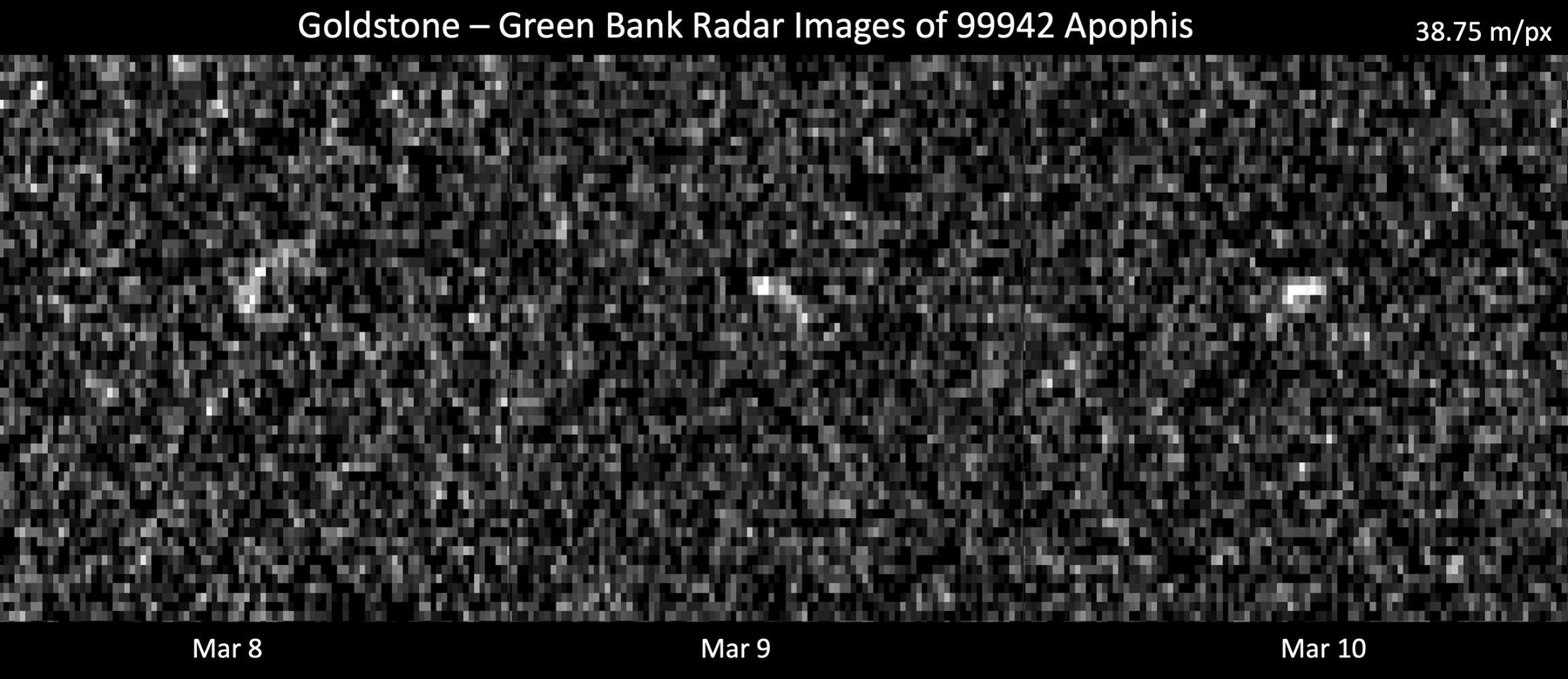
The uncertainty in its 2029 position "collapsed from hundreds of kilometers to just a handful of kilometers", said Davide Farnocchia of NASA's Center for Near-Earth Object Studies. "A 2068 impact is not in the realm of possibility anymore, and our calculations don't show any impact risk for at least the next 100 years." Apophis came off NASA's Sentry impact risk table.
06The night it goes by
Apophis has a mean diameter of about 340 metres, with a long axis of at least 450 metres. Radar suggests it is elongated and possibly has two lobes, a bit like a peanut. It is an S-type, or stony, asteroid of silicate rock mixed with nickel and iron, left over from the formation of the solar system about 4.6 billion years ago. It doesn't spin neatly: it turns end over end about once every 31 hours, with a slow rocking that takes about 264 hours, or 11 days.
According to JPL's close-approach data, the closest point comes at about 21:46 UTC on 13 April 2029, at a speed of 7.4 km/s relative to Earth. NASA says it will be visible from the Eastern Hemisphere, weather permitting, without a telescope or even binoculars. ESA lists parts of Europe, Africa and Asia. In a 2026 presentation, the OSIRIS-APEX team put the number of people within naked-eye range at 2 billion. An asteroid this large passes this close only every few thousand years on average, NASA says, so it is likely nothing like this has happened in recorded human history.
The part you won't see is what Earth's gravity does to it. NASA says Apophis will be "pulled, twisted, stretched, and squeezed". Its orbit around the Sun will get slightly larger, its spin will very probably change, and the strain may cause small landslides on its steepest slopes. ESA mentions possible quakes too. The catch is that ground-based telescopes lose it within hours, as it passes within 20° of the Sun in our sky.
07Two spacecraft, and a money problem
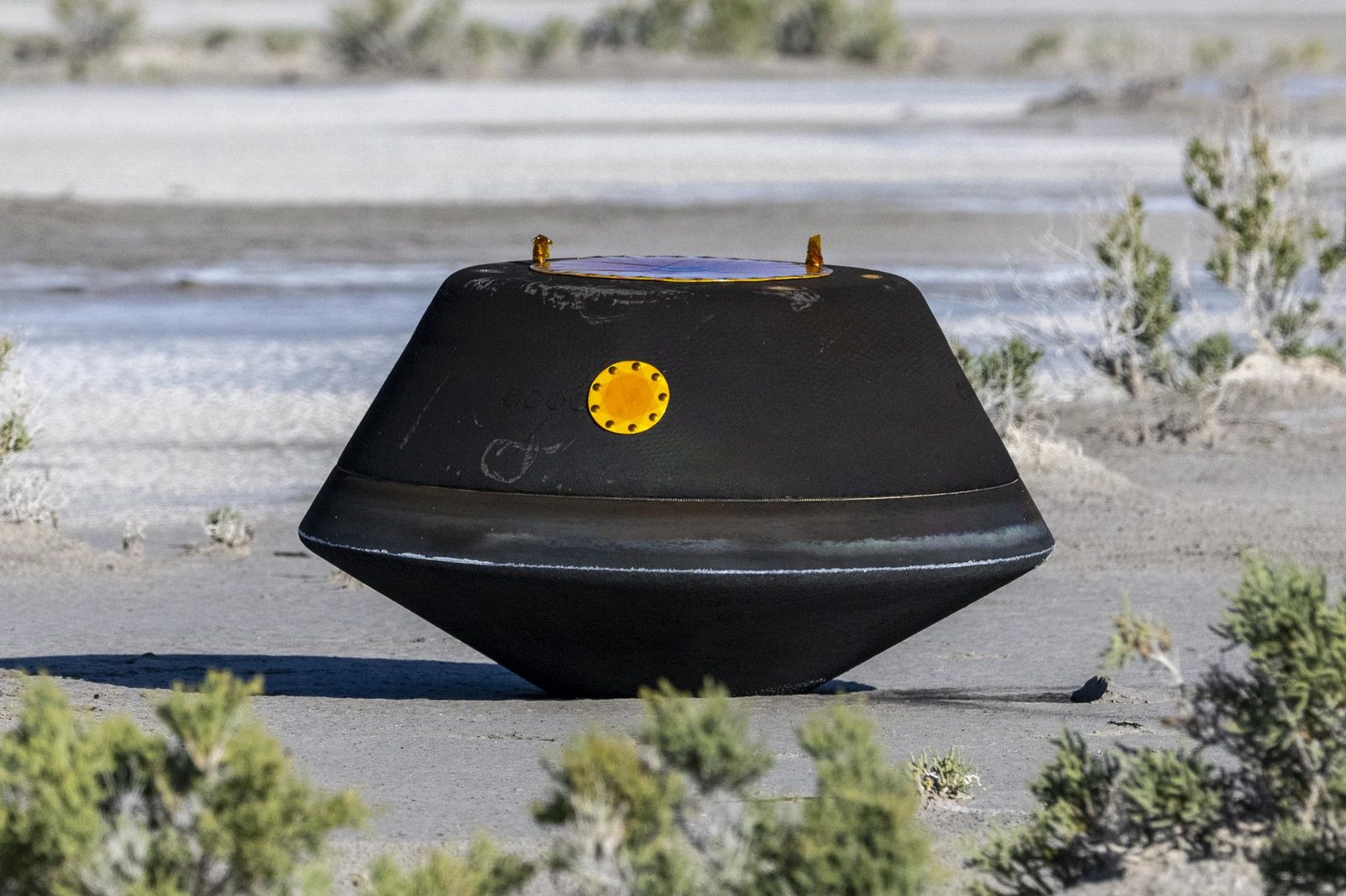
So two spacecraft are meant to be there. The first is a familiar one. OSIRIS-REx collected a sample from asteroid Bennu and dropped it off at Earth on 24 September 2023. NASA renamed it OSIRIS-APEX and sent it after Apophis. About an hour after the asteroid's closest approach, the spacecraft will use Earth's gravity to slip onto a nearly identical path, then begin an 18-month campaign. It may dip within 15 feet (about 4.6 metres) of the surface and fire its thrusters downward, stirring up rocks and dust so scientists can see what lies beneath.
The second is Ramses, an ESA mission built with Japan's space agency JAXA. It has to launch on a Japanese H3 rocket in spring 2028 to reach Apophis in February 2029, two months before the flyby. "Ramses is a mission that literally cannot be late," said Paolo Martino, ESA's Ramses mission manager.
OSIRIS-APEX has a different problem: money. The White House's 2027 budget request, released on 3 April 2026, proposed cutting NASA science by 46%. The Planetary Society counted 53 missions likely facing termination, and OSIRIS-APEX was among those proposed for cancellation. It was in the same position a year earlier, as one of 19 missions marked for cancellation in the 2026 request, before it was saved. This year, the House Appropriations Committee's bill gives it $20 million to keep preparing for the flyby. But that bill isn't law, and NASA is running on a stopgap funding law that lasts until 11 December 2026.
08So why bother?
In September 2022, NASA deliberately crashed its DART spacecraft into a small asteroid called Dimorphos, and shortened its orbit by 32 minutes. That proved a spacecraft can nudge an asteroid. Doing it safely to a real threat means knowing what you are pushing on, and how it reacts when something pulls on it.
With Apophis, nobody has to set up that experiment. As ESA puts it: "For the first time ever, nature is bringing one to us and conducting the experiment itself."
In 2004, astronomers were worried about Friday 13 April 2029. Now it could be the night 2 billion people step outside to watch an asteroid go by.
Where will you be watching from?
Sources
- Apophis facts, NASA
- Apophis, NASA
- Near-Earth Asteroid 2004 MN4 Reaches Highest Score To Date On Hazard Scale (23–24 December 2004), NASA/JPL Center for Near-Earth Object Studies
- Possibility of an Earth Impact in 2029 Ruled Out for Asteroid 2004 MN4 (27 December 2004), NASA/JPL Center for Near-Earth Object Studies
- The Torino Impact Hazard Scale, NASA/JPL Center for Near-Earth Object Studies
- Apophis, ESA
- CSI: Comet/Asteroid Scene Investigation, NASA JPL
- NASA Rules Out Earth Impact in 2036 for Asteroid Apophis, NASA JPL
- Close-approach data for 99942 Apophis, 2029–2036, NASA JPL Solar System Dynamics
- Massive asteroid subject of new findings, University of Hawaiʻi News
- NASA Analysis: Earth Is Safe From Asteroid Apophis for 100-Plus Years, NASA
- Apophis exploration, NASA
- OSIRIS-APEX, NASA
- OSIRIS-APEX, University of Arizona Lunar and Planetary Laboratory
- OSIRIS-APEX mission plan abstract (NTRS 20250001588), NASA Technical Reports Server
- OSIRIS-APEX Update (D. DellaGiustina, SBAG, January 2026), Small Bodies Assessment Group
- Ramses: ESA's mission to asteroid Apophis, ESA
- Backbone of Ramses asteroid mission stands tall, ESA
- The FY 2027 NASA budget request, The Planetary Society
- House Appropriators advance key NASA funding bill, The Planetary Society
- $20 million NASA mission to visit 'God of Chaos' asteroid saved from budget cuts, Live Science
- House Clears FY2027 CR, Now to the President, SpacePolicyOnline.com
- NASA Confirms DART Mission Impact Changed Asteroid's Motion in Space, NASA
Written by Facts Nero from the script of our video. Every claim was checked against the sources above on 25 October 2026. Corrections to the video: on its 2036 pass Apophis stays about 120 times the Moon's distance from us (JPL), not 150; the Spacewatch astronomer is Anne Descour; and we dropped the 900-megaton impact energy, the "over the Atlantic" viewing detail and the "sole planned mission" quote, which we could not confirm in a primary source.
More from Facts Nero
-
 Short · 71 sESO/M. Kornmesser
S301: the fastest known star in the Milky Way
25,000 km/s, more than 8% of the speed of light, on an 8.7-year orbit around our galaxy's black hole.
UniverseRead · 4 minWatch ▶ -
 Long video · 10 minNASA/Bill Stafford
Why Artemis III won't land on the Moon
Four astronauts, three heavy-lift rockets and test versions of two Moon landers, all in Earth orbit.
MissionsRead · 7 minWatch ▶