S301: the fastest known star in the Milky Way
A faint star near our galaxy's central black hole reaches 25,000 kilometres per second, more than 8% of the speed of light. Here is why it is so fast, and what it could reveal.
Deep in the centre of the Milky Way, a faint star called S301 has set a speed record. At the closest point of its orbit around the black hole there, it moves at about 25,000 kilometres per second.
01The fastest star we know of
The European Southern Observatory (ESO) announced the find on 19 August 2026, the same day the GRAVITY+ team's paper came out in Nature. At around 25,000 km/s, S301 is the fastest star known in our galaxy. ESO puts that at over 8% of the speed of light, or 100,000 times faster than a commercial plane. In miles, it is about 56 million miles per hour.
At that speed, you could cross the average distance from Earth to the Moon, 384,400 km, in about 15 seconds.
02Why it is so fast
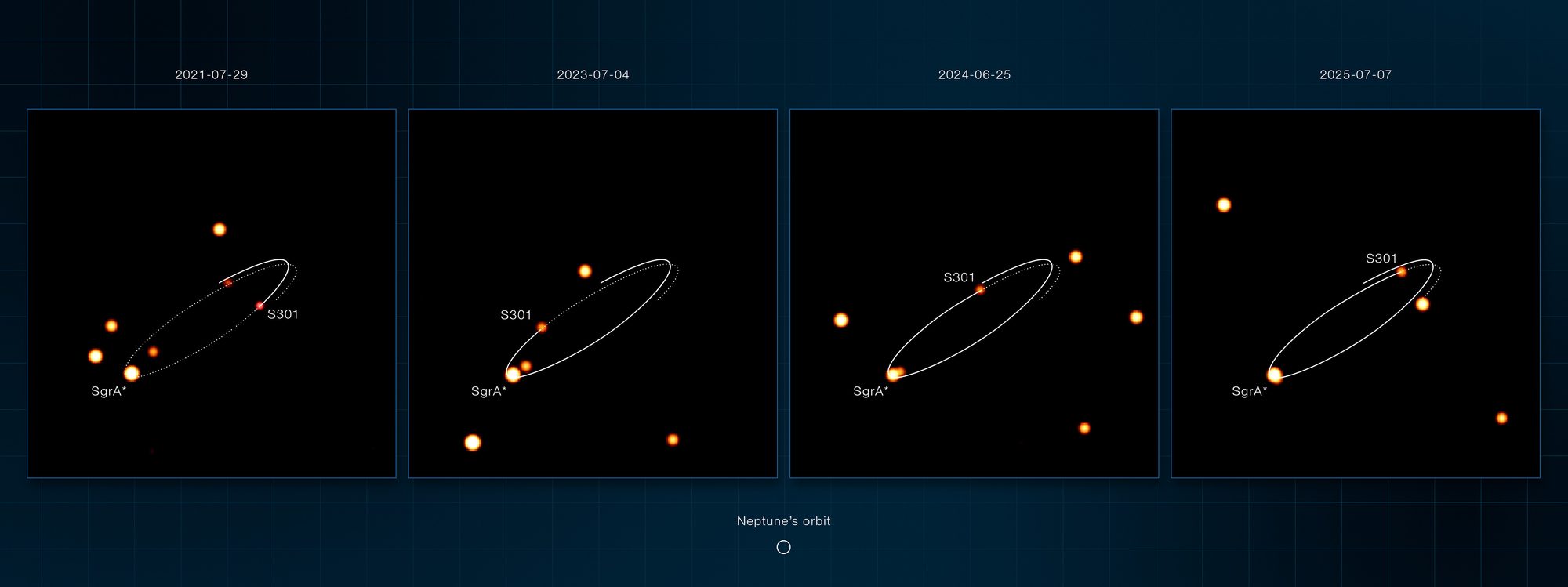
S301 orbits Sagittarius A*, the supermassive black hole at the centre of the Milky Way, which has about four million times the mass of the Sun. Its orbit is a long, stretched ellipse that takes 8.7 years to complete.
At its closest, it passes just 1.78 billion km from the black hole. That is around 12 times the distance from Earth to the Sun, and only about 20% more than the distance from the Sun to Saturn. No star has been seen closer. Its top speed comes only around that closest point: the last pass was in early 2023, and the next is due in 2031.
03A very hard star to see
S301 appears two billion times fainter than Betelgeuse, the orange star in Orion. To find it, the team used ESO's Very Large Telescope Interferometer in Chile, which combines the light of four 8-metre telescopes into a virtual telescope with 15 times the resolution of one alone. They first glimpsed S301 in spring 2023 and traced its orbit back through older data to 2017.
Stars can't form that close to a black hole. ESO says S301 was likely one of a pair of stars torn apart by the black hole's pull: S301 was trapped in orbit, and its companion was flung away.
04Where Einstein comes in
This close to a black hole, Einstein's relativity matters. Strong gravity and high speed both make a clock tick slower than one far away, and astronomers have already measured these effects in the light of stars near Sagittarius A*. When the star S2 made its 2018 close pass, the black hole's gravity shifted the lines in its light by the equivalent of about 200 km/s, according to the Nature paper.
How big is the effect for S301? Using ESO's speed and distance, the black hole's mass and the standard formulas from relativity, our own estimate is that at its closest pass S301's clock falls behind a distant clock by about 25 seconds every hour, roughly half from its speed and half from the black hole's gravity. That is our calculation, not a figure from the research team.
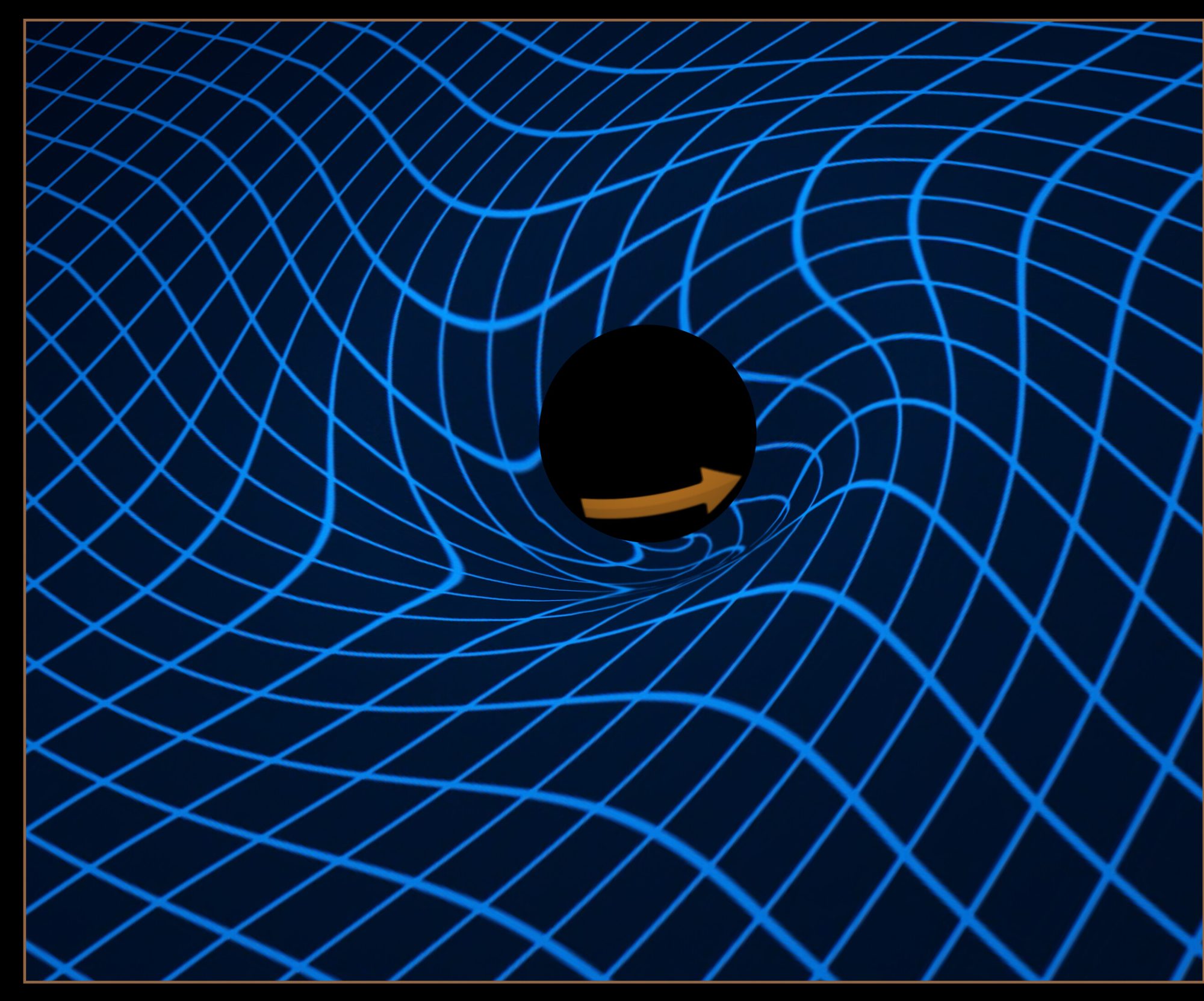
The team is after something bigger. A spinning black hole drags space around with it, and that should slowly twist S301's orbit. "With this star we hope to measure, within the next 10 years, the spin of the black hole," said Felix Mang, a PhD student at the Max Planck Institute for Extraterrestrial Physics and author of the study. ESO says following at least two full orbits, with GRAVITY+ and later an instrument on its Extremely Large Telescope, should pin the path down well enough to measure the spin directly.
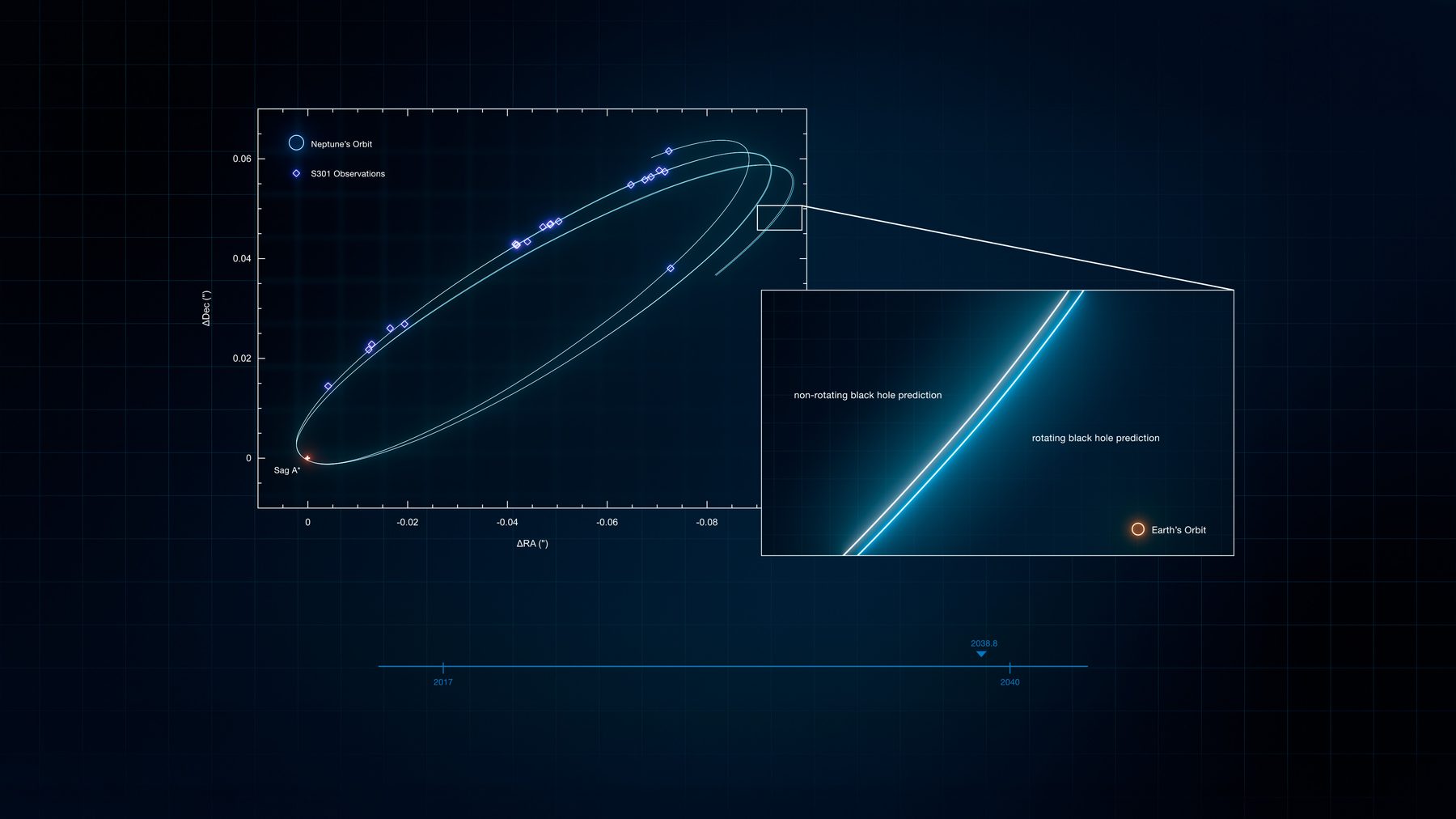
One faint star, 8.7 years per lap, could tell us how fast the Milky Way's black hole spins.
Sources
- Milky Way's fastest star orbits our supermassive black hole so closely it feels its spin (eso2612), ESO
- Discovery of a star sensitive to the spin of Sagittarius A*, Nature (GRAVITY+ Collaboration)
- A record-breaking star could reveal how the Milky Way's giant black hole spins, Science News
- Earth's Moon: facts, NASA
- Usage of images, videos, music and web texts, ESO
Written by Facts Nero from the script of our video. Claims were checked against the sources above on 25 October 2026. Corrections to the video: S301 reaches its top speed only near its closest approach to the black hole (last in early 2023, next in 2031), not "right now"; 25,000 km/s is about 56 million mph rather than "over" 56 million; and the 25-seconds-an-hour figure is our own estimate, not one published by the research team.
More from Facts Nero
-
 Short · 63 sNASA, ESA, CSA, STScI
Why is space black if there are billions of stars?
Every direction should end on a star. Two things hide that light from your eyes.
UniverseRead · 2 minWatch ▶ -
 Short · 31 sNASA/JPL-Caltech
Where is Voyager 1 right now?
About 26 billion kilometres out, past the Sun's wind, with two instruments still running.
Space probesRead · 7 minWatch ▶