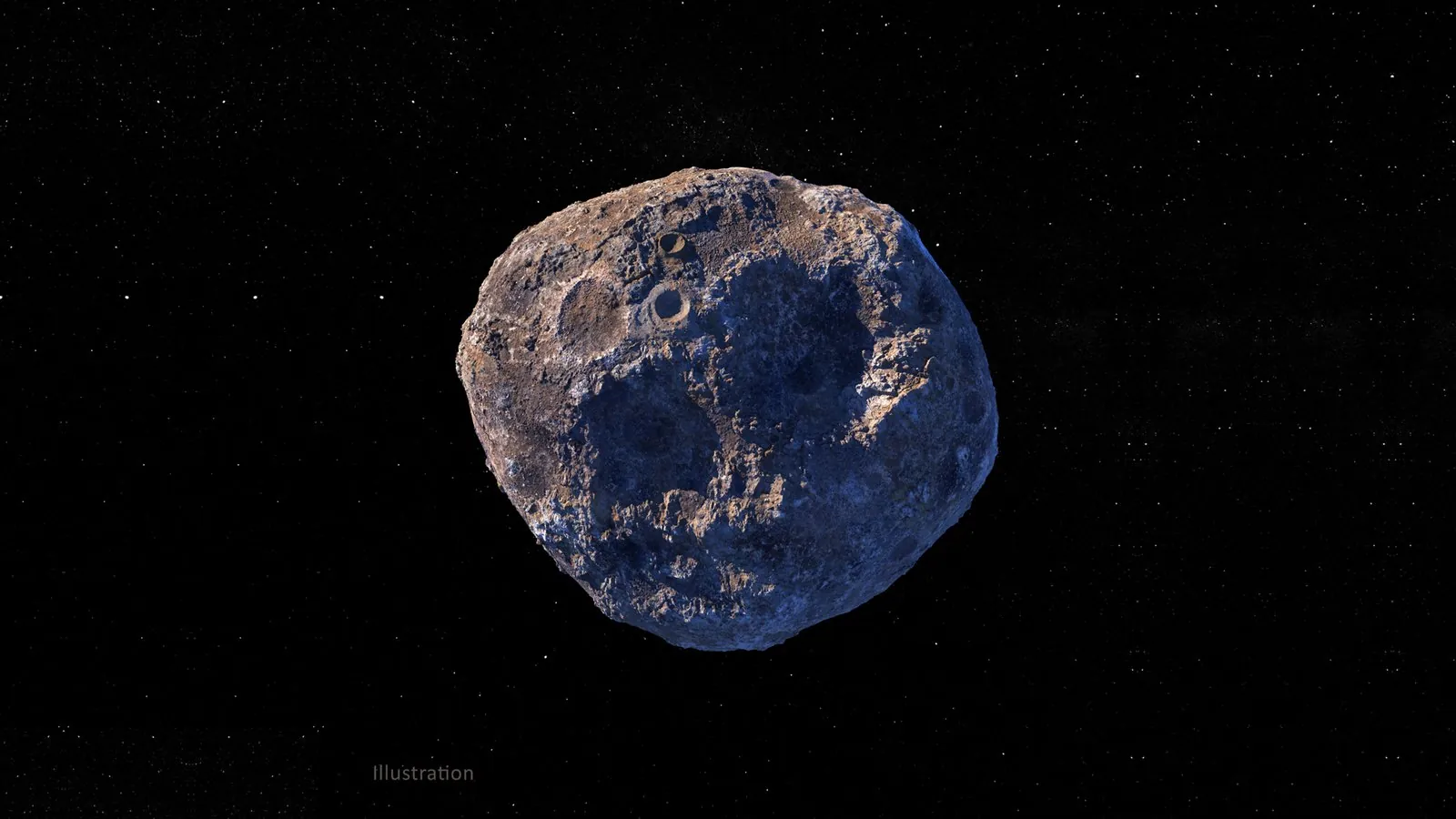
NASA's Psyche spacecraft has put its foot down. In an update on 22 October 2026, NASA said that on 28 September the spacecraft began running its electric thrusters almost continuously, pausing just once a week to check in with Earth. "It's now 'pedal to the metal' to the asteroid Psyche," said navigation lead Don Han of NASA's Jet Propulsion Laboratory. NASA says the thrusters will run nearly 90% of the time until the spacecraft arrives.
The target is the asteroid Psyche, one of the largest objects in the main asteroid belt between Mars and Jupiter. Arrival is planned for summer 2029; NASA's earlier updates, and the Southwest Research Institute, give August 2029.
01A slingshot from Mars
Psyche launched on 13 October 2023. For its first years it used its thrusters only now and then, to line up a close pass of Mars. On 15 May 2026 it flew within 4,609 km of the Martian surface. NASA says Mars's gravity added about 1,000 miles per hour (about 1,600 km/h) to its speed and tilted its orbit by about 1 degree, without using any propellant.
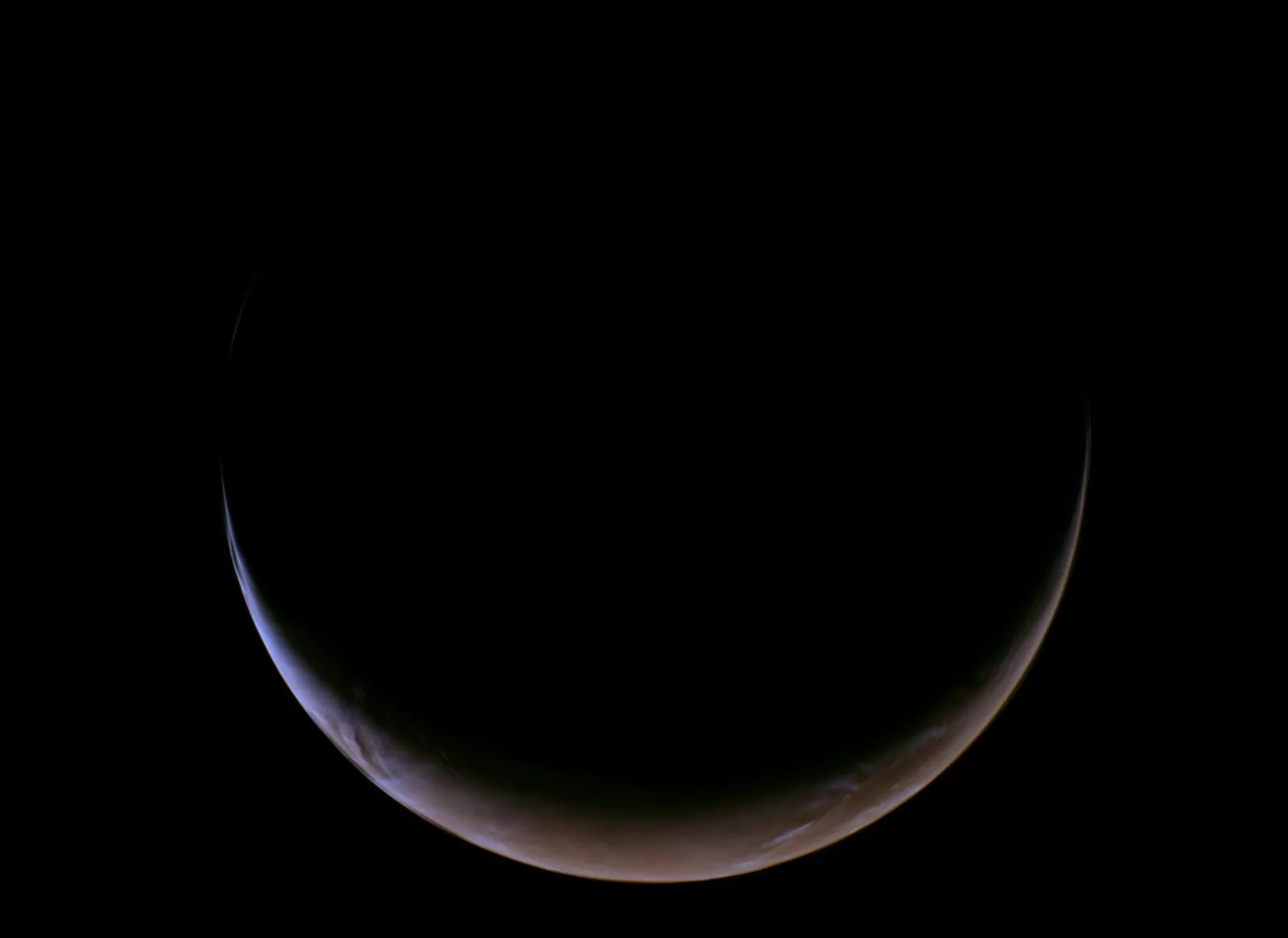
The flyby was also a rehearsal. All of Psyche's instruments were switched on to calibrate them against a well-known planet. The cameras took thousands of images, including an unusual thin crescent Mars, because the spacecraft came in from the planet's night side.
02A push the weight of an AA battery
Psyche does not burn fuel like a rocket. It uses Hall-effect thrusters, which use electric and magnetic fields to fire charged atoms of xenon gas out the back, with a blue glow. Solar panels with about 75 square metres of collecting area provide the electricity. NASA says the thrust is at most 250 millinewtons, about the force you feel holding one AA battery.
That push is tiny, but it never stops. NASA says that at top cruise speed the spacecraft will be moving at more than 100,000 miles per hour (about 160,000 km/h) relative to Earth. It launched with about 1,090 kg of xenon and, according to NASA, has used about a third of it so far.
Running on sunlight has a catch. NASA says the thrusters will run at full power for about three more months, then gradually drop to about half power as the spacecraft moves farther from the Sun and its panels collect less light.
03The world it is heading for
Asteroid Psyche was discovered in 1852 by the Italian astronomer Annibale de Gasparis, and it is not small. Measurements published in 2021 by Michael Shepard and colleagues give a size of about 278 × 238 × 171 km, about 222 km across on average. NASA quotes about 280 km at its widest. It orbits the Sun every five years or so, at an average of 2.9 times Earth's distance from the Sun (data from NASA JPL's Small-Body Database).
NASA says Psyche is thought to be the partial core of a planetesimal, a building block of an early planet, whose rocky outer layers were stripped off. If so, it would be a rare chance to see something like the metal core hidden deep inside Earth.
04How metal is it really?
Probably less than its nickname suggests. Psyche used to be seen as almost pure metal. In a 2020 review, the mission's principal investigator Lindy Elkins-Tanton and colleagues wrote that newer density, radar and spectral data point to "a mixed metal and silicate world", with roughly 30 to 60% metal by volume.
The latest density estimate, from Davide Farnocchia and colleagues in 2024, is about 4.2 grams per cubic centimetre. That is denser than ordinary rock but far below solid iron, which is about 7.9.
There is another puzzle. In 2024, a team led by Stephanie Jarmak used the James Webb Space Telescope to find signs of hydroxyl, and possibly water, in minerals on Psyche's surface. The team says this could have been delivered by other asteroids hitting Psyche. But if it is native, Psyche may not be a stripped core at all and may have formed farther from the Sun before moving inward. The spacecraft's magnetometers, cameras and gamma-ray and neutron spectrometer are designed to settle questions like these.
05What happens next
When it arrives, the spacecraft will go into orbit around Psyche and map it from a series of orbits at different heights during a prime mission of about two years, according to NASA. For now, it just keeps thrusting.
ENDSources
- Pedal to the Metal: NASA's Psyche Heads Toward Asteroid Belt (22 October 2026), NASA
- NASA's Psyche Mission Aces Mars Flyby, Targets Metal-Rich Asteroid (19 May 2026), NASA / JPL
- SwRI-led team finds evidence of hydration on Psyche (13 August 2024), Southwest Research Institute
- Jarmak et al., Estimate of Water and Hydroxyl Abundance on Asteroid (16) Psyche from JWST Data (2024), The Planetary Science Journal
- Elkins-Tanton et al., Observations, Meteorites, and Models: A Preflight Assessment of the Composition and Formation of (16) Psyche (2020), JGR Planets
- 16 Psyche: size (Shepard et al. 2021), density (Farnocchia et al. 2024) and orbit, NASA JPL Small-Body Database
- Horizons ephemeris for 16 Psyche, 29 October 2026, NASA JPL
- Asteroid Psyche, NASA
Written by Facts Nero from NASA's update of 22 October 2026 and the sources above, all checked on 29 October 2026. This is a written article with no video. Operational details (start of near-continuous thrusting, 90% thrusting time, 250 mN thrust, top speed, xenon use, power plans) come from NASA alone and are attributed to it. The Mars flyby figures are NASA's. NASA gives the asteroid as about 280 km at its widest and the Southwest Research Institute as about 226 km across; we use the measured shape from Shepard et al. (2021) via JPL. The density is Farnocchia et al. (2024) via JPL; the iron comparison is the standard density of iron. The sky position and brightness are from JPL Horizons for 29 October 2026; the 1,000 mph and 100,000 mph figures were converted to km/h by us.