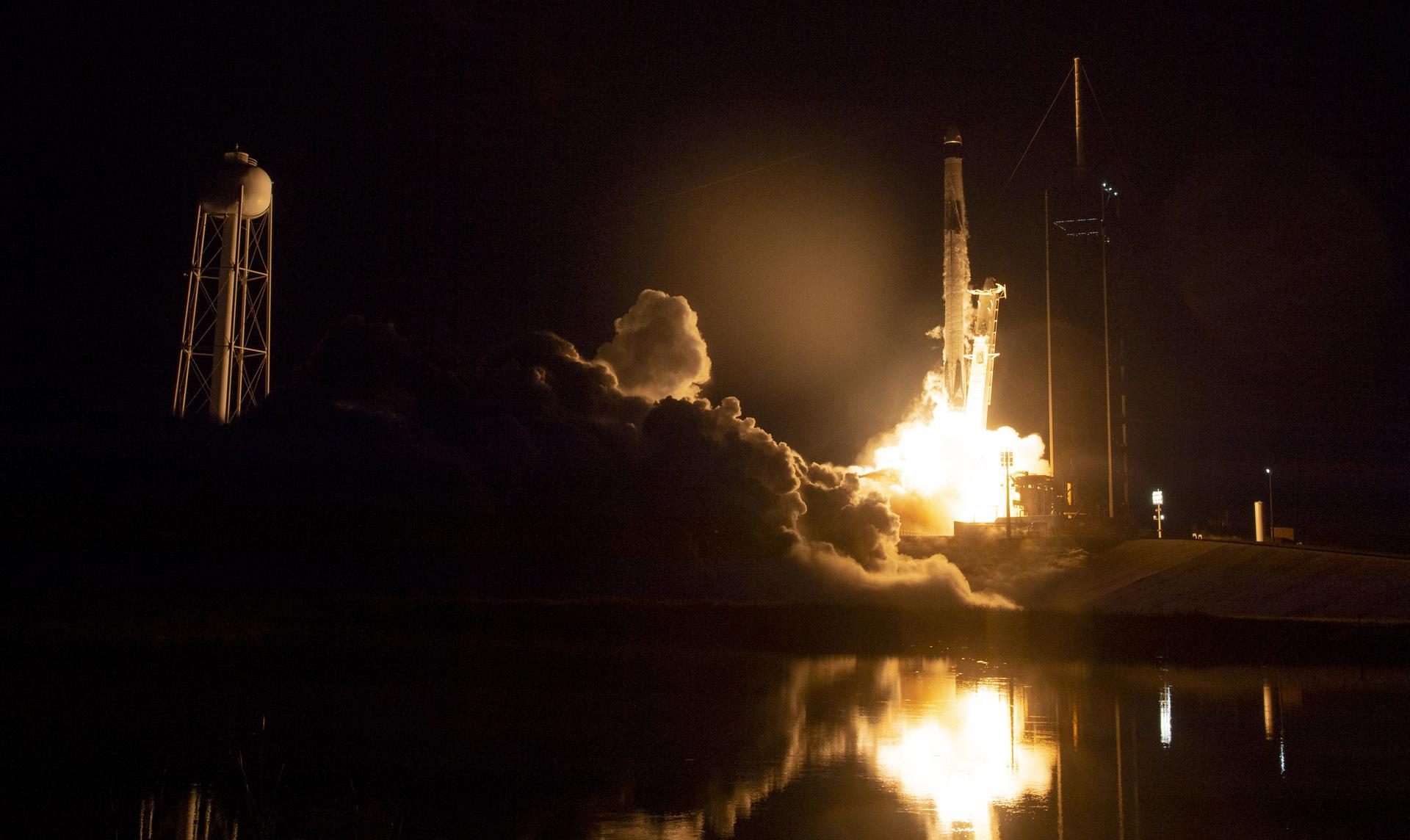
Why rocket flames almost vanish in space
On the launch pad a rocket rides a pillar of fire. Higher up, the engine is still firing, but the flame fades to almost nothing. Two things explain it: air and oxygen.
Watch a rocket launch and it climbs on a column of bright orange fire. Watch the camera on the upper stage a few minutes later and there is hardly any flame at all. The engine hasn't shut off. What has changed is the air around it.
01Air squeezes the flame
A rocket nozzle pushes hot gas out against whatever pressure surrounds it. At sea level, the atmosphere presses in on the exhaust and holds it in a tight, bright column. As the rocket climbs, that outside pressure drops. In a propulsion course by Rick Ballard, liquid engine systems lead for SLS at NASA's Marshall Space Flight Center, the pressure in space "is assumed to be zero", which is also why an engine's thrust is higher in a vacuum than at sea level.
When the gas leaving the nozzle is at a higher pressure than its surroundings, the course says the plume "will continue to expand after exiting the nozzle". In a vacuum nothing pushes back at all, so the exhaust spreads out very wide. The same hot gas is spread through a far bigger volume, and it gets too thin to glow brightly.
02Kerosene engines run fuel-rich
Engines that burn kerosene (RP-1) with liquid oxygen don't burn all of their fuel. They are deliberately run fuel-rich, with less oxygen than it would take to burn everything. Ballard's course explains that a mix that burns everything "does not necessarily provide an optimized Isp", the standard measure of an engine's efficiency. In kerosene engines with a gas generator, the fuel-rich exhaust from the turbine that drives the pumps lowers the overall mix further, to an oxygen-to-fuel ratio of about 2.0 to 2.2 by mass, according to the RocketCEA engineering documentation.
03The orange fire is leftover fuel burning in air
A 1967 study for NASA's Marshall Space Flight Center described what happens next, using the Saturn V's kerosene-burning F-1 engine. Its exhaust is "in general fuel rich" and full of tiny carbon (soot) particles. It is still near 2,000 kelvin, hot enough for the outer layers of the plume to "mix and burn with the surrounding air". That burning soot glows, and it is a big part of the orange fire you see at launch.
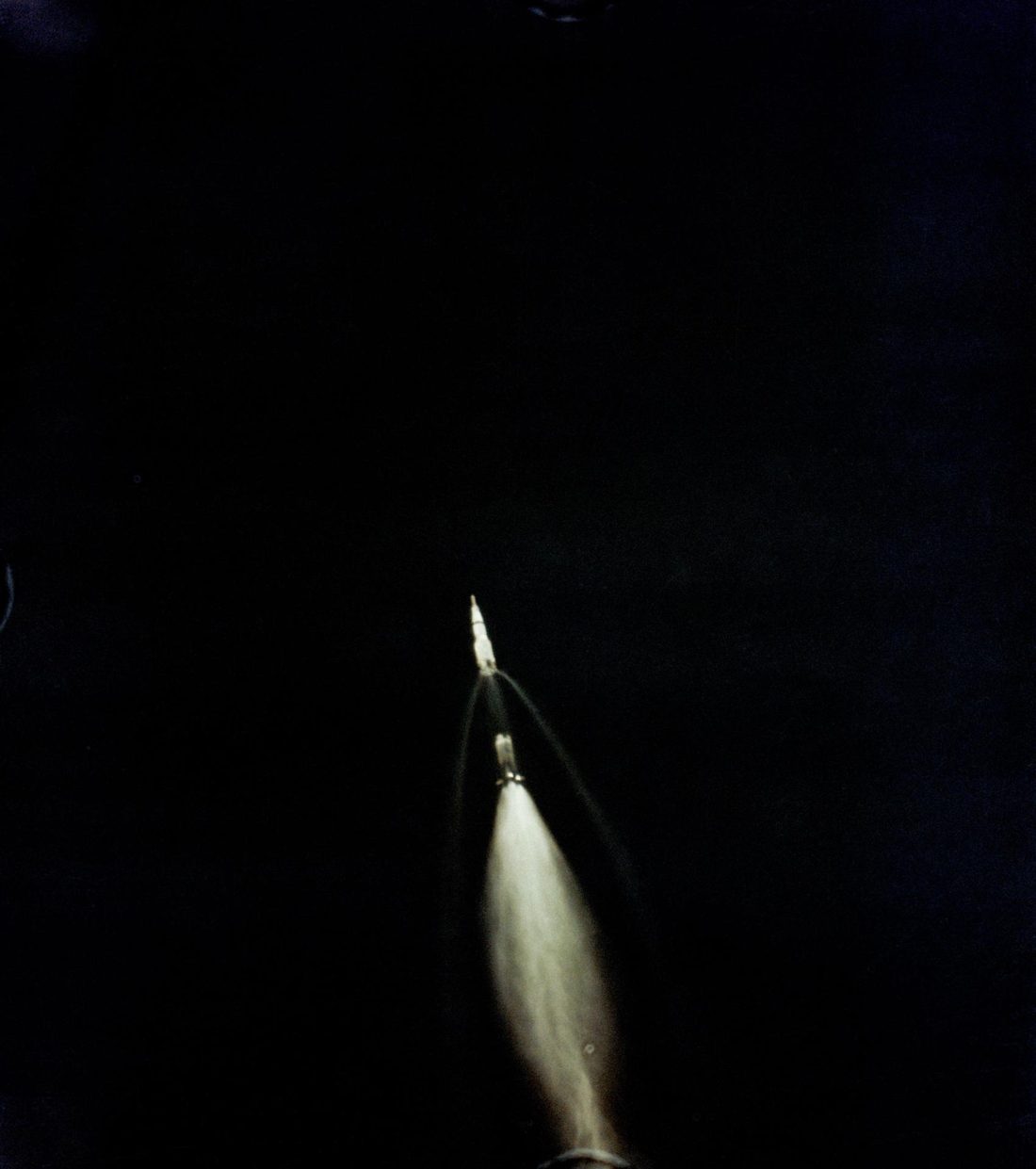
Higher up, there is less and less air for that leftover fuel to burn with. Engineers call the result afterburning cessation: in a study published in the AIAA's Journal of Propulsion and Power, the afterburning in fuel-rich rocket plumes stops as the rocket gains altitude.
04Faint, not gone
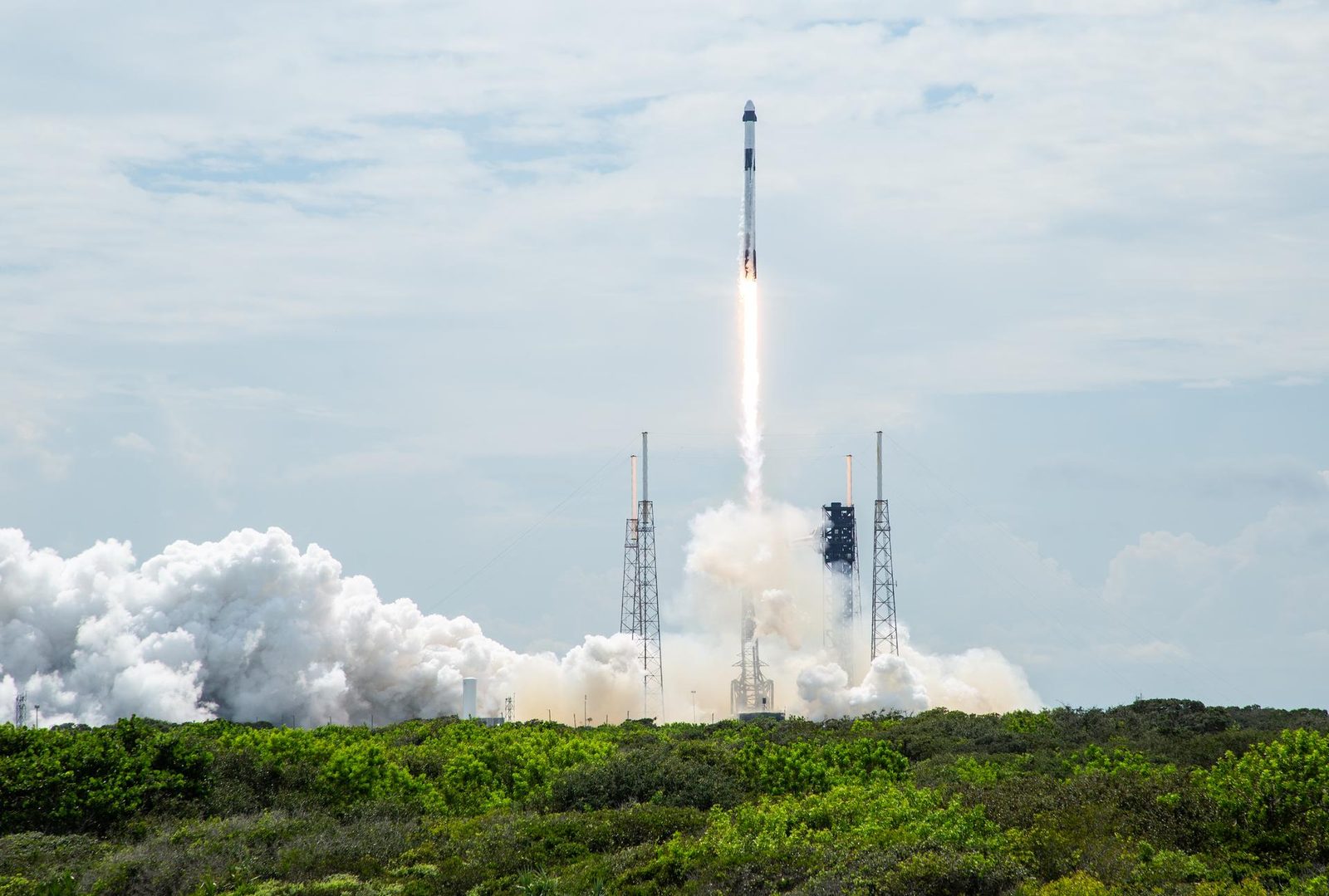
The flame doesn't vanish completely. It fades to a thin, faint plume that cameras can still pick up. And the engine up there is often not the same one that left the pad. Upper stages fly vacuum versions with much bigger nozzles: Ballard's course notes that for in-space engines, the nozzle is made as large as weight and space limits allow. It is the same kind of engine, not always the same one.
The engine hasn't shut off. The air around it has gone.
Next time you watch a launch, look for the moment the flame starts to fade. At what second does it go?
Sources
- Liquid Propulsion Systems: Evolution and Advancements, module 1, Rocket Propulsion Fundamentals (R. Ballard), NASA Marshall Space Flight Center via NTRS
- The effect of mixing, radiation, and finite rate combustion upon the flow field and surroundings of the exhaust plumes of rocket engines burning RP1 (kerosene) and liquid oxygen (1967), General Applied Science Laboratory for NASA MSFC
- Computational Assessment of Afterburning Cessation Mechanisms in Fuel-Rich Rocket Exhaust Plumes, AIAA Journal of Propulsion and Power
- NASA's Commercial Crew Partners: SpaceX spacecraft and vehicle guide (Falcon 9 propellant: LOX and RP-1), NASA
- Engine Mixture Ratio, RocketCEA documentation
- Apollo 11 staging photographed from an EC-135N aircraft (S69-39958), NASA
- NASA's SpaceX Crew-9 Launch, NASA
- SpaceX Crew-3 Launch, NASA
Written by Facts Nero from the script of our video. Claims were checked against the sources above on 25 October 2026. Two small corrections to the video: upper stages usually fly a vacuum version of the engine, so it is the same kind of engine rather than the same one, and the flame fades to a faint plume rather than disappearing completely.
More from Facts Nero
-
 Short · 65 sNASA
NASA's nuclear spaceship is heading to Mars
SR-1 Freedom uses a small reactor to power electric thrusters. Launch is planned for late 2028.
SpacecraftRead · 2 minWatch ▶ -
 Long video · 10 minNASA/Bill Stafford
Why Artemis III won't land on the Moon
Four astronauts, three heavy-lift rockets and test versions of two Moon landers, all in Earth orbit.
MissionsRead · 7 minWatch ▶