NASA confirms UVEX, its ultraviolet sky-mapper, for launch by 2031
NASA has confirmed UVEX, a $590 million telescope that will map the whole sky in ultraviolet light and chase neutron-star collisions. What the review means, and what UVEX will do.
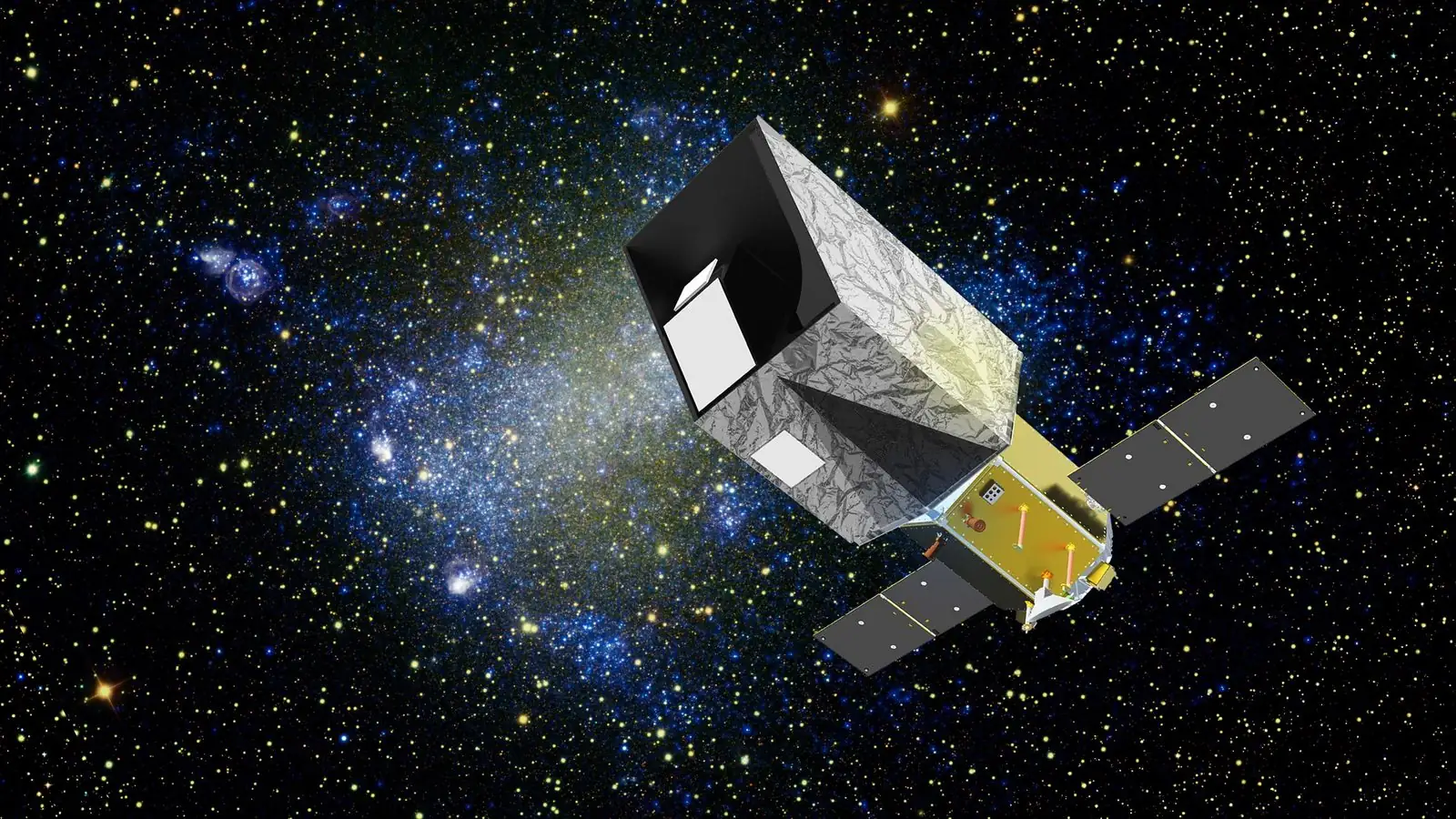
NASA has confirmed its next ultraviolet space telescope. On 27 October 2026, the agency said UVEX, the UltraViolet EXplorer, had passed a review called Key Decision Point C. With that, NASA commits to launching UVEX by January 2031, for a total lifecycle cost of $590 million.
UVEX will survey the entire sky in ultraviolet light, to show how stars and galaxies evolve. It will also be able to turn quickly towards the flash of light that follows a burst of gravitational waves from colliding neutron stars.
01What "confirmed" means
Every NASA project passes a series of key decision points. At KDP-C, a project shows that its preliminary design meets its requirements and that its cost and schedule plans are complete. If it passes, it moves into Phase C: final design and fabrication, when the hardware is designed in detail and built.
KDP-C is also when NASA puts a price and a date on the record. Under NASA's own rules, for any project costing $250 million or more, the cost and schedule set at KDP-C become the Agency Baseline Commitment, NASA's official commitment to the White House budget office and to Congress. For UVEX, that is $590 million and a launch by January 2031. The University of Maryland, whose astronomer Suvi Gezari leads the mission's science on cosmic explosions, says the team "will now move from planning to building".
02A launch date that has moved
UVEX has been in NASA's plans since 2022. In August 2022, NASA picked it and another proposal, an X-ray mission called STAR-X, for nine-month concept studies, and said the winner would be targeted for launch in 2028.
When NASA chose UVEX on 13 February 2024, as its next Astrophysics Medium-Class Explorer, the target had become 2030. A NASA spokesperson, Alise Fisher, told SpaceNews that the delay gave UVEX "an extended phase B to accommodate budget challenges within the Astrophysics Division portfolio". The new commitment, by January 2031, is later again. NASA's announcement does not say why.
The cost figures are not like for like. In 2024, NASA said UVEX would cost about $300 million, not including launch, the cap for this class of mission. The $590 million figure is the total lifecycle cost. NASA's announcement does not break the $590 million down, so the two numbers cannot be compared directly.
03The first deep ultraviolet map of the whole sky
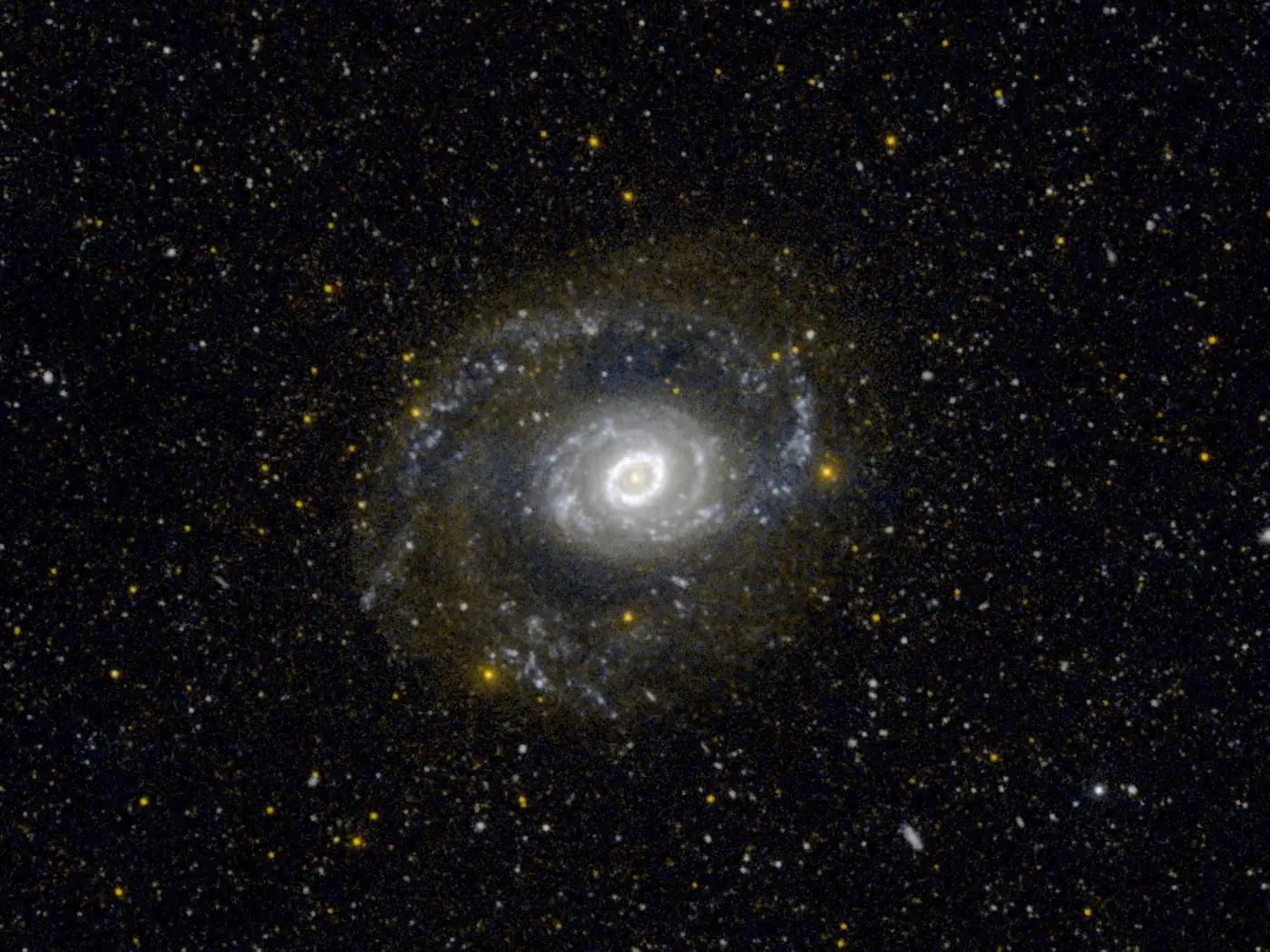
Earth's atmosphere absorbs much of the ultraviolet light coming from space, so ultraviolet astronomy is done from orbit. According to the University of Maryland, the last NASA mission to image large parts of the sky in the ultraviolet was GALEX, the Galaxy Evolution Explorer. It launched on 28 April 2003 and was switched off in June 2013. Like UVEX, it was led by Caltech.
UVEX will be far more sensitive. The team's science paper says its all-sky survey will go 50 to 100 times deeper than GALEX, and Caltech says it will be the first telescope to make deep maps of the entire sky in ultraviolet light. According to the paper, the design has a telescope with an effective aperture of 75 cm that images two ultraviolet bands at once, far and near ultraviolet, plus a long-slit spectrograph that splits light into its wavelengths. The survey is built up from repeated visits to each patch of sky over the two-year prime mission.
The detectors are a big part of the jump. According to Caltech, they are based on the CMOS imaging technology now found in billions of smartphone cameras, modified at NASA's Jet Propulsion Laboratory to sense ultraviolet light. Caltech, SRI International and JPL will build them together.
UVEX will not orbit close to Earth. The team plans to place it in a highly elliptical orbit like that of NASA's TESS planet-hunter, in step with the Moon. The team says this orbit keeps the background low and steady and lets the telescope spend more of its time observing.
04Millions of tiny galaxies
One of UVEX's main targets is small, faint galaxies nearby. In visible light, "it's very hard to distinguish these nearby galaxies from faraway ones that look similar," Fiona Harrison, the mission's principal investigator at Caltech, said in Caltech's announcement. "Ultraviolet light will make them easier to find." Caltech and the University of Maryland both say the team expects to find millions of them.
These galaxies are low in heavy elements, which makes them a nearby stand-in for the first galaxies. NASA's James Webb Space Telescope sees galaxies like this billions of light-years away, but their ultraviolet light has been stretched into the infrared on the way. UVEX will see the nearby versions in the ultraviolet itself.
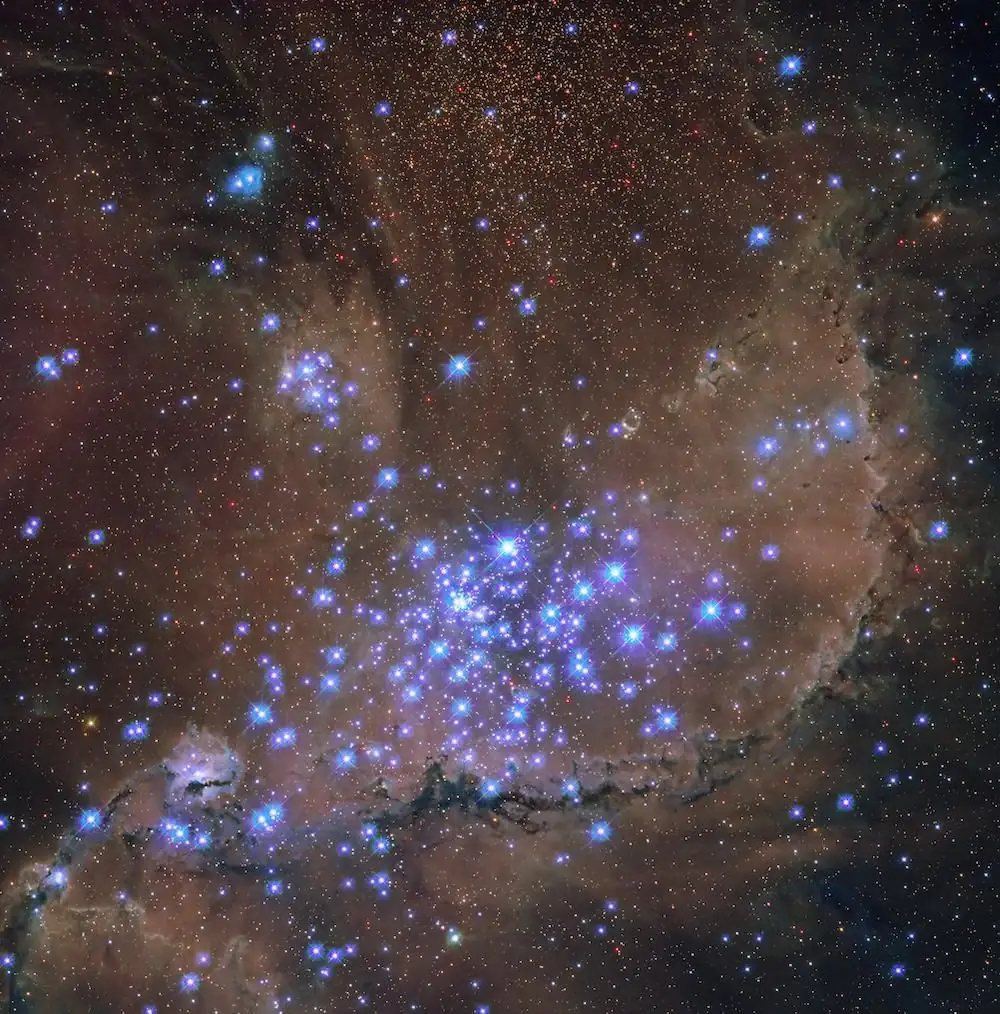
The Small and Large Magellanic Clouds, two small galaxies that orbit the Milky Way, are also on the list. The team plans repeated surveys of both to study hot, massive stars. Kareem El-Badry, a Caltech astronomer on the team, expects UVEX to turn up "stripped" stars, which have had their outer layers pulled off by a companion star. "We only know of a small number of stripped stars of this type now," he said. "UVEX will find hundreds."
05Chasing neutron-star collisions
In August 2017, the gravitational-wave detectors LIGO and Virgo picked up two neutron stars spiralling together and merging, an event called GW170817. Dozens of telescopes then watched the glow of the blast, known as a kilonova, from gamma rays to radio waves.
Hubble "cannot rapidly pivot to observe real-time events". UVEX is built to.
UVEX is designed to catch this kind of event in the ultraviolet within hours of an alert. Its spectrograph will also take spectra of young supernovae, whose ultraviolet light is brightest in the first hours to days. "I can count on two hands how many spectra we have of transient events in their infancy phase with the Hubble Space Telescope," said Mansi Kasliwal, a Caltech astronomer on the team. Hubble, she said, "cannot rapidly pivot to observe real-time events". The team's design paper puts the average response time to a new target at under three hours.
06Who is building it
Fiona Harrison is also the principal investigator of NASA's NuSTAR X-ray telescope, launched in 2012. UC Berkeley's Space Sciences Laboratory manages UVEX, Northrop Grumman is building the spacecraft, and the Space Dynamics Laboratory is also a partner. JPL provides key detector technology, and Caltech's IPAC will process and archive the data. NASA's announcement does not name a launch rocket.
The next big step for UVEX is building the hardware. NASA says that, together with other wide surveys such as its Nancy Grace Roman Space Telescope, UVEX will help build a modern map of the universe across different wavelengths of light.
Sources
- NASA's UVEX Space Telescope Successfully Passes Key Milestone (27 October 2026), NASA
- Post announcing UVEX's confirmation (27 October 2026), NASA Science on X
- Caltech Leads NASA Mission to Make the First Deep Ultraviolet All-Sky Maps, Caltech
- $590M Telescope Mission with UMD Science Co-Lead Confirmed by NASA for Launch by January 2031, University of Maryland Department of Astronomy
- New NASA Mission will Study Ultraviolet Sky, Stars, Stellar Explosions (13 February 2024), NASA
- New Caltech-led Mission Will Study Ultraviolet Sky, Stars, Stellar Explosions, Caltech
- NASA selects ultraviolet astronomy mission but delays its launch two years, SpaceNews
- NASA Selects Proposals to Study Stellar Explosions, Galaxies, Stars (2022), NASA
- Systems Engineering Handbook 3.0: NASA Program/Project Life Cycle, NASA
- NPR 7120.5F, Chapter 2 (Agency Baseline Commitment), NASA
- Kulkarni, Harrison et al., Science with the Ultraviolet Explorer (UVEX), arXiv
- UVEX: The Ultraviolet Explorer, briefing to the Astrophysics Advisory Committee, March 2024 (PDF), NASA / UVEX team
- UVEX: The Ultraviolet Explorer (mission website), Caltech
- Galaxy Evolution Explorer (GALEX), NASA Jet Propulsion Laboratory
- NASA Decommissions Its Galaxy Hunter Spacecraft, NASA
- Ultraviolet Waves, NASA Science
- Ultraviolet Ring of Stars (PIA17245), NASA/JPL-Caltech
Written by Facts Nero from NASA's announcement of 27 October 2026 and the sources above, all checked on 28 October 2026. Telescope specifications (aperture, survey depth, orbit, response time) are from the team's published design and may change as the hardware is built. The 2024 cost (about $300 million, excluding launch) and the 2026 cost ($590 million, total lifecycle) are measured differently and are not a like-for-like comparison.
More from Facts Nero
-
 Short · 71 sESO/M. Kornmesser
S301: the fastest known star in the Milky Way
25,000 km/s, more than 8% of the speed of light, on an 8.7-year orbit around our galaxy's black hole.
UniverseRead · 4 minWatch ▶ -
 Short · 63 sNASA, ESA, CSA, STScI
Why is space black if there are billions of stars?
Every direction should end on a star. Two things hide that light from your eyes.
UniverseRead · 2 minWatch ▶