Gaia-Enceladus: the galaxy the Milky Way swallowed
About 10 billion years ago a galaxy roughly the size of a Magellanic Cloud fell into the young Milky Way. Gaia found its leftover stars in 2018, and its core may still be visible to the naked eye.
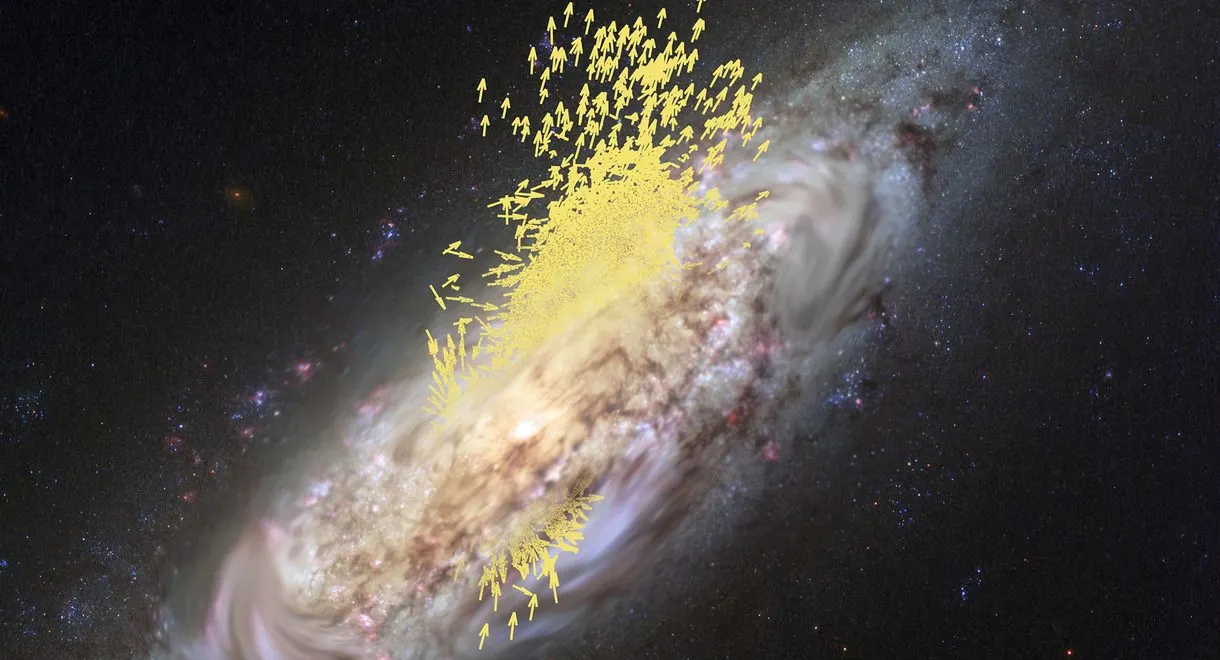
Almost all the stars in the Milky Way's disc, the Sun included, go around the centre in the same direction. So when astronomers find a crowd of stars doing something else, they want to know where those stars came from.
In 2018, data from ESA's Gaia spacecraft gave the answer for one large crowd. About 10 billion years ago, according to ESA, the young Milky Way merged with another galaxy. That galaxy was torn apart, and its stars are still all around us.
01Thirty thousand odd stars
Gaia measured the position, movement and brightness of stars more precisely than any mission before it. Using its first 22 months of observations, a team led by Amina Helmi of the University of Groningen in the Netherlands looked at about seven million stars whose full 3D positions and velocities were known.
Some 30,000 of them stood out. ESA describes them as an "odd collection" moving on elongated paths in the opposite direction to most of the Milky Way's stars. In the team's paper in Nature, the group's motion is "slightly retrograde": going the other way, but only just. These stars also sat in a different place on a plot of colour against brightness, a sign that they had a different history and chemistry.
The pattern looked familiar to Helmi. According to the University of Groningen, it reminded her of computer simulations run about ten years earlier by a former PhD student, of a large disc-shaped galaxy merging with the young Milky Way. The stars those simulations produced were "totally in line with the Gaia data". "The collection of stars we found with Gaia has all the properties of what you would expect from the debris of a galactic merger," Helmi said in ESA's release.
02Or call it a sausage
A team in Cambridge, led by Vasily Belokurov, had reached a similar conclusion earlier that year by a different route. Their 2018 paper used Gaia and Sloan Digital Sky Survey data for stars within about 10 kiloparsecs (some 33,000 light years) of the Sun. When they plotted these halo stars' velocities, the metal-richer ones formed a long, stretched shape.
"We plotted the velocities of the stars, and the sausage shape just jumped out at us," said Wyn Evans of Cambridge's Institute of Astronomy. So it became the Gaia Sausage. The shape meant these stars move on very radial orbits, plunging in close to the centre of the galaxy and back out again. "The collision ripped the dwarf to shreds, leaving its stars moving on very radial orbits, like needles," Belokurov said. That is a sign, he added, that the dwarf galaxy came in on a very eccentric orbit. The paper argued the debris came from one big accretion event, not a steady trickle of small ones.
Helmi's team chose a grander name. In Greek mythology, Enceladus was one of the Giants, a child of Gaia (the Earth) and Uranus (the Sky). "According to the legend, Enceladus was buried under Mount Etna, in Sicily, and responsible for local earthquakes," Helmi said. "Similarly, the stars of Gaia-Enceladus were deeply buried in the Gaia data, and they have shaken the Milky Way." Many papers now combine the two names as Gaia-Sausage-Enceladus, or GSE.
03What the crash looked like
According to ESA, Gaia-Enceladus was about the size of one of the Magellanic Clouds, the two satellite galaxies visible from the Southern Hemisphere. Today those are roughly ten times smaller than the Milky Way. But the Milky Way was much smaller 10 billion years ago, so the ratio between the two was "more like four to one". In Helmi's paper, the galaxy was "slightly more massive than the Small Magellanic Cloud". The Cambridge team put its total mass in gas, stars and dark matter at more than 10 billion times that of the Sun. Their paper dated the event to between 8 and 11 billion years ago.
It didn't arrive alone. Helmi's team found hundreds of variable stars and 13 globular clusters, dense balls of up to millions of stars, following the same kind of paths as the Gaia-Enceladus stars. Separately, Belokurov's colleagues identified at least eight large globular clusters that they think the Sausage galaxy brought in, strung out "like beads on a chain" on highly eccentric orbits. Small galaxies don't normally have their own globular clusters, the Cambridge team pointed out, so this one must have been big.
The crash changed our galaxy too. The Milky Way's disc has two parts: a thin disc a few hundred light years deep, where the spiral arms are, and a thick disc a few thousand light years deep that holds about 10 to 20% of its stars. According to Helmi's team, the merger stars now make up most of the inner halo, the cloud of old stars around the galaxy, and the impact puffed up the disc that already existed, helping to form the thick disc.
04A naked-eye clock
How do you date something that happened 10 billion years ago? One answer is a single bright star, ν Indi (nu Indi), in the southern constellation Indus. It is bright enough to see with the naked eye.
In 2020, a team led by Bill Chaplin of the University of Birmingham used NASA's TESS satellite to measure the star's natural oscillations, a method called asteroseismology. That gave an age of 11.0 billion years, with an uncertainty of about a billion years either way. Gaia data showed that ν Indi was born in the Milky Way, but that its motion was later knocked about, "kinematically heated", by the Gaia-Enceladus collision.
"Since the motion of ν Indi was affected by the Gaia-Enceladus collision, the collision must have happened once the star had formed," Chaplin said. The team calculated that the earliest the merger could have begun was 11.6 billion years ago, with 68% confidence, or 13.2 billion years ago with 95% confidence.
05One galaxy, or several?
Not everyone thinks GSE was one galaxy. In 2023, Thomas Donlon and Heidi Jo Newberg of Rensselaer Polytechnic Institute in New York analysed the chemistry and motions of nearby halo stars from the APOGEE and GALAH surveys. They found trends that are "opposite to expectations for a single massive, ancient merger event". In their view, the stars usually counted as GSE are a mix of at least four components, from several radial mergers that happened at different times.
Other teams keep working with a single GSE galaxy, including the Omega Centauri study further down. So the question is still open. Different ways of picking out "GSE stars" can even pick out different mixtures of stars, Donlon and Newberg note, which is part of why the argument goes on.
06The heart you can see
In the southern sky there is a fuzzy patch called Omega Centauri. Ptolemy listed it as a single star nearly 2,000 years ago, and John Herschel recognised it as a globular cluster in the 1830s. ESA/Hubble calls it the largest and brightest globular cluster in the sky: about 10 million stars, roughly 10 times as massive as other big globular clusters, 17,700 light years away. From a dark site it looks almost as big as the full Moon, and you can see it without a telescope.
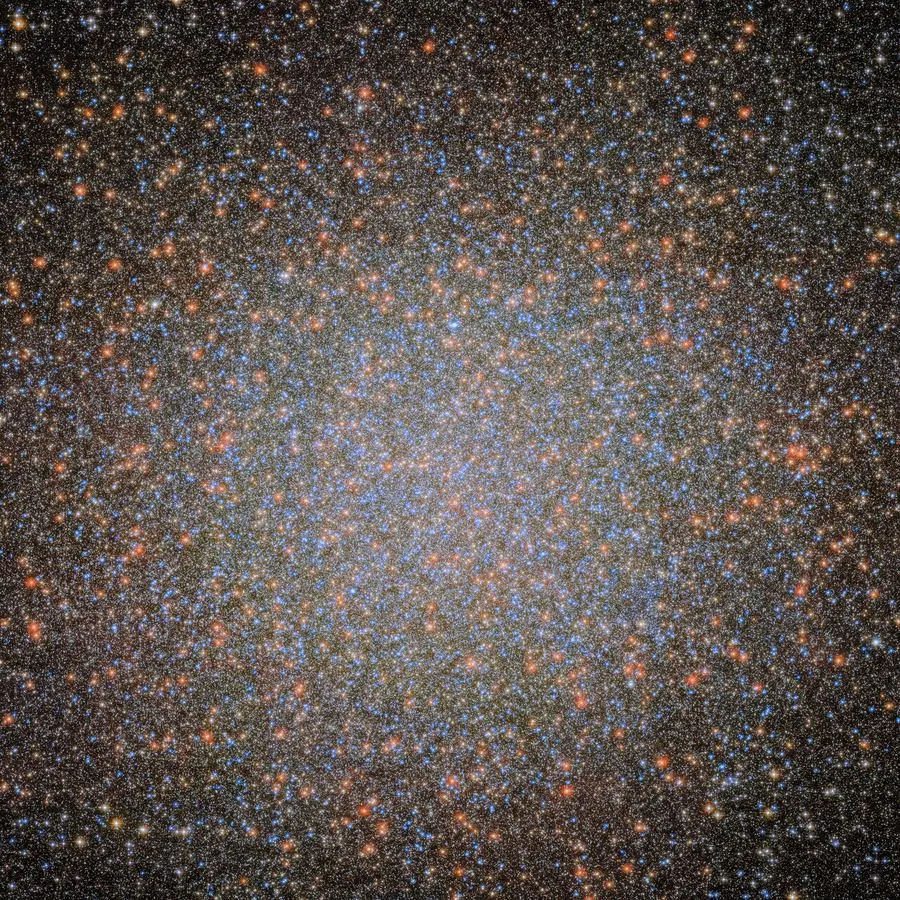
It doesn't behave like a normal globular cluster. It rotates faster and is highly flattened. Its stars also have a big spread in metal content, and an unusually large number of distinct sub-populations. Because of that, and its sheer mass, it has long been suspected to be the stripped nucleus of a dwarf galaxy that fell into the Milky Way long ago: the dense centre that survived after the rest was pulled away.
Which galaxy? One proposal is that Omega Centauri was the central star cluster of Gaia-Sausage-Enceladus, later knocked onto its current orbit by the Milky Way's central bar. A study led by Axel Mannu, posted in October 2026 and submitted to Monthly Notices of the Royal Astronomical Society, simulated that idea. It also found a trail of nitrogen-rich stars running from Omega Centauri towards the GSE debris, which the authors call "the best evidence yet" for the link. The study has not yet been peer reviewed. Other researchers have tied Omega Centauri to a different ancient merger: in 2019, Myeong and colleagues associated it with a smaller galaxy they named Sequoia.
If the GSE idea is right, people in the Southern Hemisphere can look up on a clear night and see the core of the galaxy the Milky Way swallowed.
07The next chapter: Gaia DR4
Gaia itself has stopped. On 27 March 2025, after more than a decade of work, ESA's control team switched off the spacecraft and sent it into a "retirement orbit" around the Sun.
Its data isn't finished. Gaia-Enceladus was found with 22 months of data. Gaia Data Release 4 will cover 66 months, the first 5.5 years of observations, with about twice as many observations as the last release. ESA says the Gaia archive will reopen with DR4 on 2 December 2026 at 12:00 CET.
The Milky Way isn't done merging, either. Mergers are still going on, the Cambridge team notes, such as the one between our galaxy and the much smaller Sagittarius dwarf galaxy.
The Milky Way you live in was shaped partly by the wreckage of another galaxy, and some of its stars are passing through our neighbourhood right now.
Would you go out to see Omega Centauri if you could?
Sources
- Galactic ghosts: Gaia uncovers major event in the formation of the Milky Way (31 October 2018), ESA
- Helmi et al. 2018, The merger that led to the formation of the Milky Way's inner stellar halo and thick disk, Nature 563, 85, ESA Science & Technology
- Astronomers discover the giant that shaped the early days of our Milky Way, University of Groningen
- The Gaia Sausage: the major collision that changed the Milky Way (4 July 2018), University of Cambridge
- The Gaia Sausage: The Major Collision That Changed the Milky Way Galaxy, Simons Foundation
- Belokurov et al. 2018, Co-formation of the disc and the stellar halo, arXiv
- Myeong et al. 2018, The Sausage Globular Clusters, arXiv
- TESS dates an ancient collision with our galaxy (13 January 2020), University of Birmingham
- Chaplin et al. 2020, Age dating of an early Milky Way merger via asteroseismology of the naked-eye star ν Indi, Nature Astronomy, University of Birmingham Research Portal
- Donlon & Newberg 2023, A Swing of the Pendulum: the chemodynamics of the local stellar halo indicate contributions from several radial merger events, arXiv / The Astrophysical Journal 944, 169
- Hubble finds strong evidence for intermediate-mass black hole in Omega Centauri (10 July 2024), ESA/Hubble
- NASA's Hubble Finds Strong Evidence for Intermediate-Mass Black Hole in Omega Centauri, NASA
- Häberle et al. 2024, oMEGACat II: photometry and proper motions for 1.4 million stars in Omega Centauri, arXiv
- Nitschai et al. 2024, oMEGACat III: metallicities reveal spatially well-mixed populations within ω Centauri's half-light radius, arXiv
- Mannu et al. 2026, Stirred, not shaken: dislodging ω Centauri from the Sausage galaxy through bar resonances (preprint), arXiv
- Myeong et al. 2019, Evidence for two early accretion events that built the Milky Way stellar halo, arXiv
- Farewell, Gaia! Spacecraft operations come to an end, ESA
- Gaia DR4 data sets preview (27 March 2025), ESA Gaia, Cosmos
- Gaia mission news: Gaia ESA Archive downtime ahead of DR4, ESA Gaia, Cosmos
- Gaia Data Release 4, ESA Gaia, Cosmos
Written by Facts Nero from the script of our video. Every claim was checked against the sources above on 26 October 2026. Corrections to the video: the merger was not strictly head-on (the stars are on very radial, needle-like orbits, and Helmi's paper calls the group's motion only "slightly retrograde"); the 11.6-billion-year limit from ν Indi is at 68% confidence (13.2 billion at 95%); the Mannu et al. Omega Centauri study is a preprint, not yet peer reviewed; and we dropped the claims that the galaxy "stopped making new stars" and that "most astronomers still favour the single-giant story", which we could not confirm in a primary source.
More from Facts Nero
-
 Short · 71 sESO/M. Kornmesser
S301: the fastest known star in the Milky Way
25,000 km/s, more than 8% of the speed of light, on an 8.7-year orbit around our galaxy's black hole.
UniverseRead · 4 minWatch ▶ -
 Short · 63 sNASA, ESA, CSA, STScI
Why is space black if there are billions of stars?
Every direction should end on a star. Two things hide that light from your eyes.
UniverseRead · 2 minWatch ▶