How many stars are in our galaxy? NASA's answer is 100 to 400 billion, and a figure of about 200 billion is often quoted. That is a wide range for a number scientists care about, and there is a good reason for it: nobody has counted them, and nobody can.
01Too many to count, even for Gaia
The best star-counter ever built is ESA's Gaia spacecraft. Between July 2014 and January 2025 it made more than three trillion observations of about two billion stars and other objects, measuring their positions, motions and brightness. Its 2022 data release lists about 1.8 billion sources.
Even that is a small fraction of the galaxy. Against NASA's estimate of 100 to 400 billion stars, two billion is somewhere between 0.5% and 2%, by our calculation. Most of the Milky Way's stars are too far away, too faint or too hidden for Gaia to see.
02We are inside it
Part of the problem is where we are. The Sun sits inside the Milky Way's flat disc, so we see the disc edge-on, as a band of light across the sky. It is like trying to work out the shape of a cloud while standing in the middle of it.
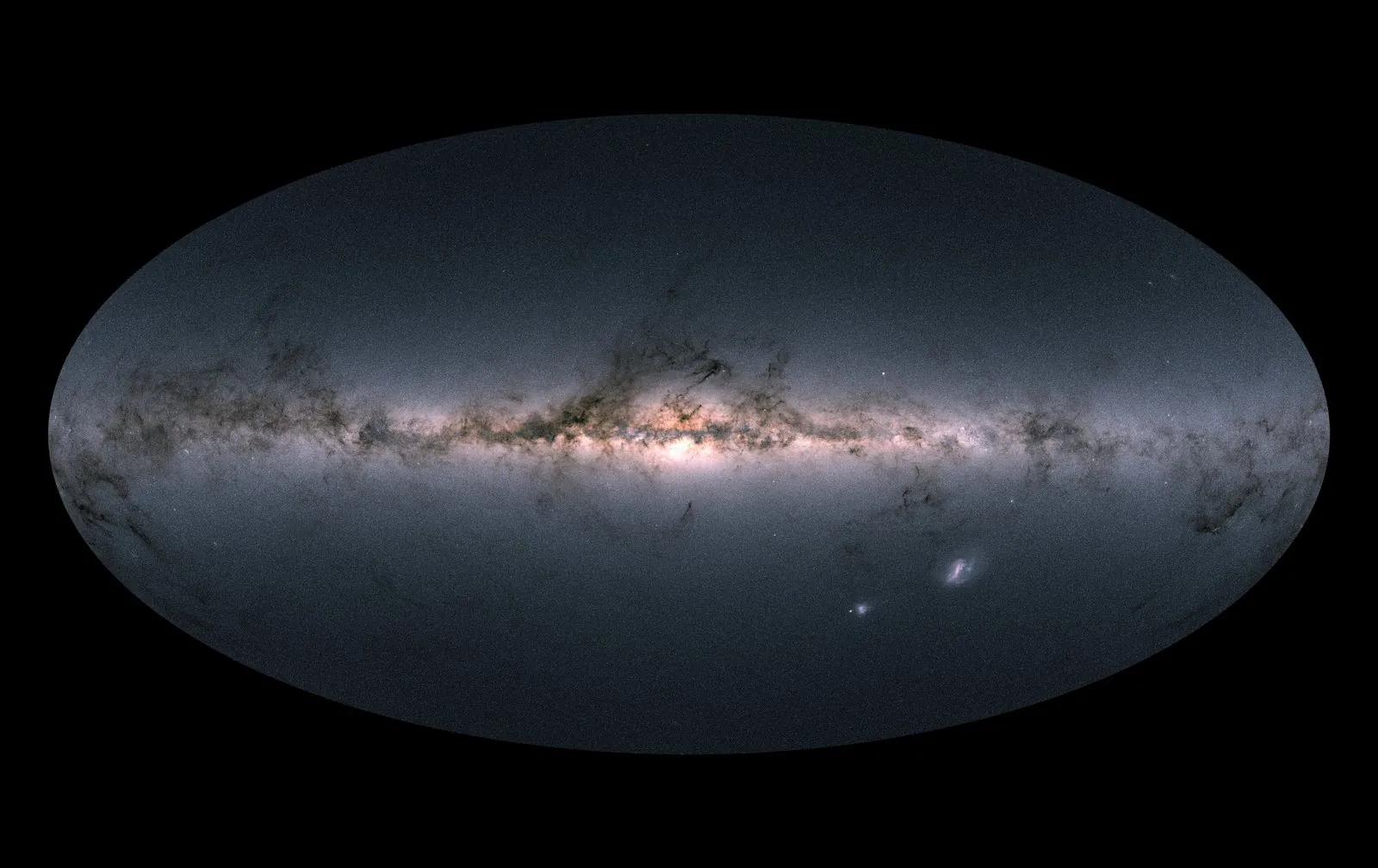
And the disc is dusty. In ESA's description of Gaia's all-sky map, at the top of this page, the darker regions along the bright band are clouds of gas and dust in the foreground, which absorb the light of the stars behind them. Many of those clouds hide places where new stars are being born.
03Weigh the galaxy, then divide
So astronomers estimate. A NASA explainer describes the basic method: work out the mass of the galaxy, work out how much of that mass is in stars, then divide by the mass of an average star.
Each step is hard. In 2019, astronomers used Hubble and Gaia to measure how fast globular star clusters move around the galaxy, and put the Milky Way's total mass at about 1.5 trillion times the mass of the Sun. NASA says only a small percentage of that is in its roughly 200 billion stars; most of the rest is dark matter, which can't be seen but can be weighed by its gravity.
The last step causes the biggest spread. If you take a star like the Sun as the average, you get one answer. But NASA says red dwarfs, stars much smaller and fainter than the Sun, make up about 75% of the Milky Way's stars. Use one of those as the average and you get many more stars from the same mass.
04Stars are not all alike
You might think you could count stars by their light instead. The video uses a good image for this: looking at a bright torch from a dark field, you can't tell how many tiny LEDs are inside it. All the starlight blends together.
It is worse than that, because stars differ enormously in brightness. The video says one big star can shine as brightly as 1,000 small ones, and that is a big understatement. In 2010 ESO reported the most massive stars then known, including R136a1, in a cluster in a small neighbouring galaxy called the Large Magellanic Cloud. ESO described these stars as millions of times more luminous than the Sun. Meanwhile, NASA says red dwarfs, the most common stars, are too faint to see with the naked eye at all.
So a galaxy's light comes mostly from its rare, bright stars, while most of its stars are faint and add very little. That is why counting by light alone doesn't work.
05A second Earth is even harder to see
The video ends with a harder problem: seeing a planet like Earth next to its star. NASA says that from another star system, Earth would look about 10 billion times dimmer than the Sun, and very close to it. NASA compares the challenge to seeing a speck of glowing algae next to a lighthouse from about 5,000 km away.
The tool for this is a coronagraph, which blocks a star's light so that faint planets next to it can be seen. NASA's Nancy Grace Roman Space Telescope, launched on 30 August 2026, carries one. Its Coronagraph Instrument took its first observation on 22 September 2026 and is still being commissioned. It is a technology demonstration: at its best, NASA says, it could image a planet like Jupiter around a Sun-like star, not an Earth.
The telescope meant to find Earth-like planets is the Habitable Worlds Observatory, NASA's concept for its next flagship telescope after Roman. NASA says its main goal is to identify and directly image 25 potentially habitable worlds and look for signs of life in their atmospheres. It is still being designed, and NASA's mission page gives no launch date.
ENDSources
- Our Milky Way Galaxy: How Big is Space?, NASA Science
- How Many Stars in the Milky Way?, NASA Goddard Blueshift
- What Does the Milky Way Weigh? Hubble and Gaia Investigate, NASA
- What Does the Milky Way Weigh? Hubble and Gaia Investigate, Space Telescope Science Institute
- How many stars are in the Milky Way?, BBC Science Focus
- Gaia overview, ESA
- Gaia Data Release 3 contents summary, ESA Gaia
- Gaia's sky in colour, ESA
- Star Types, NASA Science
- Stars Just Got Bigger (eso1030), ESO
- NASA Tool Gets Ready to Image Faraway Planets, NASA/JPL
- NASA's Dark Universe-Seeking Nancy Grace Roman Space Telescope Launches, NASA
- NASA Checks Roman Guidance System, Takes First Coronagraph Observation (30 September 2026), NASA
- NASA's Roman Space Telescope Enters Final Commissioning Phase (22 October 2026), NASA
- Habitable Worlds Observatory, NASA Science
Written by Facts Nero from the script of our Short and the sources above, all checked on 28 October 2026. Corrections to the video: for the Milky Way, astronomers estimate the number of stars mainly from the galaxy's mass and the typical mass of a star, not from its light alone; one very bright star can outshine millions of Suns, far more than the 1,000 small stars the video mentions; and the telescope designed to find a second Earth, the Habitable Worlds Observatory, is still a concept being designed. NASA's Roman telescope, launched in August 2026, carries a coronagraph that tests the technology but is not expected to see Earth-like planets. The share of the galaxy Gaia has observed is our own calculation from ESA's and NASA's figures.