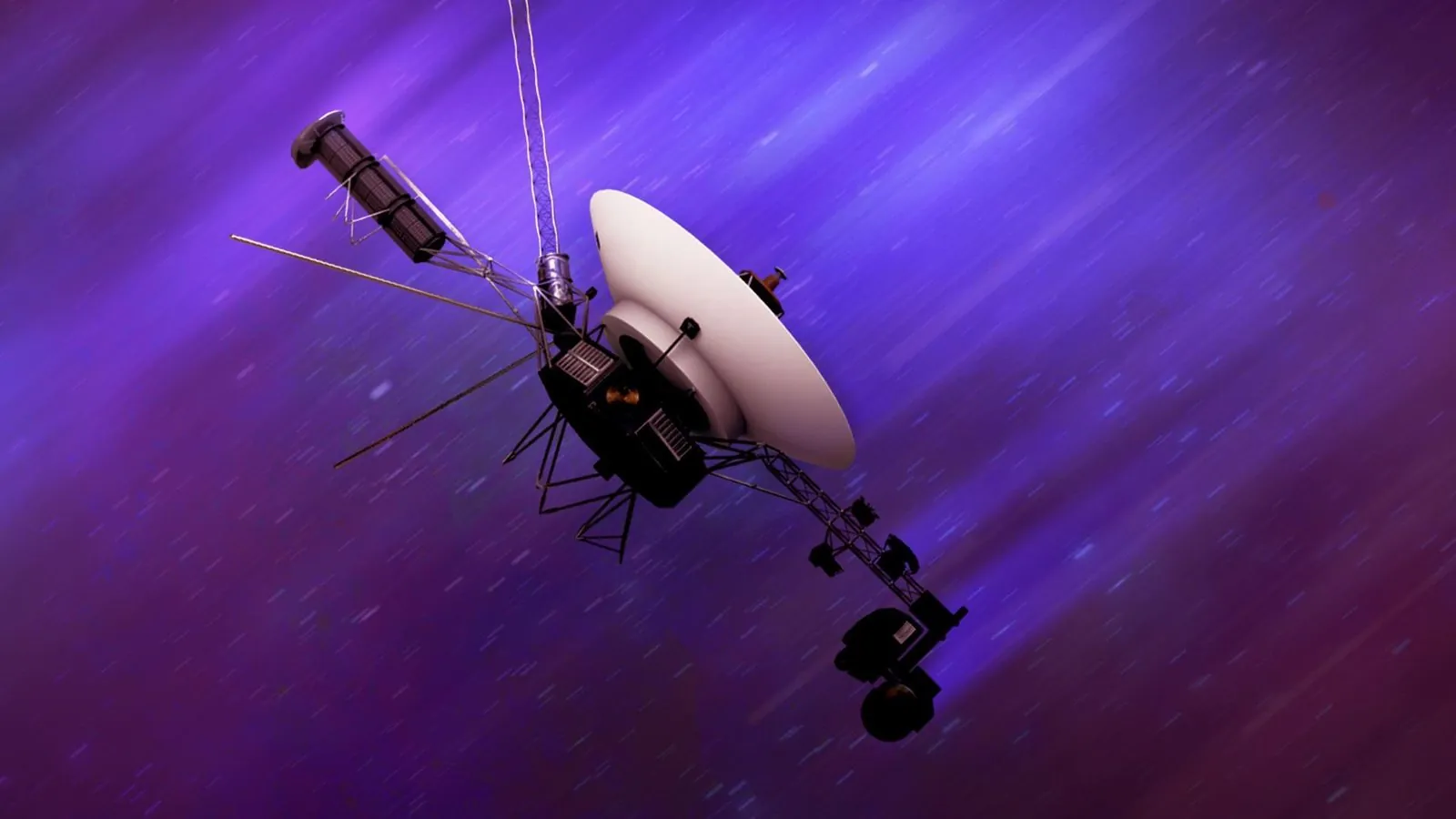
Voyager 1 is never coming back. Launched in 1977, it crossed into interstellar space in August 2012 and is now the farthest spacecraft from Earth. So where does it end up? Not in another galaxy. It will stay in the Milky Way for good.
01Fast enough to leave the Sun, not the galaxy
NASA says the Voyagers are moving through space at roughly 38,000 miles per hour, about 17 km/s. A 2019 study by Coryn Bailer-Jones of the Max Planck Institute for Astronomy and Davide Farnocchia of NASA's Jet Propulsion Laboratory puts Voyager 1's final speed away from the Sun at 16.6 km/s. That is more than enough to escape the Sun's gravity.
Escaping the whole galaxy is another matter. Studies using Gaia data put the Milky Way's escape speed at the Sun's distance from the centre at about 580 km/s (Monari and colleagues, 2018) or 528 km/s (Deason and colleagues, 2019). Voyager 1 would need to go about 30 times faster than it does.
Voyager 1 also travels with the Sun, which NASA says moves around the Milky Way at about 720,000 km/h, or 200 km/s. Even with that speed added, it is still well short of what it would need to leave.
02Passing other stars
The first star Voyager 1 comes near is not very near. Bailer-Jones and Farnocchia worked out that in about 16,700 years it will pass about 3.5 light-years from Proxima Centauri, the nearest star to the Sun. All four spacecraft heading out of the Solar System, the two Voyagers and the two Pioneers, will pass at about that distance.
The star NASA usually names is Gliese 445, a small red dwarf in the constellation Camelopardalis, about 17 light-years from us today. NASA says Voyager 1 will pass within 1.6 light-years of it in about 40,000 years. Bailer-Jones and Farnocchia, using the newer Gaia data, get about 1.9 light-years in about 44,000 years.
Either way, that is more than 100,000 times the distance from Earth to the Sun. Gliese 445 is not even in the direction Voyager 1 is heading today: the star is moving much faster than the spacecraft, about 116 km/s relative to it at the encounter in their calculation, so the star will come to Voyager rather than the other way round.
03Around and around the Milky Way
So Voyager 1 will do what the Sun does: go around the centre of the galaxy. NASA says one lap takes the Sun about 230 million years.
The video says no planet will catch it, and the odds of hitting anything are tiny. Bailer-Jones and Farnocchia estimate that a spacecraft like this would take around 1020 years, roughly seven billion times the present age of the universe, to collide with a star. Over billions of years it will pass much closer to some stars than it does to Gliese 445, they note, but those stars can't be picked out yet.
Nick Oberg, then at the Kapteyn Astronomical Institute in the Netherlands, has modelled the long trip. He found that Voyager 1 will bob up and down through the disc of the galaxy more than Voyager 2, he told the American Astronomical Society in 2021, as reported by Space.com.
04The record it carries
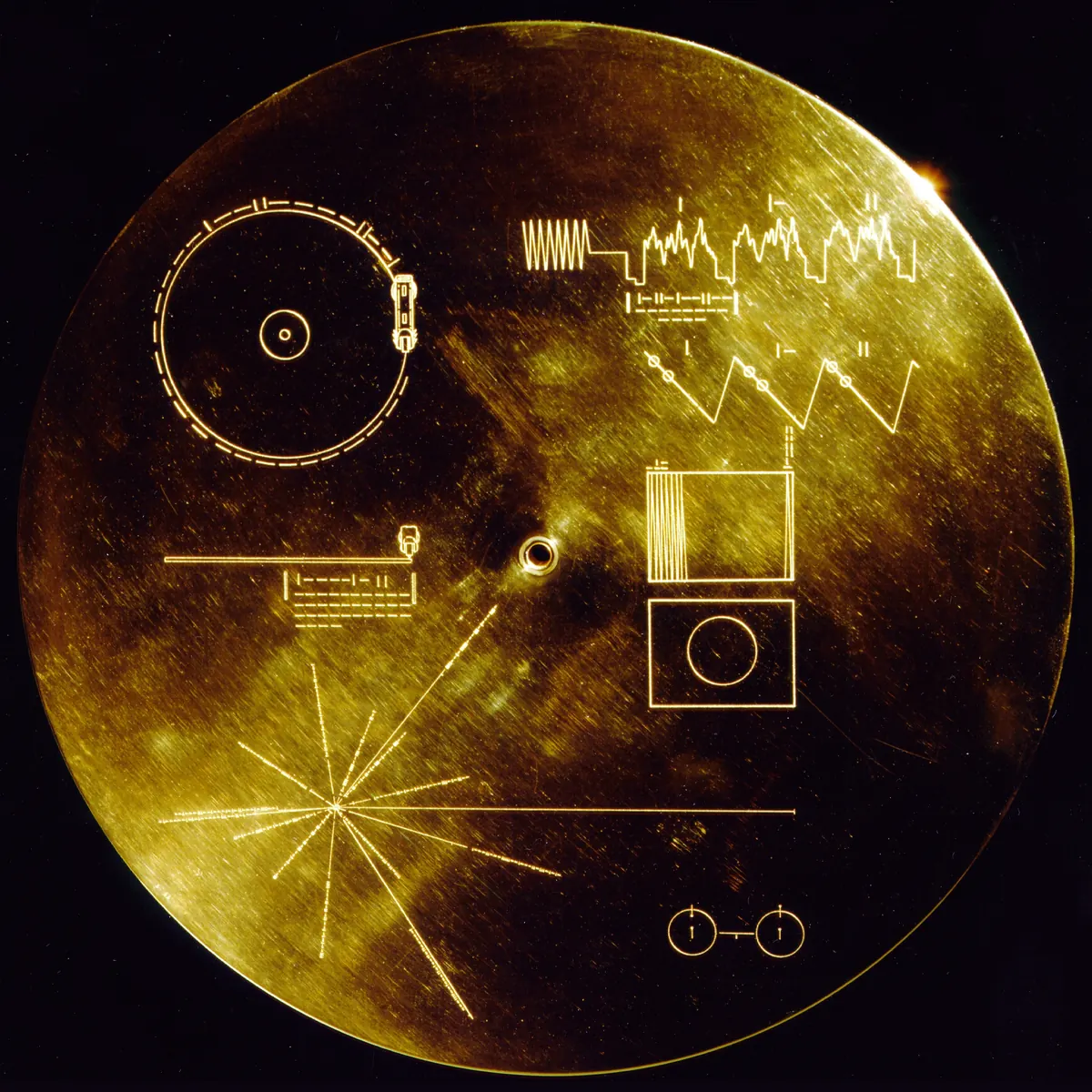
Voyager 1 carries a Golden Record, a 30 cm gold-plated copper disc. According to NASA, it holds greetings in 55 languages, 35 sounds from life on Earth, 90 minutes of music and 115 images. The cover shows the Sun's position relative to 14 pulsars, a map to where the spacecraft came from.
How long will it last? NASA's figure, from Carl Sagan's team, is more than a billion years. Oberg's work goes further. He estimated that after 5 billion years, the outward-facing side of Voyager 1's record is about 99% likely to have been damaged beyond reading by interstellar dust. The side facing the spacecraft will probably survive until the Milky Way merges with the Andromeda galaxy, about 5 billion years from now.
ENDSources
- Voyager 1, NASA Science
- Voyager: Frequently Asked Questions, NASA Science
- Hubble Provides Interstellar Road Map for Voyagers' Galactic Trek, NASA
- Bailer-Jones & Farnocchia, Future stellar flybys of the Voyager and Pioneer spacecraft (2019), arXiv / Research Notes of the AAS
- Monari et al., The escape speed curve of the Galaxy obtained from Gaia DR2 implies a heavy Milky Way (2018), Astronomy & Astrophysics
- Deason et al., The local high-velocity tail and the Galactic escape speed (2019), Monthly Notices of the Royal Astronomical Society
- Sun: Facts, NASA Science
- Oberg, The Voyagers Far into the Future (AAS 237, 2021), University of Groningen
- Scientists' predictions for the long-term future of the Voyager Golden Records, Space.com
- Voyager Golden Record overview, NASA Science
- Golden Record Cover, NASA Science
- Gaia DR3 archive (position of Gliese 445, source 1129149723913123456), ESA
Written by Facts Nero from the script of our Short and the sources above, all checked on 28 October 2026. Corrections to the video: the closest-approach figure for Gliese 445 is 1.6 light-years according to NASA and about 1.9 light-years in a 2019 study using Gaia data; and the 5-billion-year lifespan for the Golden Record is one researcher's estimate for the side facing the spacecraft, while NASA's own figure is more than a billion years. We dropped the video's closing line about what anyone who finds the record might look like, because there is nothing to check it against. The comparison of Voyager 1's speed with the escape speed, the conversion to Earth–Sun distances and the age-of-the-universe comparison are our own calculations; the sky position of Gliese 445 is from Gaia DR3.