The Voyager Golden Record: what's on it, and why
In 1977 each Voyager got a gold-plated record: 115 images, sounds of Earth, 90 minutes of music and greetings in 55 languages. What's on it, and why.
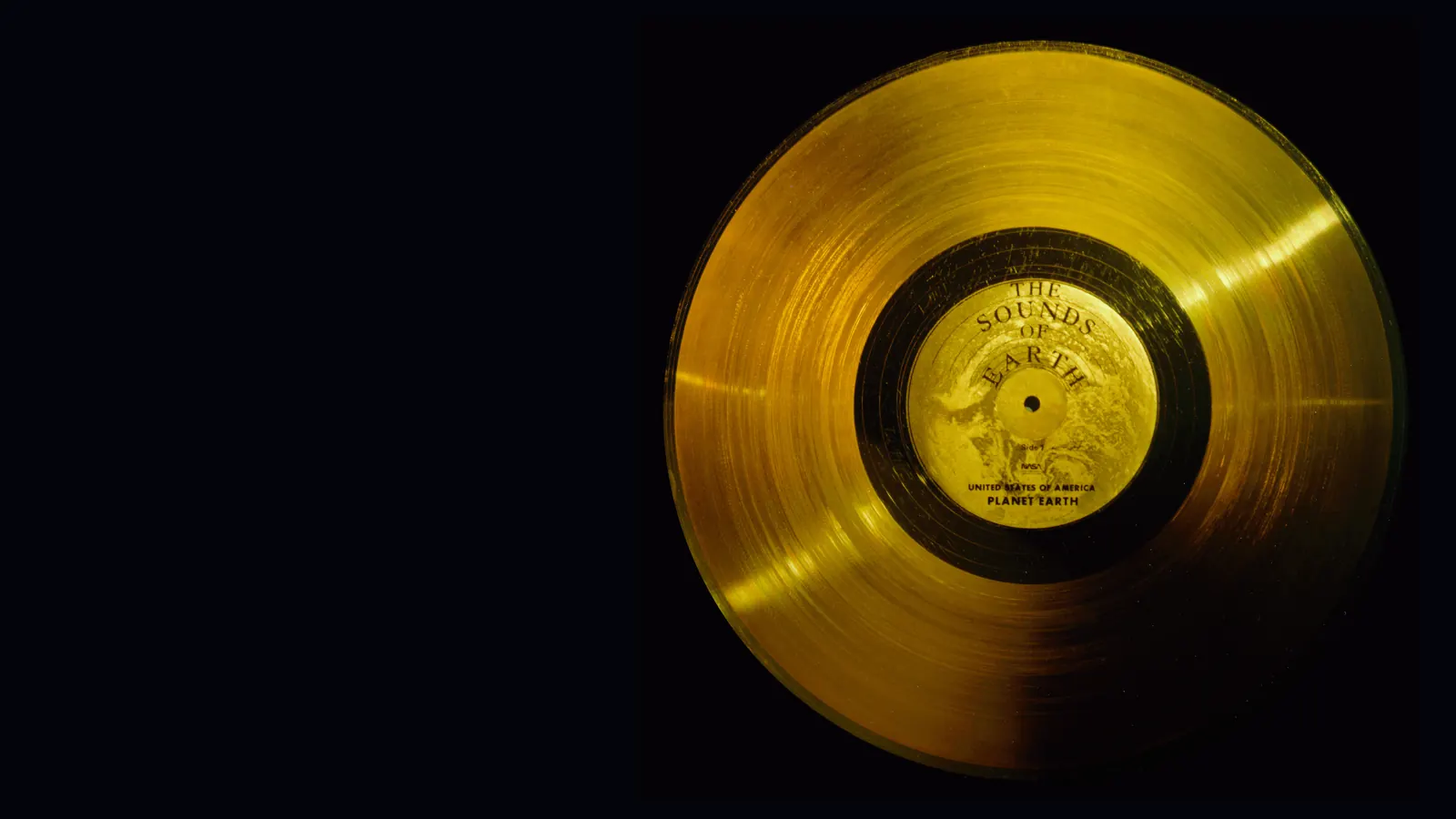
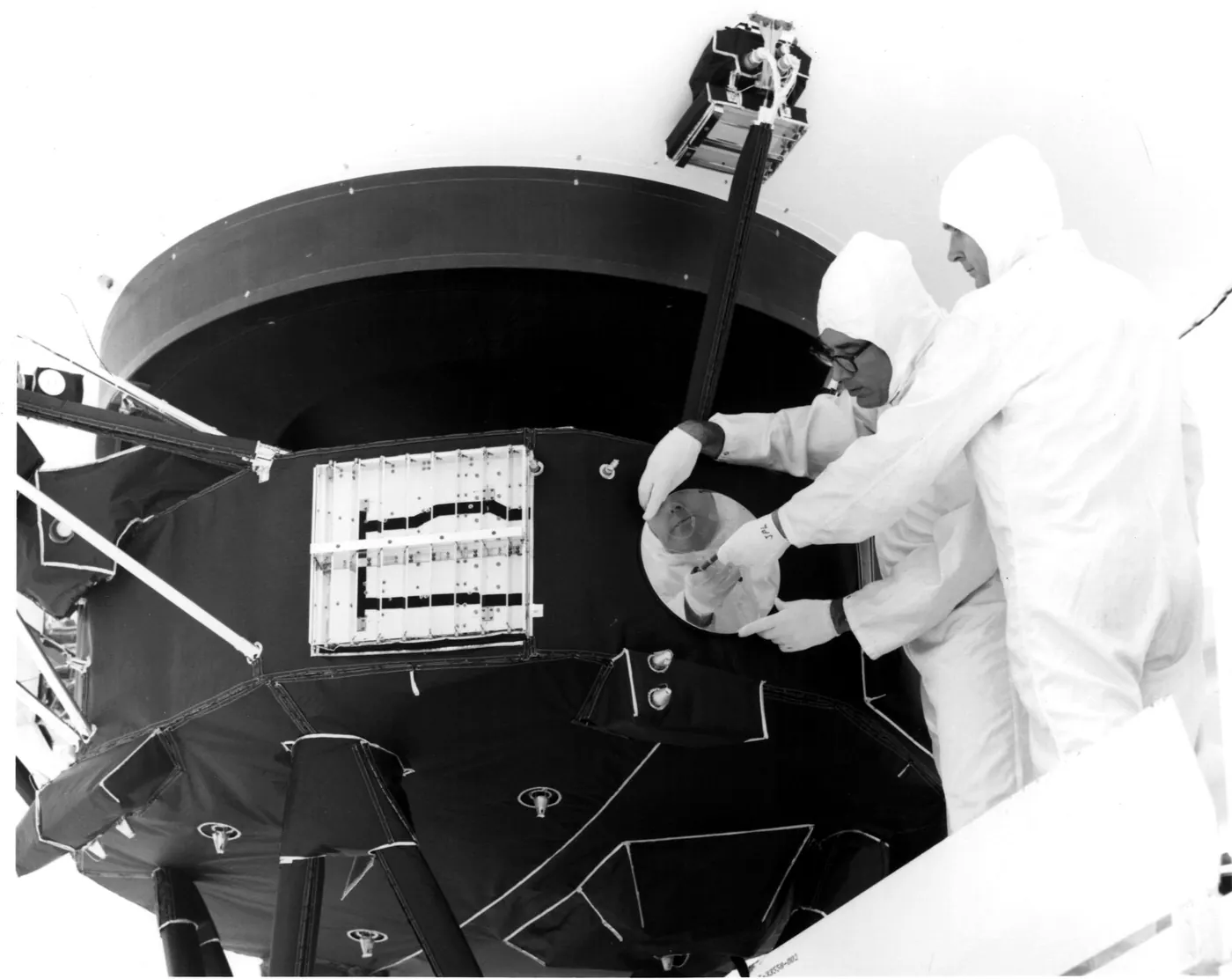
Bolted to the side of each Voyager spacecraft is a 12-inch disc of gold-plated copper. It holds pictures, music, the sound of a kiss and spoken greetings in 55 languages. It was put there in 1977 for anyone, anywhere, who might find it.
Voyager 2 launched on 20 August 1977 and Voyager 1 on 5 September 1977. Both are now in interstellar space, and both still carry the record. This is what the Voyager Golden Record contains, how it is meant to be played, and why it was made at all.
01A bottle in the cosmic ocean
NASA asked a committee chaired by Carl Sagan of Cornell University to choose the contents. Sagan was blunt about the odds. "The spacecraft will be encountered and the record played only if there are advanced spacefaring civilizations in interstellar space," he said, according to NASA. "But the launching of this bottle into the cosmic ocean says something very hopeful about life on this planet."
The team was small and the deadline was tight. Timothy Ferris, who produced the record, wrote in The New Yorker in 2017 that by the time NASA approved the idea, "we had less than six months to put it together". The credits in the team's 1978 book Murmurs of Earth list Sagan as executive director, Frank Drake as technical director, Ann Druyan as creative director, Ferris as producer, Jon Lomberg as designer and Linda Salzman Sagan as greetings organiser.
Ferris also called the records a gift "proffered without hope" of anything in return. Etched in copper, plated with gold and sealed in aluminium cases, he wrote, they "are expected to remain intelligible for more than a billion years".
02What's on the Golden Record
According to NASA, the record holds four kinds of material:
- 115 images, encoded in analogue form in the grooves. (One NASA page says 116.)
- Natural sounds: surf, wind, thunder, birds, whales and other animals.
- Music from different cultures and eras, about 90 minutes of it.
- Spoken greetings in 55 languages, plus printed messages from US President Jimmy Carter and UN Secretary-General Kurt Waldheim.
NASA's list of the pictures runs from the Sun and cell division to human anatomy, conception and birth, families, landscapes, animals, people at work, food, the Great Wall of China, the Taj Mahal, the Sydney Opera House and a radio telescope. In the sound section, Ferris wrote, Ann Druyan built a short history of Earth: from the "music of the spheres" based on Kepler's laws, through the volcanoes and thunderstorms of the early Earth, wind, rain and surf, and animals, to human sounds. Morse code spells out ad astra per aspera, "to the stars through hard work". The sequence ends with a kiss, a mother and child, an EEG recording of Druyan's own brainwaves and finally a pulsar, a spinning neutron star, as a nod to the pulsar map on the cover.
03Hello from the children of planet Earth
Linda Salzman Sagan organised the greetings. According to NASA, many of the speakers came from Cornell University and the surrounding communities, and their only instructions were to keep it brief. They run from Akkadian, spoken in Sumer about 6,000 years ago, to Wu, a modern Chinese language. The English greeting is a child's voice: "Hello from the children of planet Earth."
South Asia is well represented. NASA's list includes Bengali, Gujarati, Hindi, Kannada, Marathi, Nepali, Oriya, Punjabi, Rajasthani, Sinhalese, Telugu and Urdu. According to NASA, Bishun Khare of Cornell "almost singlehandedly" found the speakers of the Indian languages. The Hindi greeting translates as "Greetings from the inhabitants of this world." The Rajasthani one is warmer: "Hello to everyone. We are happy here and you be happy there."
Not every language made it. NASA notes that Swahili, spoken by millions of people in East Africa, was left out. The whale songs were mixed in with recordings of UN delegates speaking greetings, Ferris wrote.
0427 pieces of music
The music section has 27 tracks. According to NASA's list, they include Bach's Brandenburg Concerto No. 2, Beethoven's Fifth Symphony and his String Quartet No. 13 (the Cavatina), Stravinsky's Rite of Spring, Louis Armstrong's "Melancholy Blues", Blind Willie Johnson's "Dark Was the Night" and Chuck Berry's "Johnny B. Goode". There are also recordings from Australia, Azerbaijan, Bulgaria, China, Congo, Japan, the Navajo Nation, Peru, the Solomon Islands and many other places.
India's track is the raga "Jaat Kahan Ho", sung by Surshri Kesar Bai Kerkar, 3 minutes 30 seconds long. Ferris wrote that Ann Druyan found the LP "in a carton under a card table in the back of an appliance store".
Some choices took arguing. Ferris recalled that Sagan, on first listening, called "Johnny B. Goode" "awful", then came round to it. He also corrected a popular story: the team did not try to include the Beatles' "Here Comes the Sun" and fail to clear the rights. "Rumors to the contrary, we did not strive to include" it, he wrote.
One track was mislabelled for 40 years. According to Ferris, the piece listed as "Senegal Percussion" was actually recorded in Benin and titled "Cengunmé". The error was fixed for the record's 40th-anniversary reissue in 2017, the first time the Golden Record was made widely available on Earth.
05How to play a record with no instructions
Whoever finds the record will not have a turntable, so the cover is a set of instructions. Each record sits in an aluminium jacket with a cartridge and a needle. The diagrams on the cover, NASA explains, show the needle placed correctly at the start, and say the record should be played from the outside in, at 16⅔ revolutions per minute. One side takes about an hour.
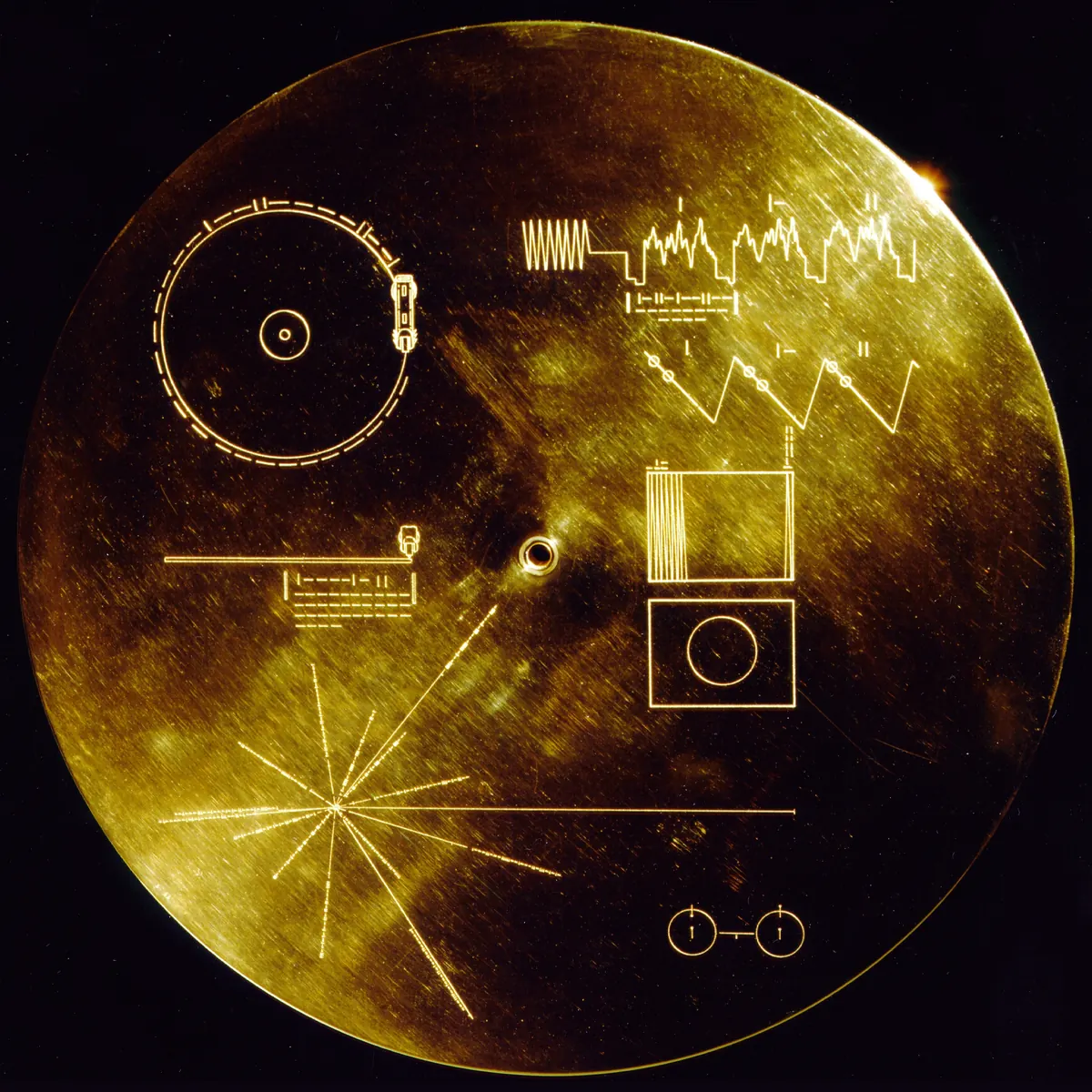
The units come from physics, not from us. The drawing at the bottom right shows the two lowest states of a hydrogen atom. The time it takes to flip between them, about 0.70 billionths of a second, is the basic unit. According to NASA, one rotation of the record takes 3.6 seconds, written on the cover in binary as a multiple of that time.
The top right shows how to turn the signal into pictures. Each picture is made of 512 vertical lines, NASA says, each lasting about 8 milliseconds. The first image is a circle, so the finder can check they have decoded it correctly.
The starburst at the bottom left is the pulsar map that also appeared on the Pioneer 10 and 11 plaques. It shows where the Sun is, relative to 14 pulsars, each identified by its own pulse rate.
There is even a clock. According to NASA, a 2 cm patch of the cover was electroplated with an ultra-pure source of uranium-238, about 0.00026 microcuries. Uranium-238 has a half-life of about 4.5 billion years, so by measuring how much of it has decayed, a finder could work out how long ago the record left Earth.
06Made in a hurry, in eight copies
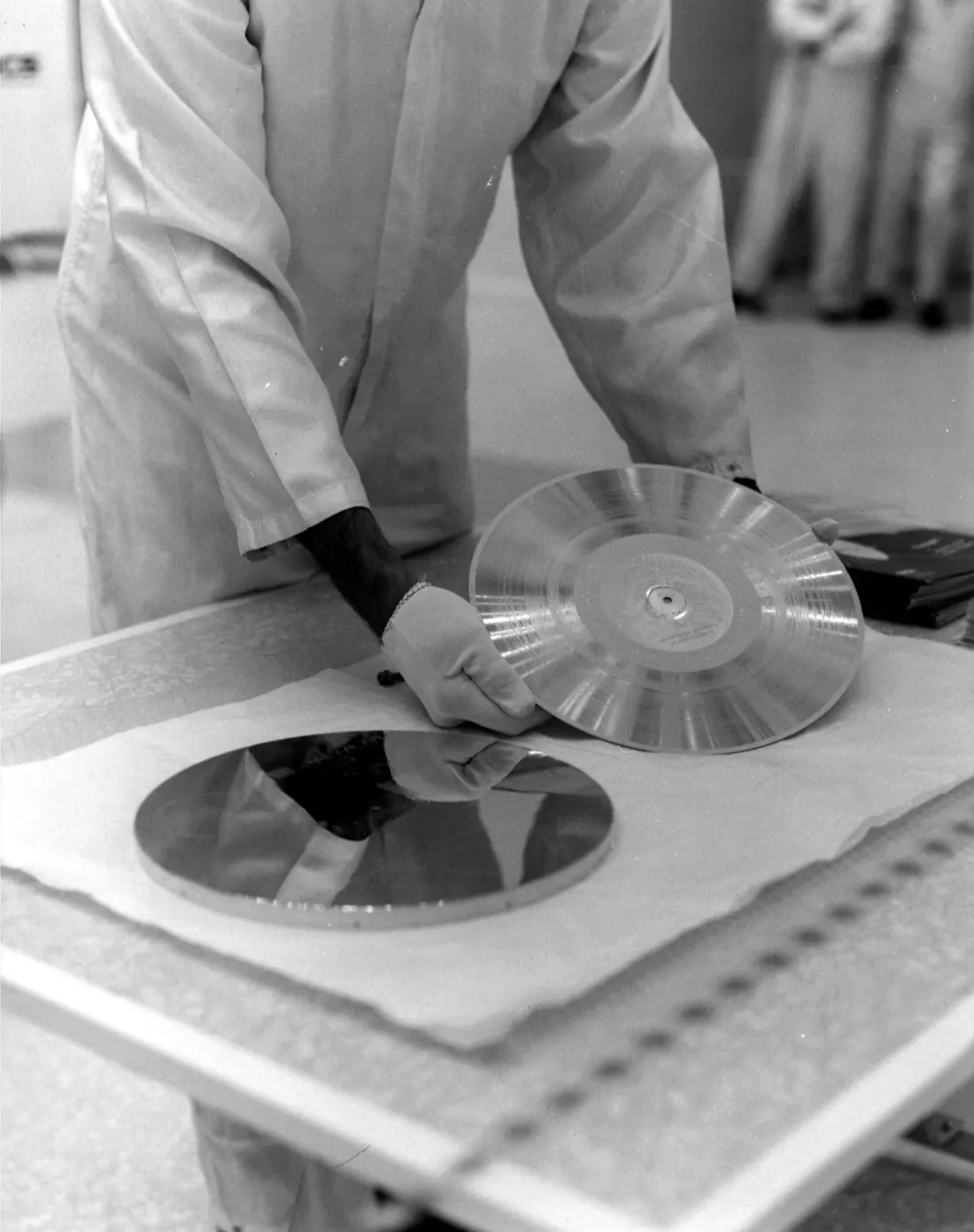
NASA's account of the manufacturing names the companies. Blank records came from Pyral S.A. of Créteil, France. CBS Records had the JVC Cutting Center in Boulder, Colorado cut the lacquer masters. These went to the James G. Lee Record Processing center in Gardena, California, which cut and gold-plated eight Voyager records. Two flew.
Each flight record carries a hand-etched line: "To the makers of music – all worlds, all times." Ferris wrote it, inspired by John Lennon's habit of scratching messages into the run-out grooves of his own records. (Lennon couldn't join the project for tax reasons, Ferris wrote, but recommended his engineer, Jimmy Iovine.) Those nine words nearly cost them the records. A NASA compliance officer found nothing about an inscription in the blueprints, and the records were rejected. NASA prepared to fly blank discs instead, until Sagan appealed to the agency's administrator.
07A message for 40,000 years from now
In his statement on the record, President Carter wrote: "This is a present from a small distant world, a token of our sounds, our science, our images, our music, our thoughts, and our feelings. We are attempting to survive our time so we may live into yours."
"Yours" is a long way off. According to NASA, it will be 40,000 years before either Voyager comes close to another planetary system. In AD 40,272, Voyager 1 will pass within 1.7 light years of a faint star called AC+79 3888 in Ursa Minor. In about 40,000 years, Voyager 2 will pass about 1.7 light years from Ross 248, a small star in Andromeda.
Meanwhile Voyager 1 is about to reach a milestone of its own. On 18 November 2026 it will be one light-day from Earth: here is what that means. And if you have wondered why, after nearly half a century in flight, it has never hit anything, we explain that too.
Sagan died in 1996, Ferris notes, at the age of 62. The record he championed will almost certainly never be played. It was never really meant for aliens alone. It is a picture of who we were in 1977, and what we wanted to say about ourselves.
"This is a present from a small distant world." Jimmy Carter, 1977
If you could add one sound to the Golden Record today, what would it be?
Sources
- Golden Record overview, NASA Science
- Golden Record contents, NASA Science
- Golden Record greetings, NASA Science
- Golden Record sounds and music, NASA Science
- Golden Record images, NASA Science
- Golden Record cover, NASA Science
- Making of the Golden Record, NASA Science
- Howdy, Strangers, NASA Science
- Voyager frequently asked questions, NASA Science
- Voyager 1, NASA Science
- Voyager 2, NASA Science
- Voyager Spacecraft Statement by the President (Jimmy Carter, 1977), The American Presidency Project, UC Santa Barbara
- Timothy Ferris, How the Voyager Golden Record Was Made (20 August 2017), The New Yorker
There is no Facts Nero video on the Golden Record yet, so this article was written from research alone and has no video. Every claim was checked against the sources above on 27 October 2026, mainly NASA's Golden Record pages, with Timothy Ferris's first-hand account for the making-of stories. Where NASA's pages differ (115 or 116 images; a uranium-238 half-life of 4.468 or 4.51 billion years), we say so or round.
More from Facts Nero
-
 Long video · 14 minNASA/JPL-Caltech
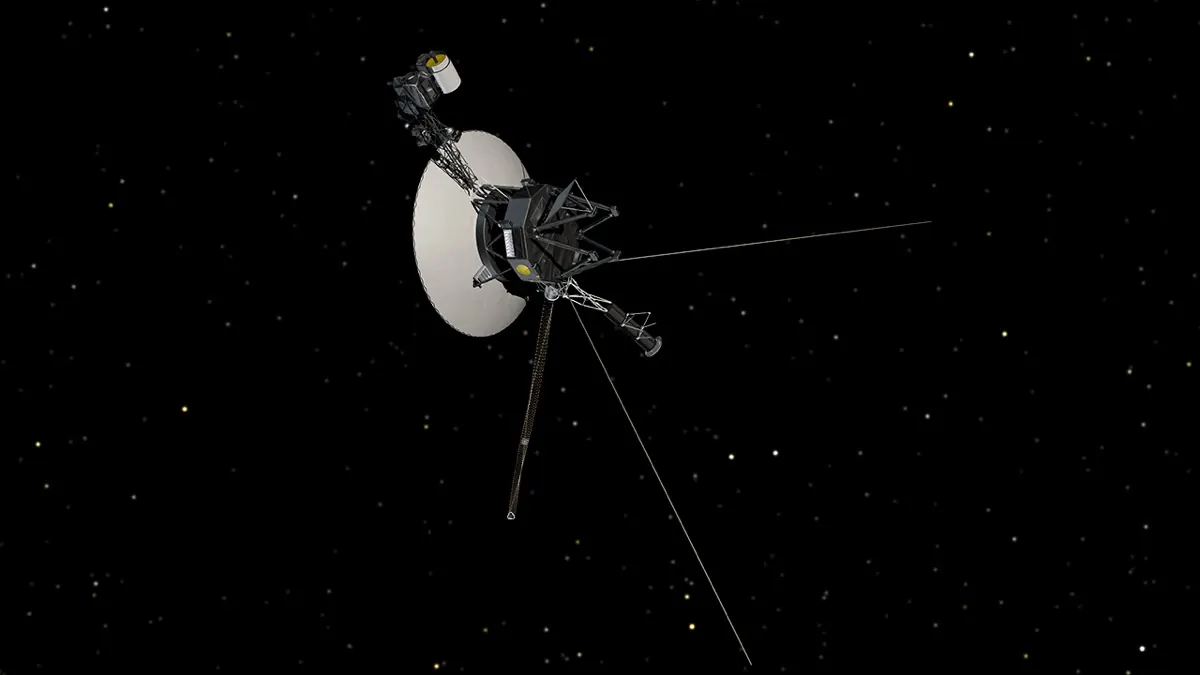
Voyager 1 is about to be one light-day from Earth
Launched in 1977 with less memory than one phone photo. On 18 November 2026 a message to it will take a full day to arrive.
Space probesRead · 7 minWatch ▶ -
 Short · 62 sNASA/JPL-Caltech
49 years in space and Voyager 1 never crashed
Deep space is almost perfectly empty. The real danger was always power.
Space probesRead · 1 minWatch ▶