Buran: why the Soviet space shuttle flew only once
On 15 November 1988 the Soviet shuttle Buran flew two orbits with no one aboard and landed itself. It never flew again. How Buran was built, and why it stopped.
At 06:00 Moscow time on 15 November 1988, a giant rocket called Energia lifted off from the Baikonur Cosmodrome. Strapped to its side was a white-and-black winged spacecraft that looked almost exactly like an American space shuttle. It was the Soviet orbiter Buran, Russian for "snowstorm".
There was nobody on board. Buran circled Earth twice, came back through the atmosphere and landed on a runway at Baikonur, all by itself. It was a remarkable flight. It was also the only one Buran ever made. So why did the Soviet space shuttle fly only once?
01A shuttle to match a shuttle
The short answer to why Buran existed at all is the American Space Shuttle. According to the historian Anatoly Zak of RussianSpaceWeb, Soviet leaders saw the US programme as a military threat and wanted a parallel system of their own. Cathleen Lewis, curator of international space programmes at the Smithsonian's National Air and Space Museum, told National Geographic that "the Soviet speculation was that the shuttle would be used to capture or destroy satellites".
The project was formally approved by a decree of the Communist Party Central Committee and the Council of Ministers in February 1976. Zak and the historians Bart Hendrickx and Dwayne Day date it to 17 February.
There is a famous story behind that decision. In 1976, two mathematicians, Dmitry Okhotsimsky and Yuri Sikharulidze, wrote a study suggesting that a shuttle launched from California could make a single orbit, dive into the atmosphere, drop a nuclear bomb on Moscow and climb back out. The tale is often told as the trigger for Buran. But in The Space Review, Hendrickx and Day point out that the academy president, Mstislav Keldysh, signed the report on 24 March 1976, "more than a month after the official approval of the Buran project". So the bomber study may have reinforced the decision, but it could not have caused it.
The Soviets had help with the design. "Through espionage, the Soviets obtained the design specifications of the US shuttle," writes the National Air and Space Museum. National Geographic says they "didn't blindly copy it", though, and the biggest differences were under the skin.
02Same shape, different machine
The US shuttle had three main engines in the back of the orbiter, which came home after every flight. Buran had no main engines of its own. Instead, the four main engines were on the core stage of the Energia rocket, which was thrown away. According to Lewis, relying on the launch vehicle instead of building high-efficiency engines into the orbiter was meant to save money.
Energia was a monster. According to RSC Energia, quoted by Spaceflight Now, it could put 100 tonnes into low Earth orbit and send 32 tonnes towards the Moon. Unlike the US shuttle's solid rocket boosters, its four strap-on boosters burned liquid fuel. And it didn't need Buran: it could fly with any heavy payload, which gave the system a flexibility the US shuttle never had.
The orbiter itself was about the same size as the American one. RussianSpaceWeb lists it at 36.37 m long with a 23.92 m wingspan, designed to carry up to 30 tonnes of cargo and a crew of two to ten for 7 to 30 days.
The programme was huge. At its peak, according to National Geographic, Buran involved more than 150,000 engineers, scientists, technicians and other workers. It was meant to be secret, but word got out. In the early 1980s, an Australian military aircraft photographed Soviet ships recovering a small test spaceplane, a BOR model, from the Indian Ocean, and the photos went round the world.
03Practice in the air
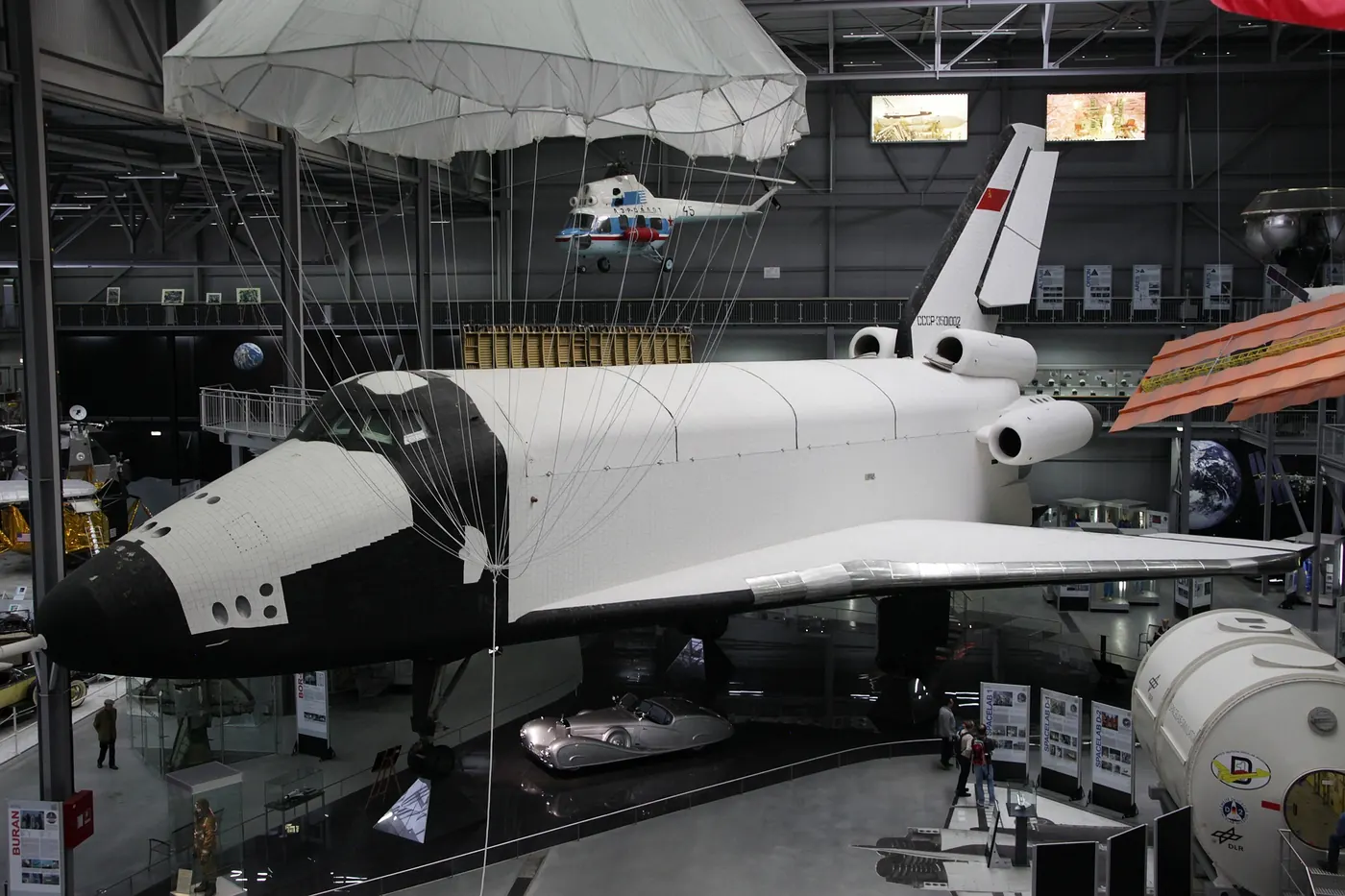
Before anything went to space, a full-size test airframe called OK-GLI (also known as BTS-002) was built to fly in the atmosphere with test pilots on board. According to RussianSpaceWeb, test pilots Igor Volk and Rimantas Stankevičius made its first flight on 10 November 1985. On 10 February 1987 it flew the first automated approach and landing on a runway, and testing ended in April 1988 after 24 flights. (The museum that now owns it says 25.)
Energia flew first, without Buran. On 15 May 1987 it launched a large military payload called Polyus. The rocket worked, but according to RussianSpaceWeb, Polyus fired its own engine in the wrong direction because of a control system problem and fell into the ocean.
04Two orbits, no crew
Buran's first launch attempt, on 29 October 1988, stopped 51 seconds before liftoff when the automatic system detected a problem, according to RussianSpaceWeb. Seventeen days later, on 15 November, it went.
Energia lifted off from Site 110 at Baikonur at 06:00:02 Moscow time. Buran made two orbits and, 206 minutes after launch, landed automatically on the runway of the Yubileiny airfield at Baikonur. Spaceflight Now puts the flight at about 3 hours 26 minutes, the same thing.
The landing was the headline. "For the first time ever, a spacecraft of such a class was landed completely automatically," RSC Energia says in its mission description, quoted by Spaceflight Now. The US shuttle always had a human crew at the controls. Buran, as National Geographic put it, "returned from space with a fine airplane-style landing controlled entirely by computer".
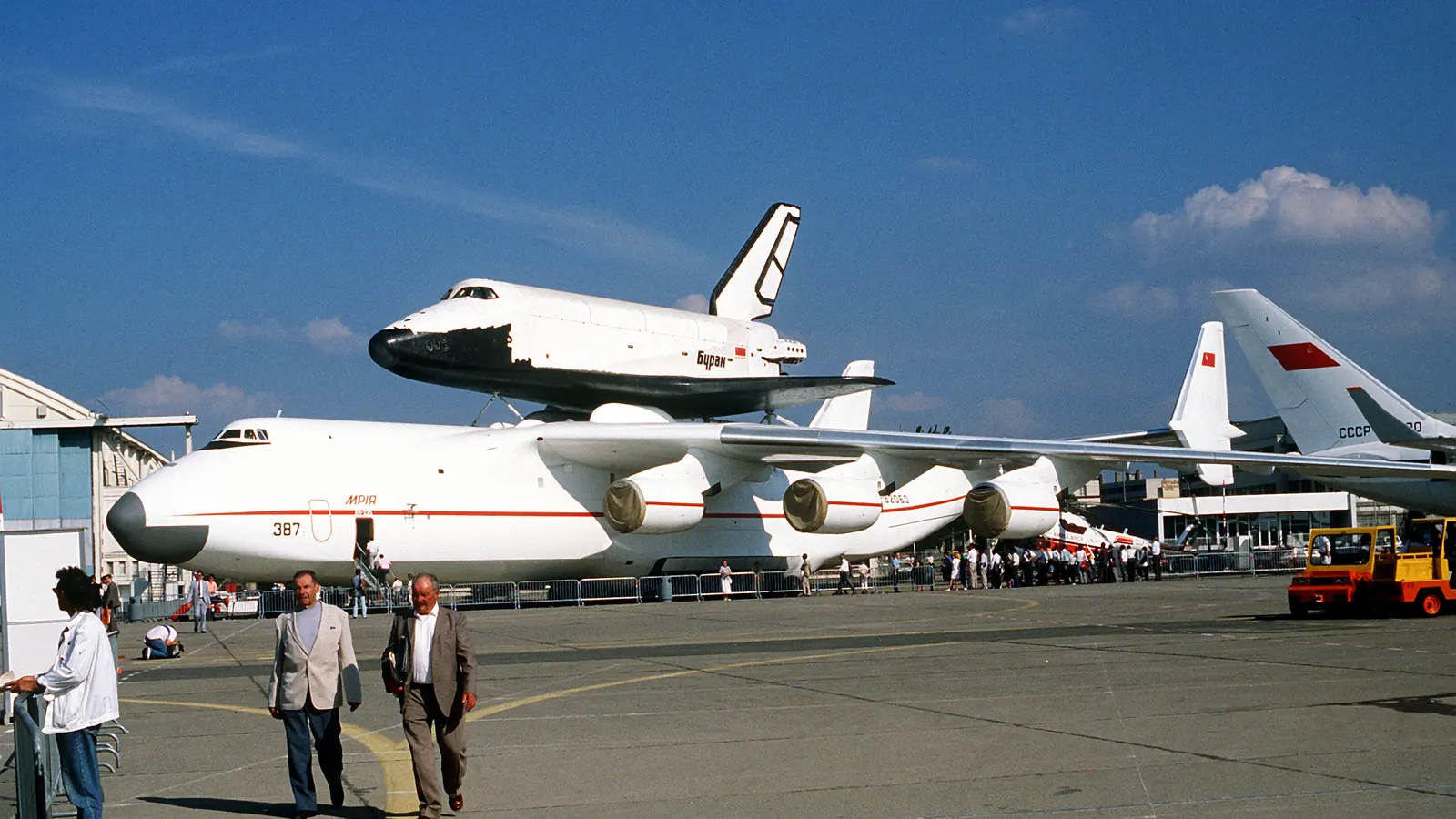
On 21 December 1988 the giant Antonov An-225 Mriya, designed to carry Buran, made its first flight. On 13 May 1989 it flew with Buran on its back, and that June it took the orbiter to the Paris Air Show, which is where our main photo was taken.
05Why Buran only flew once
Buran was not grounded by a disaster. It ran out of reasons and money.
It was expensive. RussianSpaceWeb cites an estimate that launching about 20 tonnes on Energia-Buran cost 270 million rubles, against 5.5 million rubles for a similar payload on the existing Proton rocket. Konstantin Feoktistov, an engineer who had worked on the Vostok spacecraft, sent Mikhail Gorbachev a 19-page critique arguing that the shuttle would drain money from existing programmes, according to the National Air and Space Museum. The planetary scientist Roald Sagdeev objected too.
It had no clear job. Zak writes that the programme suffered from a lack of purpose compared to its tremendous cost. The heavy space stations and military projects that might have used Energia never arrived.
Then the country disappeared. The Soviet Union broke up in December 1991. According to RussianSpaceWeb, funding for Energia-Buran dried up in 1992, and in 1993 Yuri Semenov, the head of NPO Energia, publicly admitted the project was dead. National Geographic says President Boris Yeltsin officially cancelled the programme in 1993. A second flight orbiter, 1.02, had been rolled out to the launch pad for tests in 1991. It never flew.
06What's left
The orbiter that went to space no longer exists. On 12 May 2002, the roof of the assembly building where it was stored at Baikonur collapsed. Spaceflight Now and National Geographic both report that the accident killed eight workers who were repairing the roof, and destroyed the Buran that had flown (the National Air and Space Museum calls it a test model, but RussianSpaceWeb and Spaceflight Now say it was the flight orbiter).
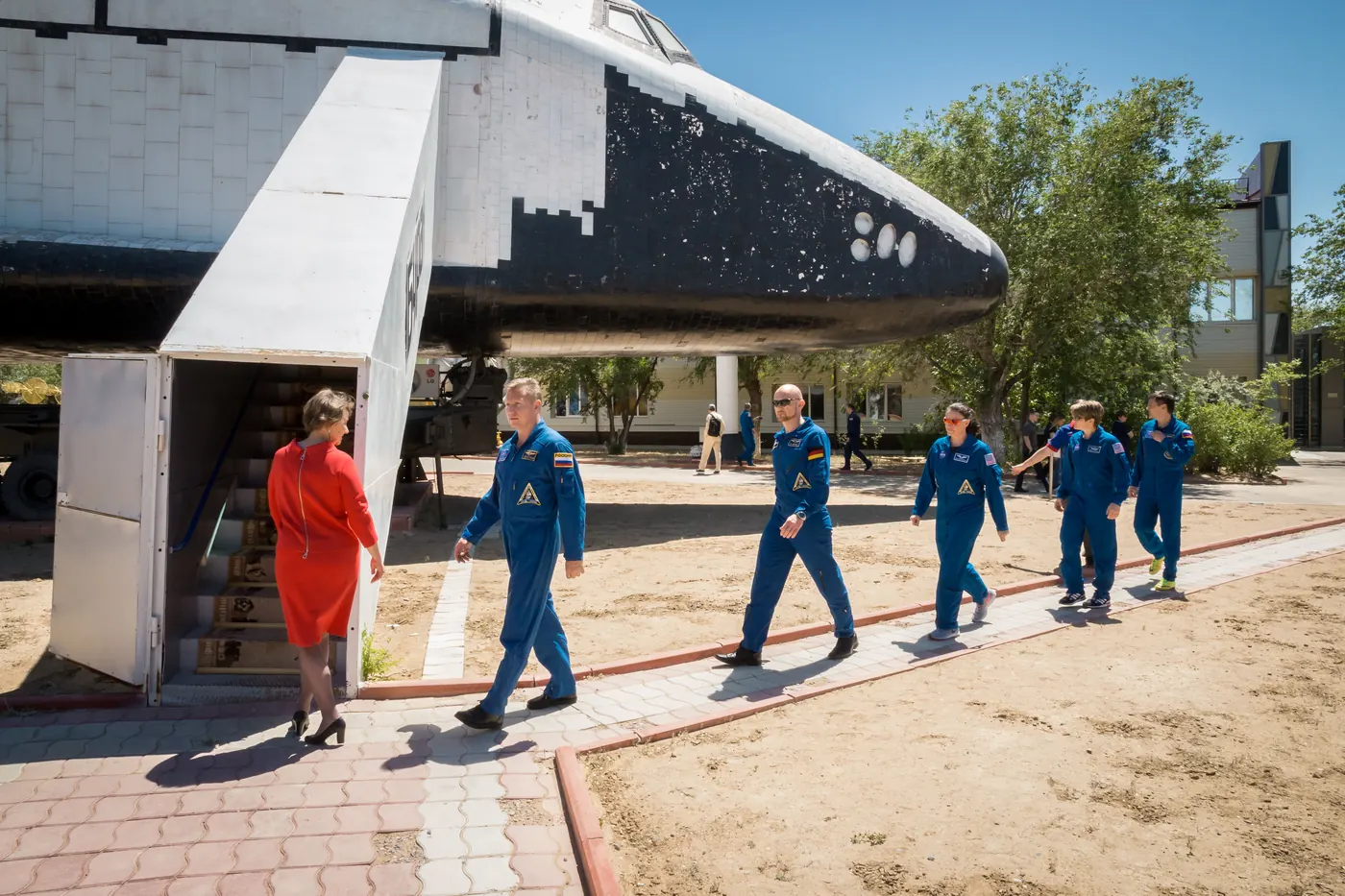
Other airframes survived. Orbiter 1.02 is still stuck inside a hangar at Baikonur. According to RussianSpaceWeb, it was defaced with graffiti in 2021. One test shuttle travelled the world by barge, appeared at the Sydney 2000 Olympics and now lives at the Technik Museum Speyer in Germany: the museum identifies it as OK-GLI. Another test airframe once housed a restaurant in Moscow's Gorky Park, and in 2014 it moved to a more public display at the VDNKh exhibition centre, according to National Geographic.
Buran's legacy is that one automatic landing, in 1988, by a winged spacecraft the size of a shuttle.
For where human spaceflight is heading now, read our Artemis III explainer. And if you've ever wondered why the flames from rockets like Energia nearly disappear high up, that's here.
"For the first time ever, a spacecraft of such a class was landed completely automatically." RSC Energia
Should Buran have been given a second flight?
Sources
- Anatoly Zak, Buran reusable shuttle (history and chronology), RussianSpaceWeb
- Cathleen Lewis, The Soviet Buran Shuttle: One Flight, Long History (15 November 2013), Smithsonian National Air and Space Museum
- Buran, the Soviet space shuttle, flew 25 years ago (15 November 2013), Spaceflight Now
- The Soviet Union's Space Shuttle Was Better Than Ours. Too Bad It Never Got to Fly, National Geographic
- Bart Hendrickx and Dwayne Day, Target Moscow (part 2): The American Space Shuttle and the decision to build the Soviet Buran (3 February 2020), The Space Review
- Space Shuttle Buran (OK-GLI), Technik Museum Speyer
- jsc2018e051936: Expedition 56 crew walk to a Buran flight article, Baikonur (31 May 2018), NASA Image and Video Library
There is no Facts Nero video on Buran yet, so this article was written from research alone and has no video. Claims were checked on 27 October 2026 against the sources above. We could not reach RSC Energia's own website from our research setup, so Energia's figures are as quoted by Spaceflight Now. Where sources disagree we say so: the decree date (17 February 1976, rounded to February 1976), the year of the Australian photos (1982 or 1983, so "early 1980s"), and whether the orbiter destroyed in 2002 was the flight vehicle. We dropped a widely repeated claim about how many heat tiles Buran lost, because sources give different numbers.
More from Facts Nero
-
 Long video · 10 minNASA/Bill Stafford
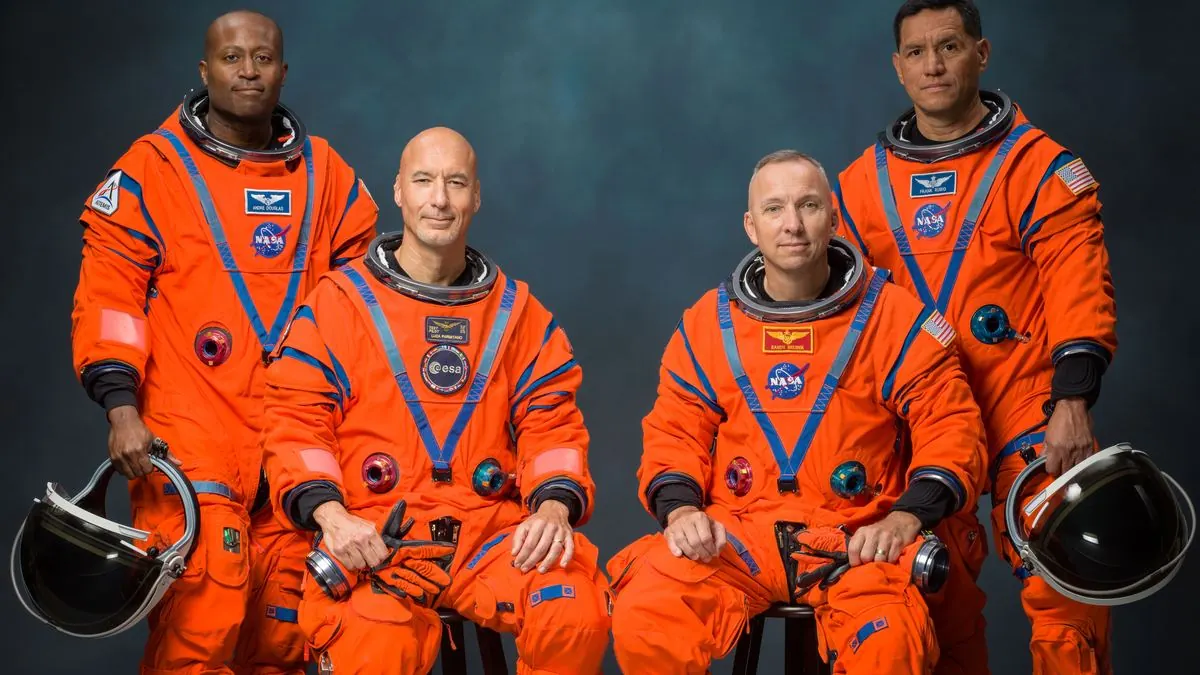
Why Artemis III won't land on the Moon
Four astronauts, three heavy-lift rockets and test versions of two Moon landers, all in Earth orbit.
MissionsRead · 7 minWatch ▶ -
 Short · 46 sNASA/Keegan Barber
Why rocket flames almost vanish in space
The engine is still firing. Without air pushing back, the exhaust spreads out, and the leftover fuel has nothing to burn with.
RocketsRead · 3 minWatch ▶