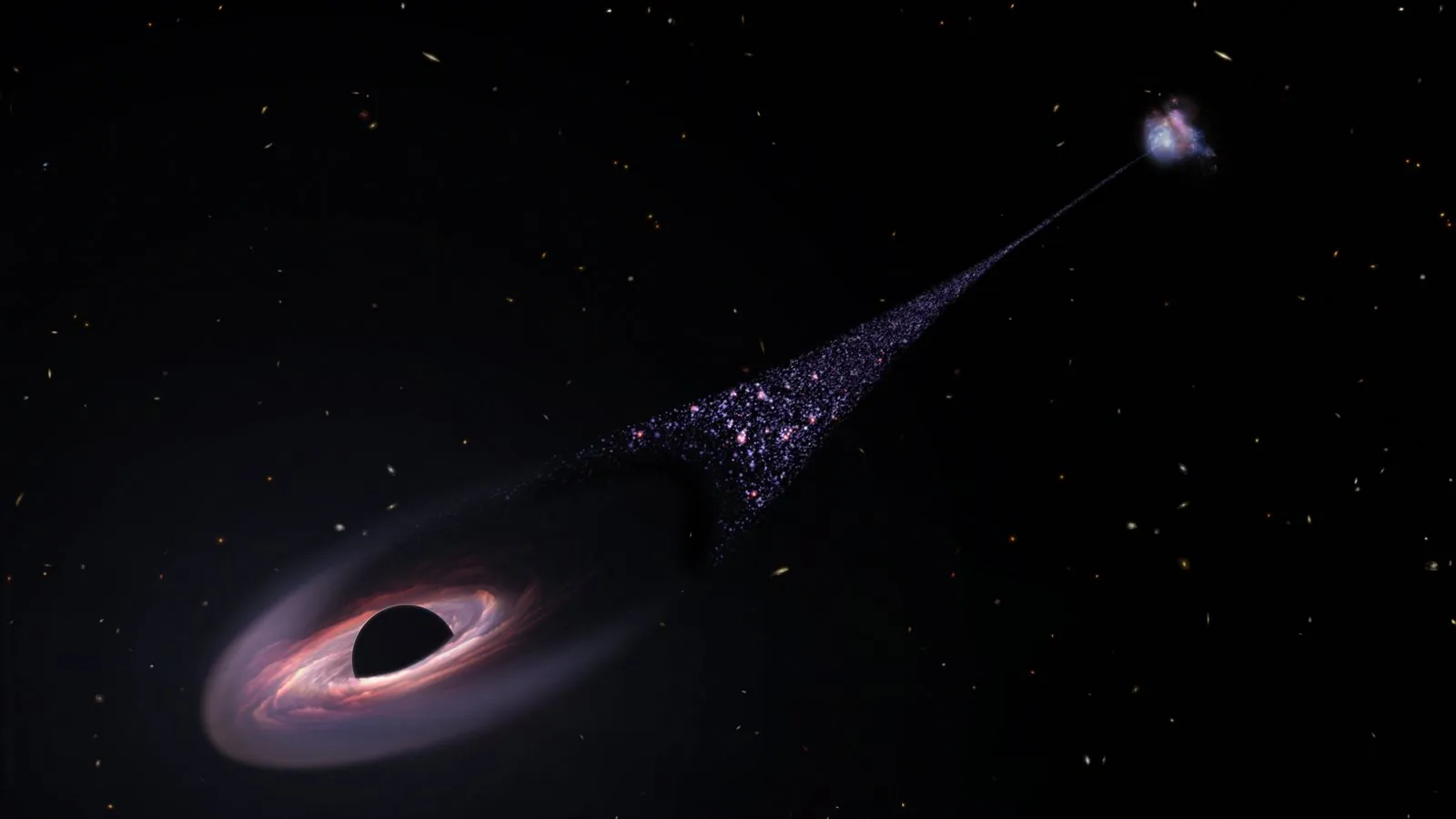
Supermassive black holes usually sit still at the centres of galaxies. But astronomers think they have found one that was thrown out of its galaxy and is now speeding away, leaving a trail of newborn stars behind it. It is called RBH-1, for runaway black hole.
01A streak that looked like a glitch
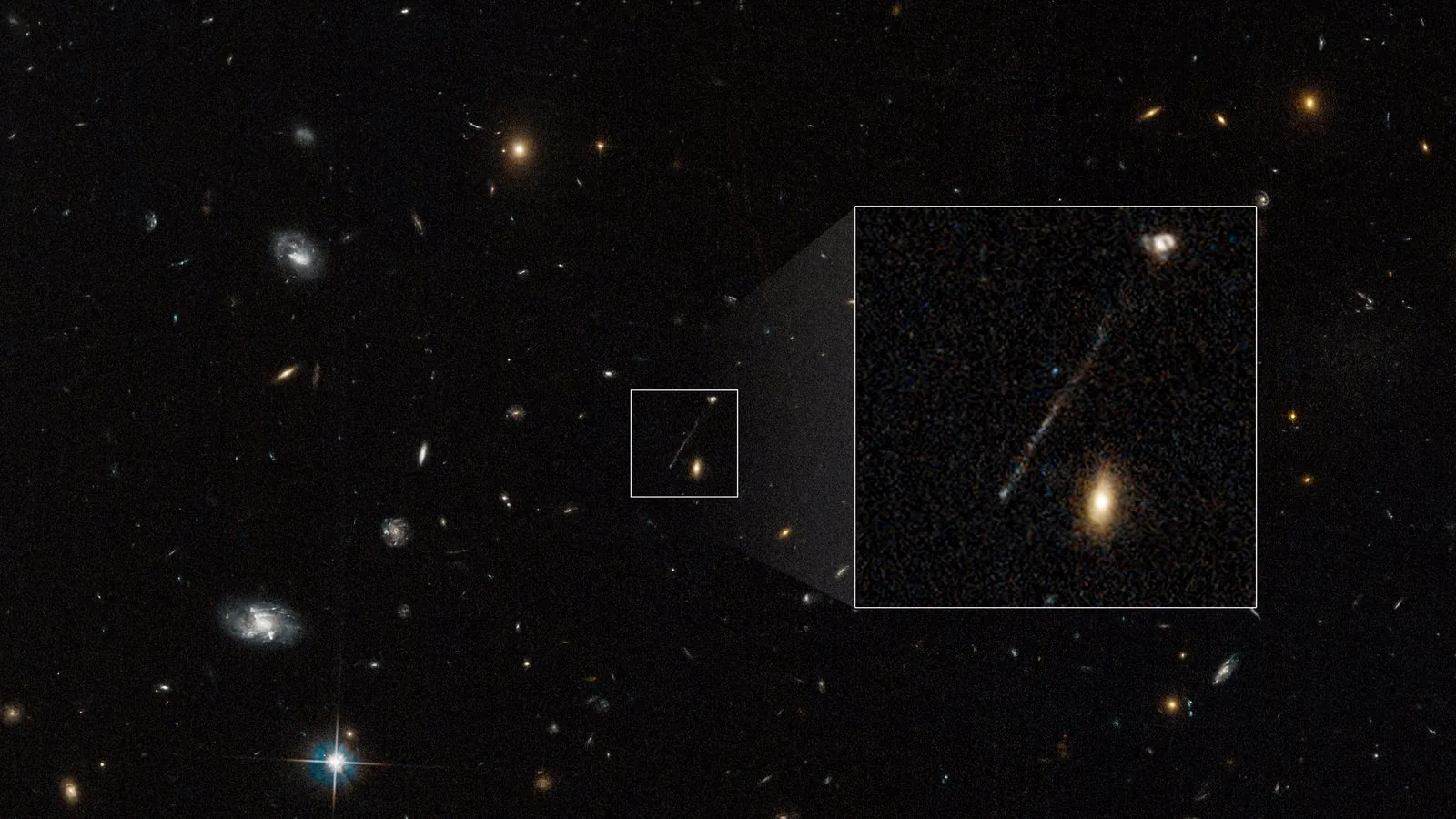
Pieter van Dokkum, an astronomer at Yale University, found it by accident while looking through Hubble images for star clusters around a nearby dwarf galaxy. "I was just scanning through the Hubble image and then I noticed that we have a little streak," he said in NASA's 2023 announcement. He first took it for a cosmic ray hitting the camera. When the team removed those, the streak was still there.
Follow-up spectra from the W. M. Keck Observatory in Hawaii showed it is a real, very bright structure of gas and young stars. According to the team's 2023 paper, it stretches 62 kiloparsecs, about 200,000 light-years, from a small galaxy. NASA says that is twice the diameter of the Milky Way.
02A wake of new stars
The team's explanation is that the black hole is ploughing through thin gas around its former galaxy. The gas in front of it is shocked and compressed, then cools behind it and forms stars. "Like the wake behind a ship we're seeing the wake behind the black hole," van Dokkum said. NASA says the trail is almost half as bright as the galaxy it is attached to, so it must contain a lot of new stars.
03What Webb measured
To test the idea, the team pointed the James Webb Space Telescope at the tip of the trail. Their results, published in The Astrophysical Journal Letters in February 2026, show a sudden jump of about 600 km/s in the speed of the gas across the tip. That is what you would expect from a shock wave in front of a fast-moving object.
From the shape of that shock, they worked out a speed of 954 km/s, give or take about 120 km/s, and a mass of at least 10 million times the Sun. Their 2023 paper had estimated about 1,600 km/s. At 954 km/s, the black hole would cover the distance from Earth to the Moon in under seven minutes, by our calculation.
The team calls RBH-1 "the first confirmed runaway supermassive black hole".
04Not everyone is convinced
Not everyone agrees that it is confirmed. In 2023, a team led by Jorge Sánchez Almeida argued in Astronomy & Astrophysics that the streak could be a flat galaxy with no central bulge, seen exactly edge-on, so that it looks like a thin line. In 2026 the same group looked at the Webb data and said the light from the tip looks more like ordinary star-forming gas than heavily shocked gas.
Writing in Scientific American in March 2026, astronomer Phil Plait concluded that it is "premature to declare this case closed". RBH-1 is the best candidate for a runaway supermassive black hole so far, but the debate isn't over.
05How do you throw out a black hole?
The idea is about 50 years old. The 2026 paper cites two ways it could happen, both predicted in the early 1970s.
A recoil. When two black holes merge, they give off gravitational waves. If the waves are stronger in one direction, the merged black hole recoils the other way, like a gun kicking back when it fires. Jacob Bekenstein predicted this in 1973.
A three-way tug of war. If three black holes meet after galaxies merge, their gravity can fling one of them out while the other two stay together. William Saslaw and colleagues predicted this in 1974. NASA's 2023 announcement said this was the team's favoured explanation then. The 2026 paper names both as possible causes.
06Not happening right now
One more thing to keep in mind: RBH-1 is about 7.7 billion light-years away, according to NASA. Its light left it when the universe was about half its present age, so we are seeing it as it was then, not as it is today.
ENDSources
- Hubble Sees Possible Runaway Black Hole Creating a Trail of Stars (6 April 2023), NASA
- Runaway Black Hole Near RCP28 (image and data), NASA
- van Dokkum et al., A candidate runaway supermassive black hole identified by shocks and star formation in its wake (2023), arXiv / The Astrophysical Journal Letters
- van Dokkum et al., JWST Confirmation of a Runaway Supermassive Black Hole via Its Supersonic Bow Shock (2026), The Astrophysical Journal Letters
- JWST Confirmation of a Runaway Supermassive Black Hole via its Supersonic Bow Shock (preprint), arXiv
- Sánchez Almeida et al., Supermassive black hole wake or bulgeless edge-on galaxy? (2023), Astronomy & Astrophysics
- JWST spectra are consistent with the edge-on star-forming galaxy scenario for the 'runaway supermassive black hole' (2026), arXiv / Research Notes of the AAS
- Have astronomers found a runaway monster black hole or just a very weird galaxy? (13 March 2026), Scientific American
- JWST Confirms: First Runaway Supermassive Black Hole Tearing Through Space, ScienceAlert
- A Strange Streak of Young Stars is Evidence of a Runaway Supermassive Black Hole, Study Finds, W. M. Keck Observatory
Written by Facts Nero from the script of our Short and the sources above, all checked on 28 October 2026. Corrections to the video: "confirmed" is the discovery team's own conclusion from its Webb data, and another team disputes it, so we describe RBH-1 as the leading candidate; and we see RBH-1 as it was about 7.7 billion years ago, not "right now". The speed of 954 km/s and mass of at least 10 million Suns are the discovery team's 2026 figures; their 2023 estimates were about 1,600 km/s and about 20 million Suns. The Earth-to-Moon time is our own calculation. The sky position is that of the host galaxy given in the 2023 paper.