Our Short claims that if you fell into a supermassive black hole, you wouldn't feel a thing. That is broadly what physics says, with some caveats about the details. This article goes through the fall step by step, using a NASA supercomputer simulation and the general relativity behind it.
01Small black holes are the dangerous ones
Black holes don't kill you with gravity's pull as such. What kills you is the difference in pull between your head and your feet, called the tidal force. It stretches you out like a noodle, which astrophysicists call spaghettification.
Near a small black hole that difference is huge. "Stellar-mass black holes, which contain up to about 30 solar masses, possess much smaller event horizons and stronger tidal forces, which can rip apart approaching objects before they get to the horizon," said Jeremy Schnittman, the NASA Goddard astrophysicist who made the simulation. "If you have the choice, you want to fall into a supermassive black hole."
The physics FAQ hosted by mathematical physicist John Baez gives numbers from the classic textbook Gravitation. For a black hole of 8 solar masses, tides become fatal about 400 km from the centre, while the event horizon's radius is just 24 km. The fatal distance grows only with the cube root of the mass, but the horizon grows in step with the mass. So above about 1,000 solar masses you could probably cross the horizon alive.
02Crossing the point of no return
The event horizon is not a surface. There is no wall and no jolt. The Baez FAQ puts it this way: "there's nothing locally special about the event horizon". What you would see is strange: light bending around the black hole distorts and duplicates the sky, as NASA's simulation shows.
The Short says gravity at the edge is "almost gentle". More precisely, the stretching is gentle there. The pull itself is enormous, but a freely falling body doesn't feel its own fall, so what you would notice is only the tidal stretch.
NASA's simulation follows a camera falling into a non-spinning black hole of 4.3 million Suns, the mass of Sagittarius A*, the black hole at the centre of our galaxy. Its event horizon has a radius of about 12.5 million km. NASA says the camera takes about 3 hours to fall from its starting point, nearly 640 million km away, to the horizon. To anyone watching from far away, though, it would never quite get there: its image would slow down and seem to freeze just outside.
03Where space and time swap
Inside the horizon, the Short says, "space and time swap roles". That is a common way to describe the maths. In the usual coordinates for a non-spinning black hole, the Baez FAQ explains, the time coordinate becomes a direction in space inside the horizon, and moving toward the future means moving to smaller distances from the centre.
So the centre is no longer a place you could steer away from. It lies in your future, like next Monday. Geraint Lewis and Juliana Kwan of the University of Sydney put it this way in a 2007 paper: once you cross the horizon, "your destiny lies at the central singularity, irrespective of what you do". NASA describes it as space-time itself flowing inward at the speed of light at the horizon.
04How long do you have?
The Short says about one minute for Sagittarius A*. That is the right size, but it is an upper limit, not a typical time.
Lewis and Kwan show that the most time anyone can experience between the horizon and the centre of a non-spinning black hole is π × GM/c³. That maximum applies only to someone who somehow starts at rest right at the horizon. Anyone falling in from outside gets less. For 4.3 million Suns, that formula gives about 66 seconds, by our calculation.
NASA's simulated camera, falling in from outside, gets far less. "Once the camera crosses the horizon, its destruction by spaghettification is just 12.8 seconds away," Schnittman said. It is destroyed about 128,000 km from the centre and reaches the singularity microseconds later. The real Sagittarius A* is thought to spin, which NASA left out to keep the calculation simpler, and spin changes these numbers.
05The end nobody can describe
At the centre is the singularity, where, in NASA's words, "the laws of physics as we know them cease to operate". The Baez FAQ says the same in its own way: "At the singularity all of present physics is mute as to what will happen." Describing it would take a theory of quantum gravity, which nobody has yet. So the Short is right: nobody knows what happens at the very end.
06The real black hole at our centre
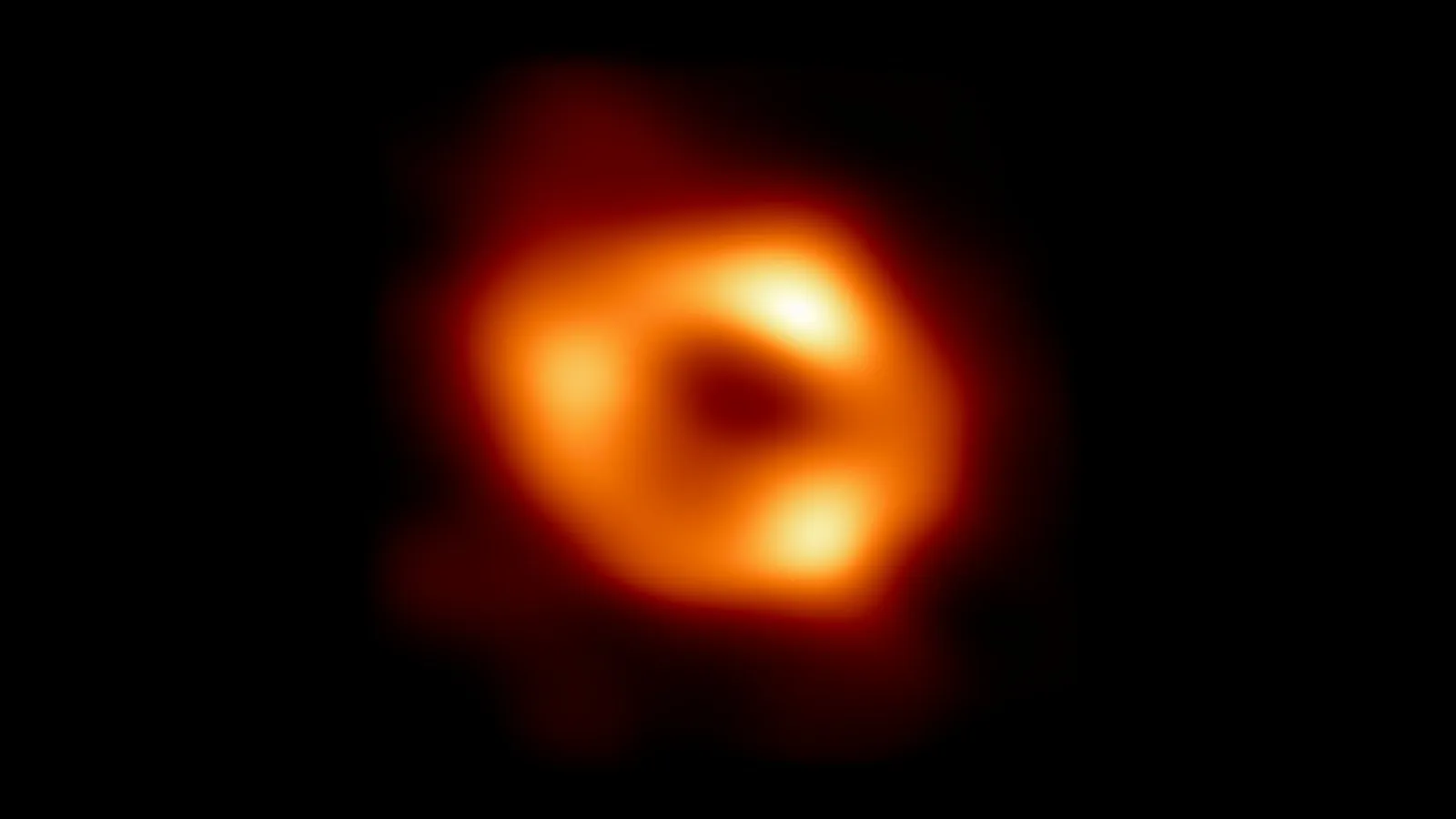
Sagittarius A* is about 27,000 light-years away. Stars orbiting it, tracked by ESO's GRAVITY instrument, give a mass of about 4.3 million Suns. In 2022, the Event Horizon Telescope, a network of radio telescopes spanning the Earth, released the first image of it (top of this page): a ring of glowing gas around a dark centre. Its team says the image fits a spinning black hole of about 4 million Suns.
ENDSources
- New NASA Black Hole Visualization Takes Viewers Beyond the Brink (6 May 2024), NASA
- NASA Black Hole Visualization Takes Viewers Beyond the Brink (SVS 14576), NASA Goddard Scientific Visualization Studio
- Beyond the Brink: Tracking a Simulated Plunge into a Black Hole (SVS 14585), NASA Goddard Scientific Visualization Studio
- Lewis & Kwan, No Way Back: Maximizing survival time below the Schwarzschild event horizon (2007), Publications of the Astronomical Society of Australia / arXiv
- What happens to you if you fall into a black hole? (Physics FAQ), John Baez / Usenet Physics FAQ
- Watch stars move around the Milky Way's supermassive black hole in deepest images yet (2021), ESO
- Astronomers Reveal First Image of the Black Hole at the Heart of Our Galaxy (12 May 2022), Event Horizon Telescope
- First Sagittarius A* Event Horizon Telescope Results. I (2022), The Astrophysical Journal Letters
Written by Facts Nero from the script of our Short and the sources above, all checked on 30 October 2026. Corrections to the video: the "about one minute" figure is the theoretical maximum time between the horizon and the centre of a non-spinning black hole of Sagittarius A*'s mass (π × GM/c³, about 66 seconds, our calculation from the formula in Lewis & Kwan 2007). Anyone falling in from outside gets less; in NASA's simulation the camera is destroyed 12.8 seconds after crossing. It is the tidal stretching, not gravity itself, that is gentle at the horizon of a supermassive black hole. NASA's simulation uses a non-spinning black hole for simplicity, and spin would change the numbers. The 8-solar-mass and 1,000-solar-mass figures come from the Physics FAQ, which takes them from Misner, Thorne and Wheeler's Gravitation.