Facts Nero
Astronauts finish the ISS solar-array upgrade after 18 spacewalks
On 5 November 2026, Anil Menon and Joshua Kutryk installed the eighth and last roll-out solar array on the space station, lifting its power from about 160 to 215 kilowatts.
By Facts Nero3 min read
Key facts
- Spacewalk
- 5 November 2026, 6 h 59 min
- Crew
- Anil Menon (NASA), Joshua Kutryk (CSA)
- Array
- 8th and final IROSA, channel 3B
- Power before → after
- About 160 kW → about 215 kW
- Spacewalks for the upgrade
- 18 since February 2021
- US spacewalk number
- 101
The International Space Station has its full new set of solar wings. On 5 November 2026, NASA astronaut Anil Menon and Canadian Space Agency astronaut Joshua Kutryk installed and unfurled the eighth and final International Space Station Roll-Out Solar Array, or IROSA, ending a power upgrade that began in February 2021.
NASA says the roll-out arrays raise the station's power generation from about 160 kilowatts to about 215 kilowatts. The spacewalk lasted 6 hours and 59 minutes, from 8:36 a.m. to 3:35 p.m. EST. It was US spacewalk 101, Menon's fifth and Kutryk's second, and the 286th spacewalk in support of the station.
01The last array
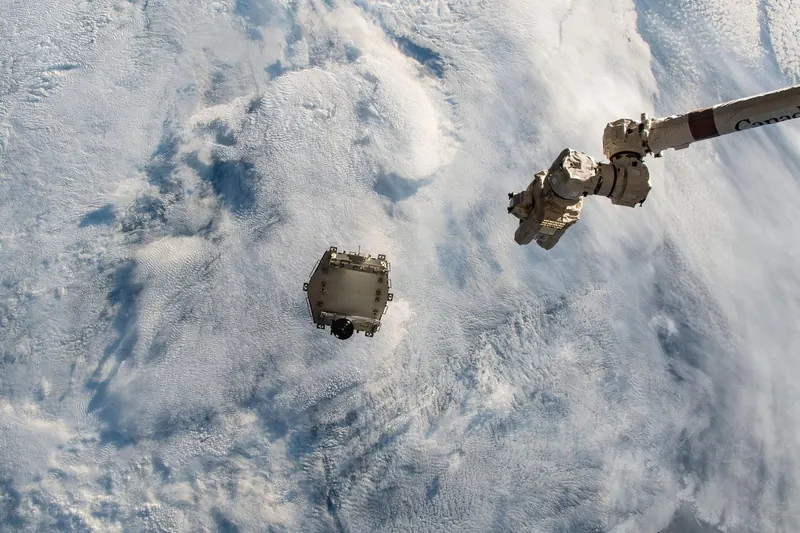
Menon and Kutryk worked on the starboard side of the station's main truss, on power channel 3B. According to Space.com, they picked up the roughly 340-kilogram (750-pound) array from a temporary stowage platform, carried it on the Canadarm2 robot arm, and bolted it to a bracket that had already been fitted. They had done much the same work on 29 October for the seventh array.
When Menon plugged the cables in, Mission Control first saw only about half the electrical current it expected. Nichole Stilwell, the spacewalk officer on the ground, told them they might not be able to deploy. Because a lit array makes electricity, they had to wait until the station passed into Earth's shadow before they could safely check the connectors. After that, Stilwell reported good currents and gave the go-ahead.
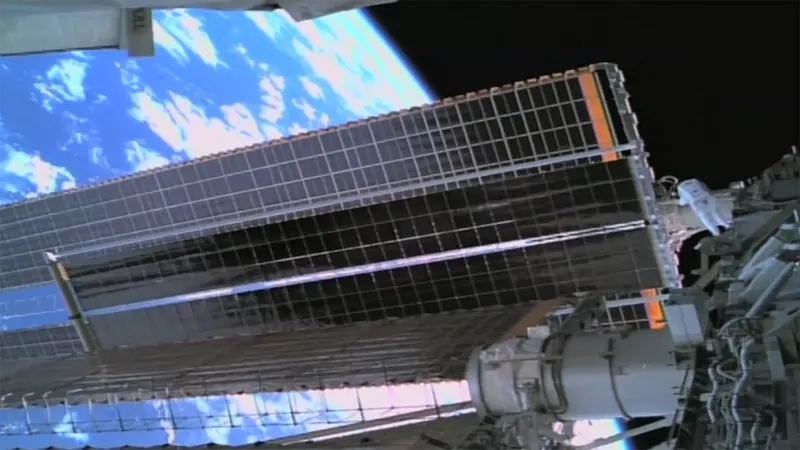
They released two bolts and watched the array roll out to its full length of about 19 metres (63 feet). Space.com notes that no motor is needed: the array extends itself using energy stored in its rolled carbon-composite booms, in about ten minutes. “We got it done!” Menon said at the end of the walk.
02Why the station needed more power
The ISS launched with eight large solar wings. Over time those wings have aged, and the station's electricity needs have grown. Beginning in June 2021, SpaceX Dragon cargo ships delivered IROSA units that mount in front of the old wings and add power without replacing them.
NASA's own tally: work to prepare the power channels and install the eight arrays took 18 spacewalks from February 2021 to November 2026. Earlier pairs of spacewalkers put arrays on the other channels in 2021, 2022 and 2023; Menon and Kutryk finished the set with the seventh and eighth.
At the end of the walk, Space.com quotes Menon saying the new arrays are about half the size of the old ones and bring more power. NASA's published figures for the whole upgrade are the 160-to-215 kilowatt range above, which is an increase of about a third.
03What the extra power is for
More kilowatts mean more room for science experiments, life support and the systems that keep crews alive. The Space Foundation notes that the upgrade helps meet those growing demands. Completing it also frees future spacewalks for other maintenance, instead of more solar work.
The station itself is ageing, and partner agencies are already planning what comes after it. For now, its power system is as strong as this upgrade can make it.
About this article
Written by Facts Nero from NASA's station blog posts of 5 November 2026 and the reports above, all checked on 6 November 2026. This is a written article with no video. The 6 h 59 min duration, 160→215 kW figures, 18 spacewalks, US spacewalk 101 and the 286th station spacewalk come from NASA. The start and end times, 340 kg mass, 19 m length, the shunt-current hold, the shadow wait and Menon's quotes come from Space.com's live coverage of the same walk. We use NASA's power numbers rather than the '30%' or '40%' phrases in quotes. The second photo is an earlier IROSA at the station (NASA, 2022), shown because it is a clear public-domain view of the same kind of array.
Sources
- Spacewalkers Install Final Roll-Out Solar Array (5 November 2026), NASA
- Spacewalk Begins to Install Last Roll-Out Solar Array (5 November 2026), NASA
- 'We got it done!' Spacewalking astronauts finish installing next-gen ISS solar arrays (5 November 2026), Space.com
- Astronauts Complete ISS Solar Array on 101st Spacewalk (5 November 2026), Space Foundation
- Spacewalkers Wrap Up Space Station Solar Power Upgrade (5 November 2026), Aviation Week