Facts Nero
NASA's twin Mars probes are about to slingshot past Earth
On 7 and 9 November, NASA's two ESCAPADE probes swing past Earth and fire their engines to head for Mars, a manoeuvre no Mars mission has done before.
By Facts Nero4 min read
Key facts
- Launched
- 13 November 2025, New Glenn
- First flyby burn
- 7 Nov, 3:21 p.m. IST (4:51 a.m. EST)
- Second flyby burn
- 9 Nov, 4:21 p.m. IST (5:51 a.m. EST)
- Each burn
- About 9 minutes
- Closest approach
- About 965 to 1,770 km up
- Mars arrival
- 7 and 9 September 2027
A year after leaving Earth, NASA's two ESCAPADE spacecraft are coming back, on purpose. This weekend, each one will skim past our planet and fire its engine at the closest point, using Earth's gravity and its own thrust together to throw itself toward Mars. NASA says no Mars-bound spacecraft has ever successfully done this kind of “powered flyby”, and ESCAPADE will do it twice.
01When it happens
According to NASA, the first spacecraft starts its engine burn at 4:51 a.m. EST on Saturday 7 November (3:21 p.m. in India). The second follows two days later, starting at 5:51 a.m. EST on Monday 9 November (4:21 p.m. in India). Each burn lasts about 9 minutes, and both happen as the spacecraft fly over southern Australia.
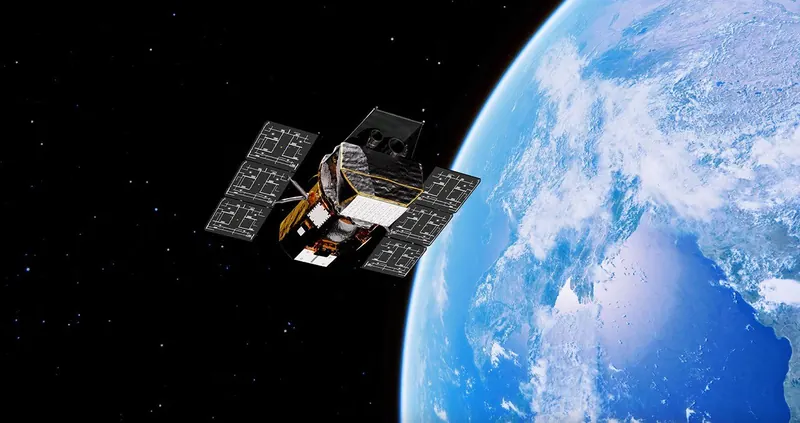
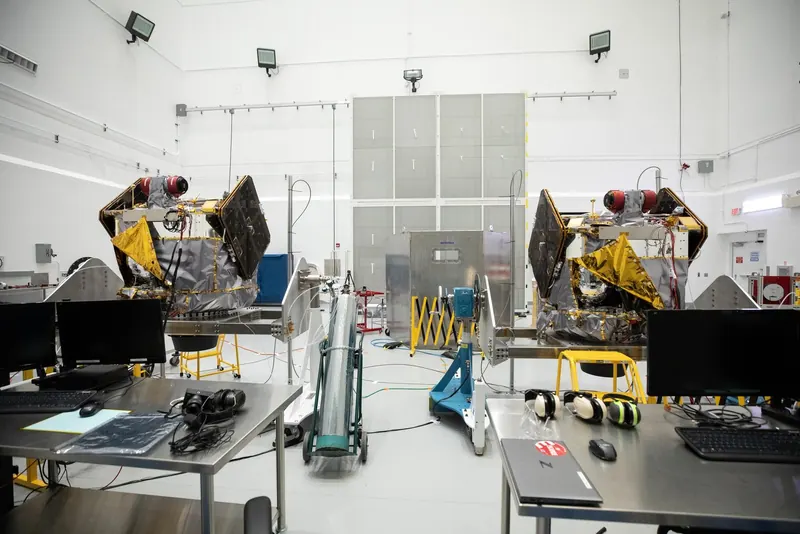
The two probes are nicknamed Blue and Gold. EarthSky reports that Blue goes first. At closest approach, NASA says, they will be between about 600 and 1,100 miles (about 965 to 1,770 kilometres) above the ground, higher than most satellites.
02Why go back to Earth to reach Mars?
Mars missions usually launch when Earth and Mars line up, which only happens about every 26 months. That alignment gives the shortest trip for the least fuel. But ESCAPADE launched on 13 November 2025, on Blue Origin's New Glenn rocket, at a time when NASA says Earth and Mars were on opposite sides of the Sun.
So instead of heading straight for Mars, the two spacecraft took a detour. They flew a kidney-bean-shaped loop around a point in space called Earth-Sun Lagrange point 2, about 1.5 million kilometres from Earth on the side away from the Sun, and then came back to meet Earth just as the planets lined up again. That moment is now.
03How a powered flyby works
When a spacecraft falls toward Earth, it speeds up. Firing the engine at that fastest, lowest point gives more extra speed for the same fuel than firing it anywhere else. This is called the Oberth effect, and NASA uses it here together with the bend that Earth's gravity puts in the path.
NASA says each burn will raise the spacecraft's speed by more than 1,000 miles per hour, from about 6.3 to about 6.7 miles per second, roughly 10.1 to 10.8 kilometres per second. At that speed, NASA points out, you could cross the United States from Washington to San Francisco in under 7 minutes.
04Can you see them?
Only with a telescope. NASA says the spacecraft, each about the size of a fridge, will be faint points moving slowly against the stars. They should be visible with telescopes from southern Australia during the burns, and from the western United States in the hours before. They will not be visible from India. If you have a telescope, NASA's JPL Horizons system gives the spacecraft's positions for your location.
05What ESCAPADE will do at Mars
After the burns comes a 10-month cruise. NASA plans for the two spacecraft to reach Mars on 7 and 9 September 2027. Mission controllers will fine-tune the path with several course corrections on the way.
At Mars, ESCAPADE will become the first mission with more than one spacecraft flying in formation around the planet. Its goal is to watch how the solar wind, the stream of charged particles flowing from the Sun, strikes Mars and strips away its atmosphere. With two spacecraft in different places at once, scientists can tell changes in time from changes in place. The mission team at UC Berkeley says the main science campaigns are planned to begin in late spring 2028, after months spent adjusting the two orbits.
The detour has already paid off. On its loop, ESCAPADE flew through a distant part of Earth's magnetotail, the long tail of Earth's magnetic field that the solar wind stretches out behind the planet. NASA says no spacecraft had directly explored that region before, and the team plans to share what it saw soon.
About this article
Written by Facts Nero from NASA's ESCAPADE update of 2 November 2026 and the sources above, all checked on 5 November 2026, before the flybys took place. All times and speeds are NASA's planned values; we converted them to Indian time and kilometres. The launch date and rocket come from the UC Berkeley mission team and EarthSky. The names Blue and Gold come from Berkeley and EarthSky; which one flies first is from EarthSky only. The 2028 start of the science campaigns is from the Berkeley mission page. The distance to Lagrange point 2 is the standard value for that point. That ESCAPADE will not be visible from India is our own reading of NASA's viewing guidance, which lists only Australia and the western US. We will update this article after the burns.
Sources
- NASA's Twin ESCAPADE Spacecraft to Slingshot Past Earth on Way to Mars (2 November 2026), NASA Science
- Star Charts for ESCAPADE's Earth Flyby, NASA Scientific Visualization Studio
- ESCAPADE mission design, UC Berkeley Space Sciences Laboratory
- ESCAPADE mission to fly past Earth twice in 2 days (5 November 2026), EarthSky
- Horizons System, NASA JPL Solar System Dynamics