Facts Nero
Hera has reached the asteroid that DART pushed off course
ESA's Hera spacecraft has seen Dimorphos for the first time, the small asteroid NASA's DART hit in 2022. What it is looking for, and when the close-ups come.
By Facts Nero4 min read
Key facts
- First separate view
- 18 October 2026, from 1,280 km
- Distance from Earth
- About 197 million km
- Dimorphos
- About 151 m across
- Didymos
- About 780 m across
- DART impact
- 26 September 2022
- First detailed images
- Due 25 November 2026
For two years, the European Space Agency's Hera spacecraft has been flying toward a pair of asteroids that humans have already changed. Now it can see both of them. On the evening of 18 October 2026, from 1,280 kilometres away, Hera's camera picked out the small asteroid Dimorphos as a separate dot next to its larger partner, Didymos, for the first time.
“With this image the smaller Dimorphos asteroid becomes visible for the first time,” said Michael Kueppers, ESA's Hera project scientist. “Before this acquisition the spacecraft was still resolving the Didymos system as a single dot. But now, even though Dimorphos is made up of only around one pixel in this initial image, it is clearly well separated from its parent body.”
01The asteroid humans moved
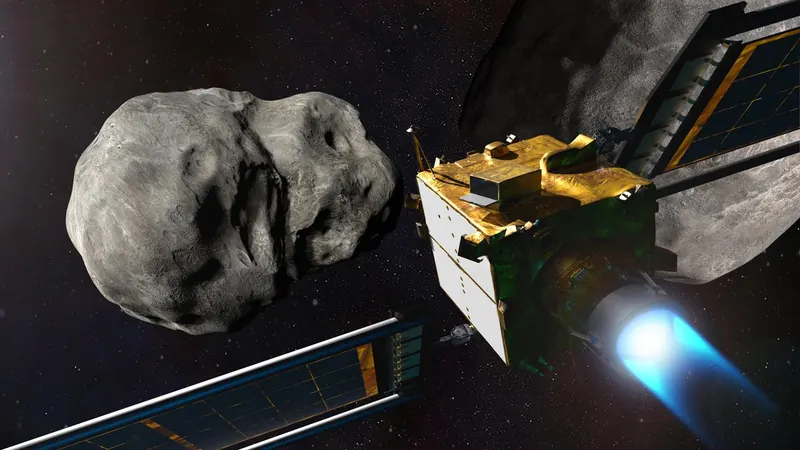
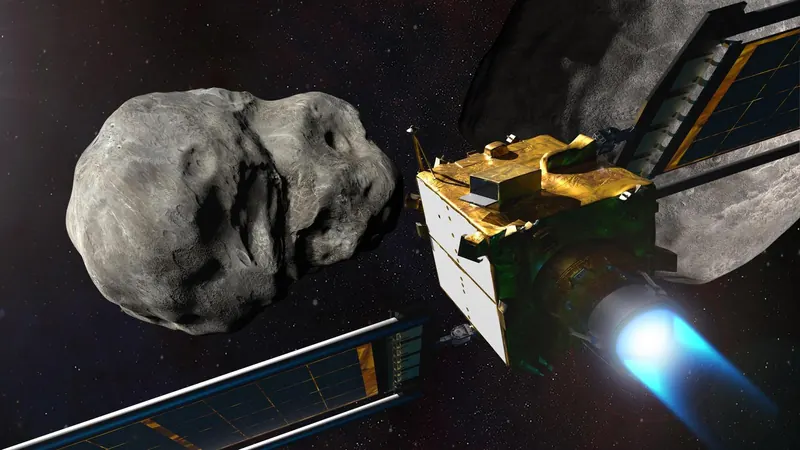
Dimorphos is famous for one reason. On 26 September 2022, NASA's DART spacecraft (the Double Asteroid Redirection Test) flew into it on purpose, at about 6.1 kilometres per second, according to ESA. Neither asteroid was ever a threat to Earth. DART was a test of whether hitting an asteroid could change its path.
It worked. Before the impact, Dimorphos took 11 hours and 55 minutes to go once around Didymos. In October 2022, NASA announced that the impact had shortened that by 32 minutes, give or take about 2 minutes. ESA now gives the change as about 33 minutes. The collision also threw out a plume of debris that ESA says spread across 10,000 kilometres of space. ESA calls Dimorphos the first object in the solar system to have had its orbit measurably shifted by human action.
But DART was destroyed in the crash, so it could not show what it did to the asteroid. That is Hera's job. ESA lists the open questions: Did the impact leave a crater, or reshape Dimorphos completely? What is the asteroid made of, what is its mass, and why did it move so much more than computer simulations predicted?
02How small are these asteroids?
Both are tiny compared with the asteroids you might picture. ESA gives Dimorphos as 151 metres across, about the size of the Great Pyramid of Giza, and Didymos as 780 metres across, a little smaller than the Burj Khalifa in Dubai is tall. According to ESA, the two are on average just 1.15 kilometres apart, and Dimorphos moves around Didymos at about 18 centimetres per second, slower than a walking pace.
That is why Dimorphos was only about one pixel wide in the first image. The pair are currently about 197 million kilometres from Earth, ESA and Space.com report.
03Hera's trip
Hera launched on 7 October 2024 on a SpaceX Falcon 9 rocket. In March 2025 it flew past Mars, which bent its path toward Didymos. ESA says the spacecraft performed so well that the team planned a later, harder braking approach, bringing its arrival forward to November 2026, a month earlier than first planned.
The braking came in October 2026. ESA says two thruster firings, a week apart, slowed Hera to just 20 metres per second relative to the asteroids, slow enough to creep closer in small steps. Several news reports, including heise online and Spain's La Sexta, say Hera reached the asteroid system on 4 November. Hera does not settle into a fixed orbit at first. It approaches step by step.
04What happens next
ESA says it will reveal the first detailed images of Dimorphos on 25 November 2026. “Our views will grow much sharper as Hera comes closer,” said Hera mission manager Ian Carnelli.
Over the following months, Hera will carry out what ESA calls a close-up “crash site investigation” of Dimorphos with several instruments. It also carries two shoebox-sized CubeSats, Milani and Juventas, which it will release to fly even closer. ESA says the survey will eventually lead to a landing; heise online reports the CubeSats are expected to be released in early 2027.
The answers matter for planetary defence. If a dangerous asteroid is ever found heading for Earth, hitting it with a spacecraft is one of the few tested ways to push it aside. Hera's measurements are meant to turn that from a single successful experiment into a method engineers can plan with. Read more about how planetary defence works in our story on what happens if we miss a city-killer asteroid.
About this article
Written by Facts Nero from ESA's Hera releases and the sources above, all checked on 5 November 2026. This is a written article with no video. The first-light details, the quotes, the braking manoeuvres and the 25 November date come from ESA, and are repeated by Space.com, heise online and INAF. The sizes, the 1.15 km separation, the 18 cm/s speed, the 6.1 km/s impact speed and the 10,000 km plume are ESA's figures. The 32-minute orbit change (with an uncertainty of about 2 minutes) is NASA's 2022 measurement; ESA and INAF now give about 33 minutes. ESA's pages we read say only that Hera arrives in November 2026; the 4 November arrival date and the early-2027 CubeSat release come from news reports named in the text. Hera's own image is published under ESA's standard licence, so we link to it instead of showing it. The picture at the top is NASA's illustration of DART before the impact, not a photograph.
Sources
- First light: Hera resolves two asteroids instead of one (27 October 2026), ESA
- Hera's first view of the separate Didymos and Dimorphos asteroids (image), ESA
- ESA's Hera targets early arrival at Didymos asteroids (October 2025), ESA
- NASA Confirms DART Mission Impact Changed Asteroid's Motion in Space (11 October 2022), NASA
- Dimorphos in sight: Europe's Hera probe gets its 1st look at battered space rock (3 November 2026), Space.com
- ESA's Hera probe photographs the two asteroids separately for the first time (28 October 2026), heise online
- Hera's observations of Didymos and Dimorphos (30 October 2026), INAF-IAPS
- La misión Hera llega al asteroide que la NASA desvió (4 November 2026, Spanish), La Sexta