Facts Nero
Light-driven winds may help explain Webb's bright early galaxies
A 4 November 2026 study finds that ultraviolet light from young stars can blow thin gas out of early galaxies. That clearing may make those galaxies look brighter to Webb.
By Facts Nero4 min read
Key facts
- Paper
- 4 November 2026, The Astrophysical Journal
- Lead author
- Shyam Menon (Flatiron Institute)
- Co-author
- Aaron Smith (University of Texas at Dallas)
- Light studied
- Lyman-alpha ultraviolet
- Dense clumps
- Radiation weaker than gravity
- Thin gas between stars
- Radiation can drive fast winds
When the James Webb Space Telescope looked back to the first few hundred million years after the Big Bang, it saw more bright galaxies than older models expected. A new simulation study, published on 4 November 2026 in The Astrophysical Journal, offers one piece of the answer: ultraviolet light from young stars can push thin gas and dust out of the way, clearing the view.
The work was led by Shyam Menon of the Flatiron Institute's Center for Computational Astrophysics, with co-author Aaron Smith of the University of Texas at Dallas. Their preprint on arXiv is titled “Lyman-alpha Radiation Pressure in Dense Star Clusters: Implications for Star Formation and Winds at Cosmic Dawn.”
01What Lyman-alpha light does
Young, hot stars flood their surroundings with a kind of ultraviolet light called Lyman-alpha. Hydrogen atoms soak it up and almost immediately spit it out again at the same wavelength, so a single photon can bounce from atom to atom many times before it escapes. Each bounce transfers a little push.
“Each photon bounces back and forth like a ping-pong ball, transferring momentum with every collision,” Smith said in the Simons Foundation's write-up of the study. That repeated scattering is hard to simulate, which is why earlier work struggled to say how strong the effect is in a real galaxy.
02Dense clumps versus thin fog
Menon and Smith took snapshots from existing simulations of dense star-cluster nurseries and calculated the Lyman-alpha force on the gas with the COLT Monte Carlo code, trying dust levels from none up to a tenth of the dust in the Sun's neighbourhood.
In the densest filaments, where most of the stars are being built, the paper finds that gravity still wins. Lyman-alpha may trim the gas-to-star conversion efficiency by only about 10% when some dust is present, and even in a dust-free case a large fraction of the gas can still turn into stars. So the radiation is not strong enough, in those dense clumps, to shut star formation down.
Between the clumps, where the gas is thinner and gravity is weaker, the opposite happens. There the radiation can exceed gravity by a large factor and drive fast winds in a few million years. “When the density is low enough, the Lyman-alpha radiation can push the gas to really high speeds, launching explosive winds that can shoot material clear out of the galaxy,” Menon said.
03Why that would make galaxies look brighter
Clearing the loose gas and dust opens a cleaner line of sight from the stars to our telescopes. The Simons Foundation compares it to a leaf blower: it does not move the trees, but it clears the leaves. That is the link the authors draw to Webb's surprisingly bright early galaxies — not that the stars themselves are somehow impossible, but that less fog sits in front of them.
The paper itself is careful. It says Lyman-alpha radiation pressure reinforces the emerging picture of how these systems work; it does not claim to be the whole explanation. The strength of the effect depends strongly on how much dust is there and what it is made of, and the authors say more work is needed on early-universe dust and on simulations that grow stars, gas flows and Lyman-alpha light together.
04What this does not settle
Webb's early-galaxy puzzle has several proposed answers: stars that form more efficiently, bursts of star formation, and unusual stellar populations among them. This study adds a physical reason why some of those galaxies could look brighter than expected even if the stars themselves are ordinary. It does not replace the other ideas.
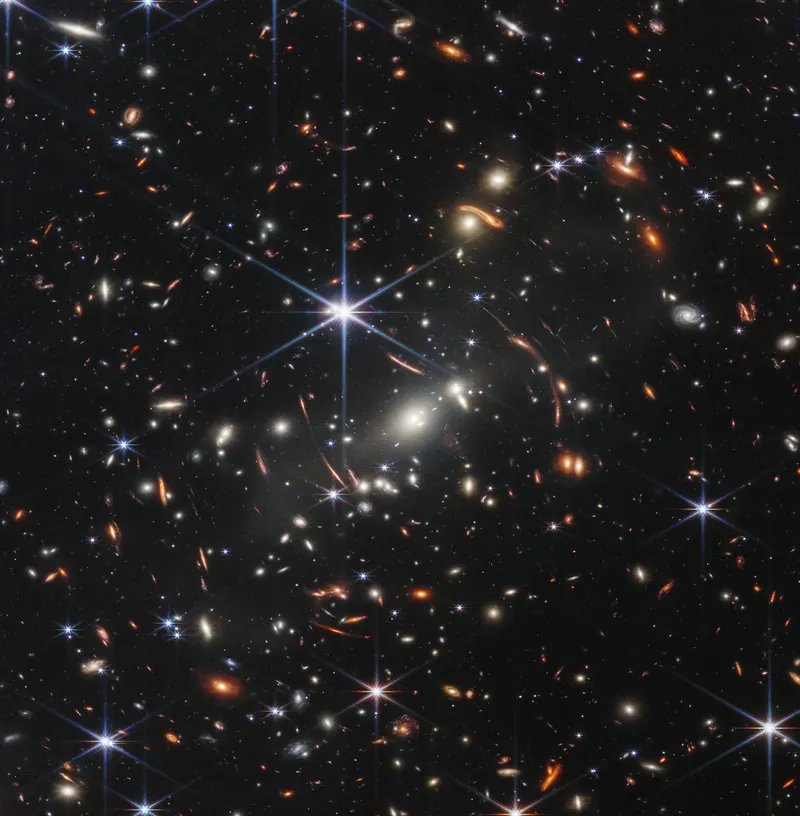
The deep field at the top of this page is Webb's first public deep image, of the cluster SMACS 0723. It is not the dataset Menon and Smith analysed; it is the kind of deep view that made the bright-early-galaxy question hard to ignore.
About this article
Written by Facts Nero from the Simons Foundation release of 4 November 2026 and the arXiv abstract of Menon & Smith (2605.13982), checked on 6 November 2026. This is a written article with no video. Quotes are from the Simons Foundation. The ~10% effect in dusty dense gas, the still-high star-formation efficiency, the winds in low-density gas and the dependence on dust come from the paper abstract. We treat the ‘brighter because the fog clears’ idea as the authors' interpretation in the release, not as a measured brightness for a specific Webb galaxy. We could not open a paywalled ApJ HTML page; the arXiv abstract and the institute release agree on the main numbers we use. The hero image is Webb's first deep field (NASA/ESA/CSA/STScI), used as an example of a deep early-universe view, not as the study's data.
Sources
- A Cosmic ‘Leaf Blower’: Light-Propelled Winds Help Explain Early Universe's Bright Galaxies (4 November 2026), Simons Foundation
- Lyman-alpha Radiation Pressure in Dense Star Clusters: Implications for Star Formation and Winds at Cosmic Dawn (arXiv:2605.13982), arXiv / The Astrophysical Journal
- New study explains why early universe galaxies appeared unusually bright (5 November 2026), Parallax
- Bright Early Galaxies: ‘Leaf Blower’ Winds May Explain Webb, ICWWM summary of the Simons Foundation release