Facts Nero
Betelgeuse's hidden companion Siwarha is stirring up its atmosphere
New ALMA and VLA radio images show Betelgeuse changing shape as its small companion star, Siwarha, orbits through the giant's outer atmosphere. Here is what the astronomers found.
By Facts Nero4 min read
Key facts
- Telescopes
- ALMA (Chile) and the NSF VLA (USA)
- Observations
- 2021 to 2026, seven frequencies
- Companion's orbit
- About 2 times Betelgeuse's radius
- Brightness cycle explained
- About 2,100 days
- Coolest layer measured
- About 2,200 K
- Paper
- The Astronomical Journal, Oct 2026
Betelgeuse, the red supergiant at Orion's shoulder, has a small companion star that orbits so close it passes through the giant's outer atmosphere. New radio observations suggest that the companion, called Siwarha, is leaving its mark there. The results were published in The Astronomical Journal and announced by the US National Radio Astronomy Observatory (NRAO) on 26 October 2026.
“This companion is orbiting so close to the star that it actually passes through its extended atmosphere,” said Lynn Matthews of MIT Haystack Observatory, who led the study.
01Who is Siwarha?
Betelgeuse's brightness rises and falls in a cycle of about 2,100 days, almost six years. In 2024, astronomers proposed that a small companion star caused it. NRAO says the idea has since been supported by direct imaging and by spectroscopic studies.
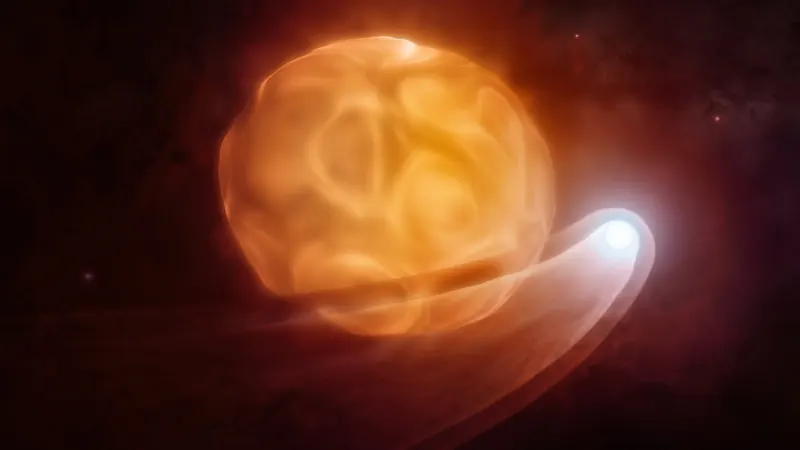
The name is a play on the giant's own. NRAO explains that Betelgeuse comes from the Arabic for “the hand of al-Jawza”, so the companion was named Siwarha, “her bracelet”. NRAO says Siwarha is thought to orbit only about twice Betelgeuse's radius from the star, deep inside its extended atmosphere.
02Seeing a star that can't be seen
Siwarha is far too faint to see in the radio images. The team calculated it would be tens to hundreds of times too faint to detect. So the astronomers watched Betelgeuse instead. They combined observations from the Atacama Large Millimeter/submillimeter Array (ALMA) in Chile and the US National Science Foundation's Karl G. Jansky Very Large Array (VLA), taken between 2021 and 2026 at seven frequencies, from 22 to 485 gigahertz. Each frequency sees a different depth in the star's atmosphere, so together they let the team study it layer by layer.
Both telescopes can resolve Betelgeuse's disc, meaning they see its shape instead of a single point of light. Across the observations, the team measured how egg-shaped the star's radio-emitting atmosphere looked. It was more stretched when Siwarha should have been at its farthest from Betelgeuse as seen from Earth, and rounder when Siwarha should have been passing in front of or behind the star. That pattern fits the idea that the companion disturbs the gas as it orbits, like a boat leaving a wake on a lake.
This is still indirect evidence. Both ALMA and NRAO say observations covering more of Siwarha's orbit are needed to test it.
03A star bouncing back from the Great Dimming
The same data show how Betelgeuse has recovered since its Great Dimming of late 2019 and early 2020, when, NRAO says, the star threw off a huge cloud of material that partly blocked our view of it. In 2019, months before the dimming, a study led by Matthews found the star's atmosphere unusually cool at radio wavelengths. Her team suggested a shock wave from deep inside the star had disturbed the outer layers.
The atmosphere has now warmed back to more normal levels. About 2.7 times the star's radius out, the gas measures about 3,500 kelvin, close to the temperature of Betelgeuse's surface. Closer in, ALMA's highest frequency confirmed a long-suspected cool layer between the visible surface and the hotter chromosphere above it. There the temperature drops to about 2,200 kelvin, more than 1,000 degrees cooler than the surface.
Those are “brightness temperatures”, which ALMA explains as the temperature that matches the radiation the telescope picks up.
04Why it matters
Red supergiants like Betelgeuse are near the ends of their lives. They shed huge amounts of material before they explode as supernovae. NRAO says studies like this one show how they lose that material, and how a close companion's pull might shape the process. NRAO expects the planned Next Generation Very Large Array to make such studies far more routine.
None of this means Betelgeuse is about to explode. The study is about the star's atmosphere and its companion, and it makes no prediction about when Betelgeuse will go supernova.
About this article
Written by Facts Nero from the NRAO and ALMA releases and the published paper, cross-checked with Space.com on 3 November 2026. This is a written article with no video. The picture at the top is an artist's illustration of the proposed interaction, not a telescope image of the companion. The radius figures, the 2,200 K and 3,500 K temperatures and the frequency range appear in both the NRAO and ALMA releases. The 2024 proposal, the later support from imaging and spectroscopy, the faintness calculation and the meaning of the names come from NRAO only. We do not give a distance to Betelgeuse: published estimates differ, and Space.com's “about 650 light-years” is not in the releases. The sky position is from SIMBAD, and the rising time is our own calculation.
Sources
- What Lurks Within the Shadows of Betelgeuse? (26 October 2026), National Radio Astronomy Observatory
- ALMA and VLA Reveal Signs of a Companion Stirring Betelgeuse's Atmosphere, ALMA Observatory
- Matthews, Dupree, Richards & Dent 2026, New Spatially Resolved Observations of Betelgeuse from the VLA and ALMA: Evidence for Atmospheric Perturbations from a Close Companion, The Astronomical Journal
- Betelgeuse is haunted by a cosmic poltergeist tormenting the doomed star's atmosphere (31 October 2026), Space.com
- Betelgeuse (alf Ori): position, SIMBAD, CDS Strasbourg
- Media resources and image use (CC BY 4.0), National Radio Astronomy Observatory