Facts Nero
Webb finds dusty ice in interstellar comet 3I/ATLAS, like worlds beyond Neptune
A new Webb study finds the ice in interstellar comet 3I/ATLAS is unusually dusty. It looks less like our comets and more like icy worlds beyond Neptune. What that says about other stars.
By Facts Nero5 min read
Key facts
- Discovered
- 1 July 2025, ATLAS telescope, Chile
- Interstellar objects known
- 3 (this is the third)
- Webb looks used
- 6 Aug 2025, 22 Dec 2025, 1 Apr 2026
- Ice grain size
- About a micron or smaller
- Paper published
- 26 Oct 2026, ApJ Letters
Interstellar comet 3I/ATLAS is long gone from our part of the solar system, but the data on it is still coming in. On 26 October 2026, a team led by Silvia Protopapa of the Southwest Research Institute (SwRI) published a study in The Astrophysical Journal Letters on the ice grains streaming off it, measured by the James Webb Space Telescope. The grains look unlike those of most comets we know. They look much more like the ice on some of the distant worlds beyond Neptune.
01A visitor from another star
3I/ATLAS was first reported on 1 July 2025 by the NASA-funded ATLAS survey telescope in Rio Hurtado, Chile. It is the third object ever found passing through the solar system from outside it, after 1I/‘Oumuamua in 2017 and 2I/Borisov in 2019. That is what the “3I” in its name means. NASA says astronomers knew it was interstellar from the hyperbolic shape of its path: it is not in a closed orbit around the Sun.
Comets like this one formed in a disc of gas and dust around another star, then were thrown out into the galaxy. So, as Protopapa puts it, the grains in its coma “hold clues to the conditions where the comet was born”.
02What Webb saw
Webb's program for interstellar objects was set up in advance. “We designed this program to be ready the moment an active interstellar comet was found and to follow it over time,” said Martin Cordiner of NASA's Goddard Space Flight Center and the Catholic University of America, who leads it. The team observed 3I/ATLAS with Webb's Near-Infrared Spectrograph (NIRSpec) three times, on 6 August 2025, 22 December 2025 and 1 April 2026, before and after the comet's closest approach to the Sun.
Water ice leaves fingerprints in infrared light: a deep dip, or absorption band, near 3 microns and two weaker ones near 1.5 and 2.0 microns. Most icy comets show all three. In 3I/ATLAS the 3-micron band is strong, but the 1.5- and 2.0-micron bands are very weak or missing.
“That combination was a puzzle,” Protopapa said. “The strong 3-micron band points to water ice in the coma. But the weak or absent shorter-wavelength bands suggest the ice is not in the form we usually see in solar system comets.”
03Tiny grains of dirty ice
The team compared the spectra with models of how light scatters off grains of different sizes and makeup. The best fit is grains about a micron or smaller, made of water ice mixed with dust. In grains that small and dusty, light passes through only a short distance of ice, so the weaker bands fade while the 3-micron band stays strong. In the paper's best-fitting models, the dust mixed into the ice is a glassy silicate mineral, amorphous pyroxene.
Size is not what makes 3I/ATLAS different. “The grains of 3I/ATLAS are about the same size as those in our own comets,” Protopapa said. “What seems to set them apart is how much dust is mixed into the ice.” Ice grains in our own comets are thought to be fairly pure.
The grains also seemed to change. By the April 2026 observation, as the comet moved away from the Sun, the data favoured an extra group of ice-rich grains, larger than before but still around a micron. “We can't yet tell whether the changes over time are the result of the Sun heating the grains differently at each observation, or of new material exposed as the comet's surface eroded near the Sun,” said Michael Kelley of the University of Maryland, the paper's second author.
04It looks like the worlds beyond Neptune
The team then compared 3I/ATLAS with Webb spectra of trans-Neptunian objects, icy bodies that orbit beyond Neptune and are thought to preserve material from the early solar system. The shape of the 3-micron band matches several groups of them, especially ones whose spectra also show carbon dioxide ice and organic compounds. Like 3I/ATLAS, those objects lack strong 1.5- and 2.0-micron bands. SwRI notes that the match is in the water-ice band, not in the carbon dioxide.
“At first glance, 3I/ATLAS looks different from the icy comets we know,” Protopapa said. “But when we placed it alongside distant icy worlds in our own solar system, it no longer looked out of place.” Her team's suggestion is that the icy building blocks of planets, here and around other stars, may share the same range of tiny grains, from fairly pure ice to ice mixed with dust, with 3I/ATLAS at the dusty end.
If that holds up, SwRI says, it could mean the physical form of water ice is set early in planet-forming discs and partly survives in the icy bodies that form there. The team says future Webb observations of comets will test whether 3I/ATLAS is typical.
05Not the first surprise from 3I/ATLAS
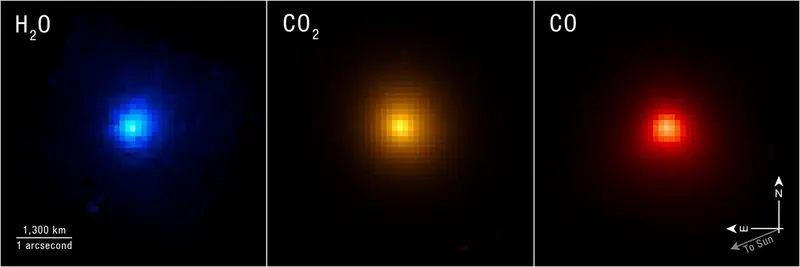
Webb has studied this comet before. In 2025, Cordiner's team reported that 3I/ATLAS was surrounded by gas dominated by carbon dioxide, with about 7.6 times more carbon dioxide than water. Their paper says that is one of the highest ratios ever measured in a comet.
In June 2026, ESA's Webb team reported that the comet's ice carries ratios of deuterium (heavy hydrogen) and of carbon-13 that are not found in our own comets. ESA says the low level of carbon-13 points to a very old origin, because galaxies build up carbon-13 over time as stars are born and die. The new ice study does not give the comet an age.
About this article
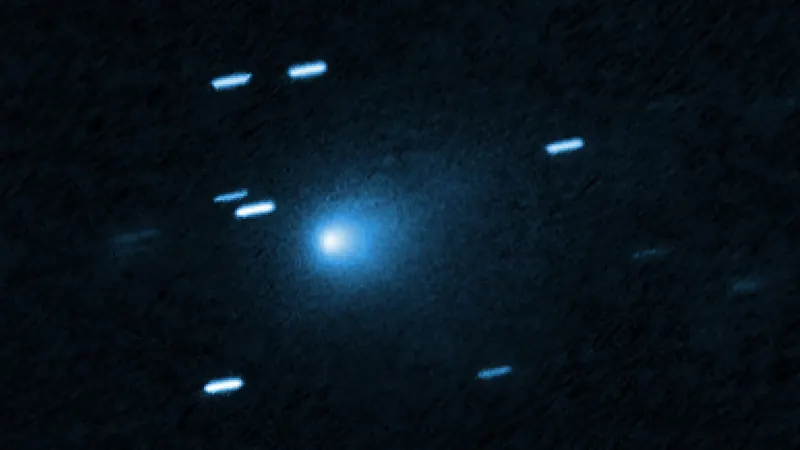
Written by Facts Nero from the SwRI release of 26 October 2026 and the published paper, cross-checked with Space.com and Sci.News on 3 November 2026. This is a written article with no video. The observation dates come from the paper's abstract and the pyroxene from its model description. The 7.6-to-1 carbon dioxide ratio comes from Cordiner and colleagues' 2025 paper. The deuterium and carbon-13 result comes from ESA/Webb's June 2026 release. Space.com writes that the comet may have formed 10 to 12 billion years ago. Neither the SwRI release nor the paper gives an age, so we did not use that figure. The hero image is Hubble's view of 3I/ATLAS from 21 July 2025; the background stars are streaks because the telescope was tracking the comet.
Sources
- SwRI-led study uses Webb to compare interstellar comet 3I/ATLAS with icy bodies in our solar system (26 October 2026), Southwest Research Institute
- Protopapa et al. 2026, JWST Reveals Refractory-rich Water Ice in Interstellar Comet 3I/ATLAS, The Astrophysical Journal Letters
- James Webb Space Telescope uncovers new clues about the origins of 'interstellar invader' comet 3I/ATLAS (2 November 2026), Space.com
- Webb Finds Dust-Rich Water Ice in Interstellar Comet 3I/ATLAS, Sci.News
- Comet 3I/ATLAS: overview, discovery and timeline, NASA Science
- Cordiner et al. 2025, JWST detection of a carbon dioxide dominated gas coma surrounding interstellar object 3I/ATLAS, arXiv / The Astrophysical Journal Letters
- Webb finds clues to ancient, distant origin of Comet 3I/ATLAS (22 June 2026), ESA/Webb
- 3I/ATLAS, Hubble image (heic2509a), ESA/Hubble